- Known for
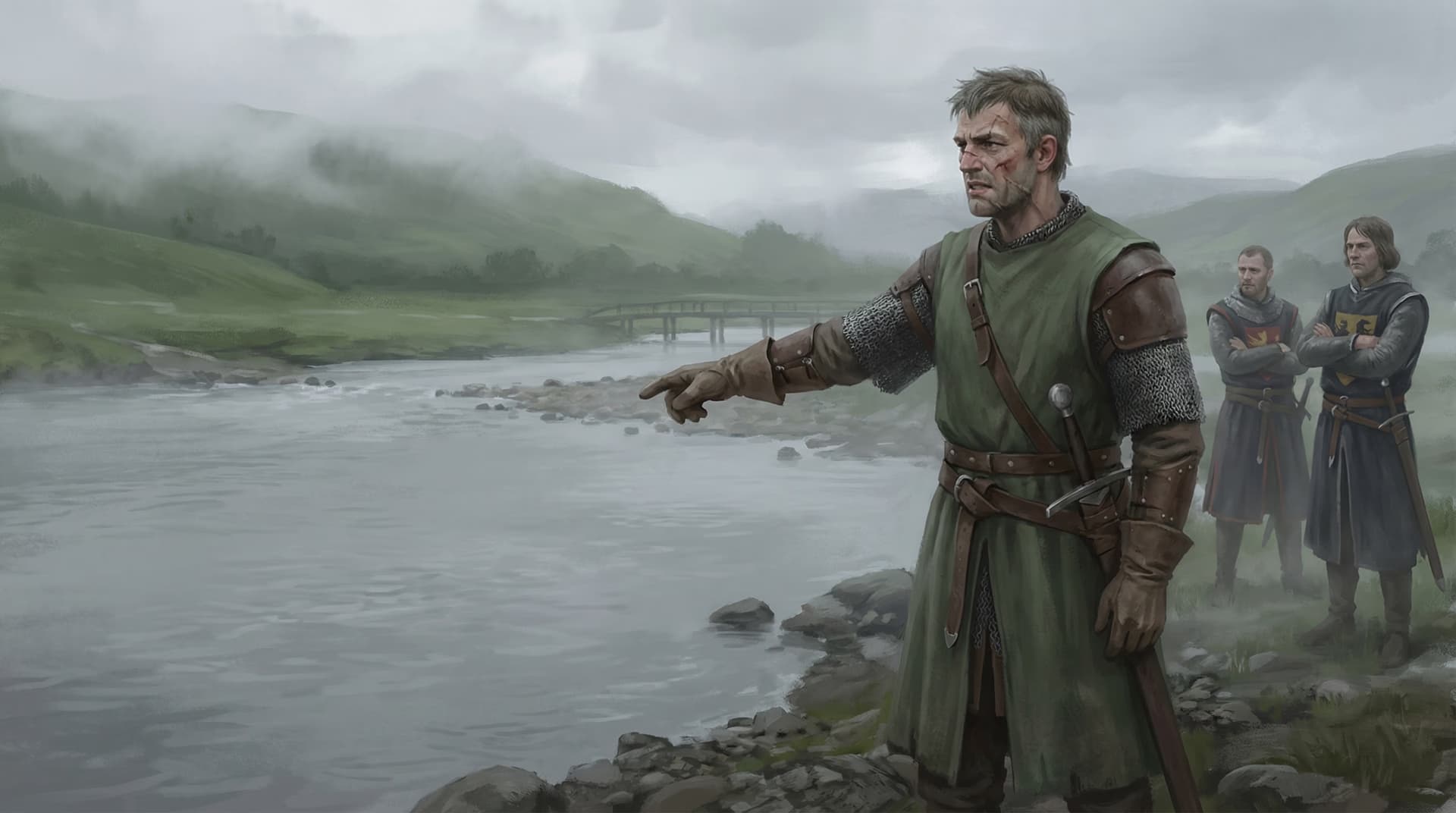
- Scottish knight who defected to the English before Stirling Bridge, offered a flanking strategy that was ignored, then reportedly returned to fight alongside Wallace at Falkirk
- Fatal flaw
- A survivalist who read the room better than anyone but trusted no cause long enough for any cause to trust him back
The Story
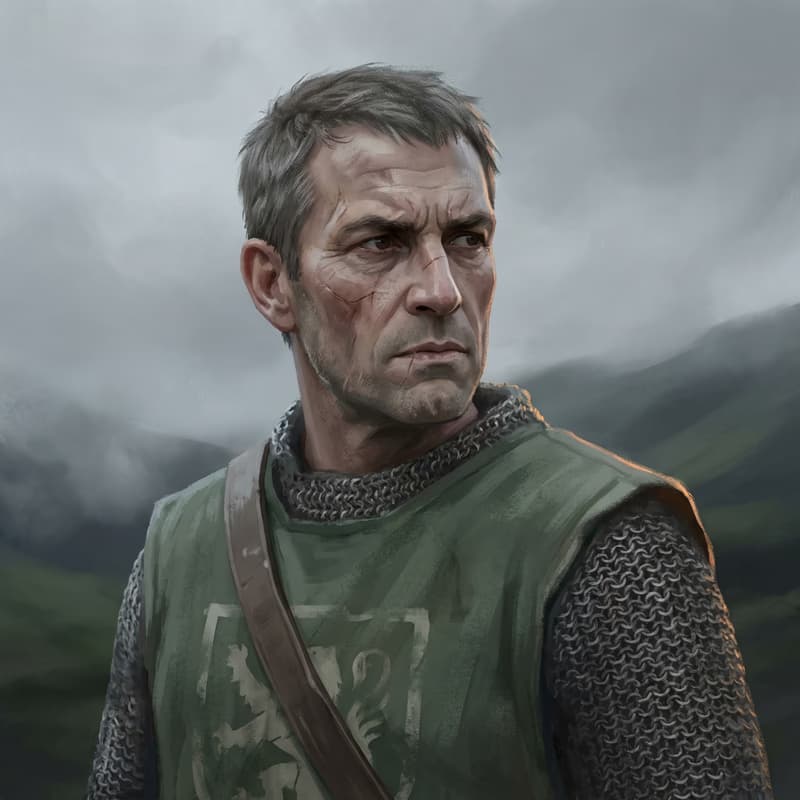
July 1297. The Scottish rebellion is collapsing before it has properly begun. At Irvine, on the banks of a loch between the town and Bourtreehill House, the assembled nobles of Scotland are negotiating their own surrender. Robert Bruce, James Stewart, the Bishop of Glasgow, all of them bowing their heads and reaching for English quills. The uprising that was supposed to throw off Edward I's occupation is dissolving into handshakes and sealed parchments.
One man watches this and makes a calculation. Sir Richard Lundie, laird of Lundin, a knight from Fife who just weeks earlier helped lead the band that killed the English Sheriff of Lanark alongside William Wallace, looks at the nobles kneeling before Henry Percy and decides he is finished. He tells the assembled Scottish lords that there is no safety in a host divided against itself. Then he rides across the lines, takes his men with him, and joins the English.
It was the act of a pragmatist, or a coward, or a man who understood that loyalty to a fractured cause is just a slower form of suicide. Within two months, he would be standing on the south bank of the River Forth, urging the English commanders to use the one tactic that could have destroyed Wallace's army. They would ignore him. Five thousand Englishmen would die because of it. And the man who switched sides to save himself would become the most controversial figure in the Scottish wars, neither patriot nor traitor, but something more unsettling: the man who was right.
The deeper truth about Lundie is that he understood power as a mechanism, not a principle. He did not fight for Scotland because Scotland was sacred. He did not fight for England because England was just. He fought for whichever side looked capable of winning, and when neither side did, he fought for himself. It was an honest position. It was also one that guaranteed he would never be trusted by anyone.
Personality & Motivations
Lundie was not Wallace. He did not burn with righteous fury or refuse to bend the knee on principle. He was not Comyn, playing dynastic chess across generations. Lundie was a minor nobleman with good instincts and no illusions. He could read a battlefield, read a political room, and read the odds. What he could not do was commit.
His early alliance with Wallace was genuine. The two men fought together, bled together, killed together. It was Lundie who co-led the raid on Lanark that killed the English sheriff William de Heselrig on May 3rd, 1297, one of the foundational acts of the Scottish rebellion. This was not a man standing at the back. He was in the vanguard, sword drawn, when it mattered.
But Lundie was also a landowner. He held estates in Fife. He had tenants, obligations, a family name stretching back to the time of William the Lion. When the Irvine negotiations revealed that every major Scottish noble was preparing to submit, Lundie saw the mathematics clearly: Wallace and Andrew Moray were raising an army of commoners, and the nobility was abandoning them. A knight who stayed with the rebels would lose everything. A knight who crossed to the English would keep his lands, his title, his life. Lundie chose survival. He would not be the last Scotsman to make that calculation, but he was among the most honest about it.
What Most People Get Wrong
The common version of Lundie's story paints him as a simple traitor, a Scottish knight who sold out his country for English gold. The reality is stranger and more tangled. Lundie did not just switch sides once. He switched at least twice, possibly three times, and each switch was driven by a cold reading of who was actually winning.
He began as Wallace's ally, fighting in the very raids that launched the rebellion. He defected to the English at Irvine when the Scottish nobles capitulated. Then, after the disaster at Stirling Bridge proved the English were not invincible, he appears to have returned to the Scottish side. An English song written after the battle specifically blames the defeat on Lundie's treachery, suggesting he may have sabotaged the English from within or switched back to the Scots mid-battle. By 1298, he was listed among the nobles who supported Wallace's appointment as Guardian of Scotland, and multiple sources place him fighting alongside Wallace at Falkirk. His sword was later honored at the laying of the Wallace Monument's foundation stone in 1861, displayed beside the blades of Wallace, Robert the Bruce, Sir John de Graham, and the Black Douglas. You do not earn a place among those swords by being remembered as a traitor.
Key Moments
Lanark, May 3rd, 1297. The killing that started everything. Lundie co-led the armed band that attacked the English garrison at Lanark and killed William de Heselrig, the English High Sheriff. For decades, historians credited this act to Wallace alone. Recent scholarship, particularly research from the University of Glasgow, has revealed that Lundie was an equal partner in the raid. It was not a lone wolf striking in the dark. It was a coordinated military operation led by two knights who understood what they were beginning.
Irvine, July 1297. The Scottish nobles gathered to resist Edward I's occupation took one look at the English force assembled against them and began negotiating surrender. Bruce, Stewart, the Bishop of Glasgow, all capitulated. Lundie watched the collapse, declared there was no safety in a divided army, and rode to the English camp with his retainers. It was the moment that defined him in the chronicles. The pragmatist who walked away.
Stirling Bridge, September 11th, 1297. Standing with the English army on the south bank of the Forth, Lundie offered the Earl of Surrey a plan that could have changed history. He knew of a ford two miles upstream where sixty horsemen could cross abreast. Give him the cavalry, he urged, and he would take the Scots in the flank while they watched the bridge. Hugh Cressingham, Edward's treasurer, dismissed the advice. Surrey waved him off. The English crossed the narrow bridge two abreast into a killing ground. Five thousand men died in three hours. Cressingham was skinned alive. Lundie's plan, rejected by arrogance and impatience, was the last good idea the English had that day.
The Second Defection, late 1297. After Stirling Bridge, Lundie vanishes from English records. An English war song from the period blames the defeat on his treachery, accusing him of betraying the English cause during or after the battle. Whether he actively sabotaged the English position, withheld his cavalry at the critical moment, or simply rode north when the killing started, the result was the same: by the time Wallace was appointed Guardian of Scotland, Lundie was back among the Scots. Listed as one of the nobles who endorsed Wallace's authority, he had completed the circle from rebel to defector to rebel again.
Falkirk, July 22nd, 1298. Lundie stood with Wallace at the last great battle of the Guardian's campaign. When Edward I's army smashed the Scottish schiltrons with massed longbow fire, the Scottish cavalry fled the field. But accounts from Blind Harry and other sources place Lundie among the small group, alongside Malcolm Earl of Lennox, Ramsay of Auchterhouse, and Wallace of Riccarton, who withdrew in good order and returned to fight. It was the end of Wallace's military career. Whether it was the end of Lundie's is unclear. After Falkirk, the historical record falls silent on him.
The Detail History Forgot
Lundie's sword survived him by more than five centuries. On June 24th, 1861, when the foundation stone of the National Wallace Monument was laid on Abbey Craig, the very hill where Wallace had watched the English cross the bridge in 1297, five ancient swords were carried to the summit and displayed before the assembled crowd. They belonged to William Wallace, Robert the Bruce, Sir John de Graham, the Black Douglas, and Sir Richard de Lundie, laird of Lundin. The sword is now held at Drummond Castle, ancestral seat of the Earls of Perth, who descended from the Lundin line. That a man remembered by English chroniclers as a turncoat had his blade honored alongside Scotland's greatest heroes tells you everything about how the Scots themselves ultimately judged him. They forgave the defection. They remembered the man who came back.
The Downfall
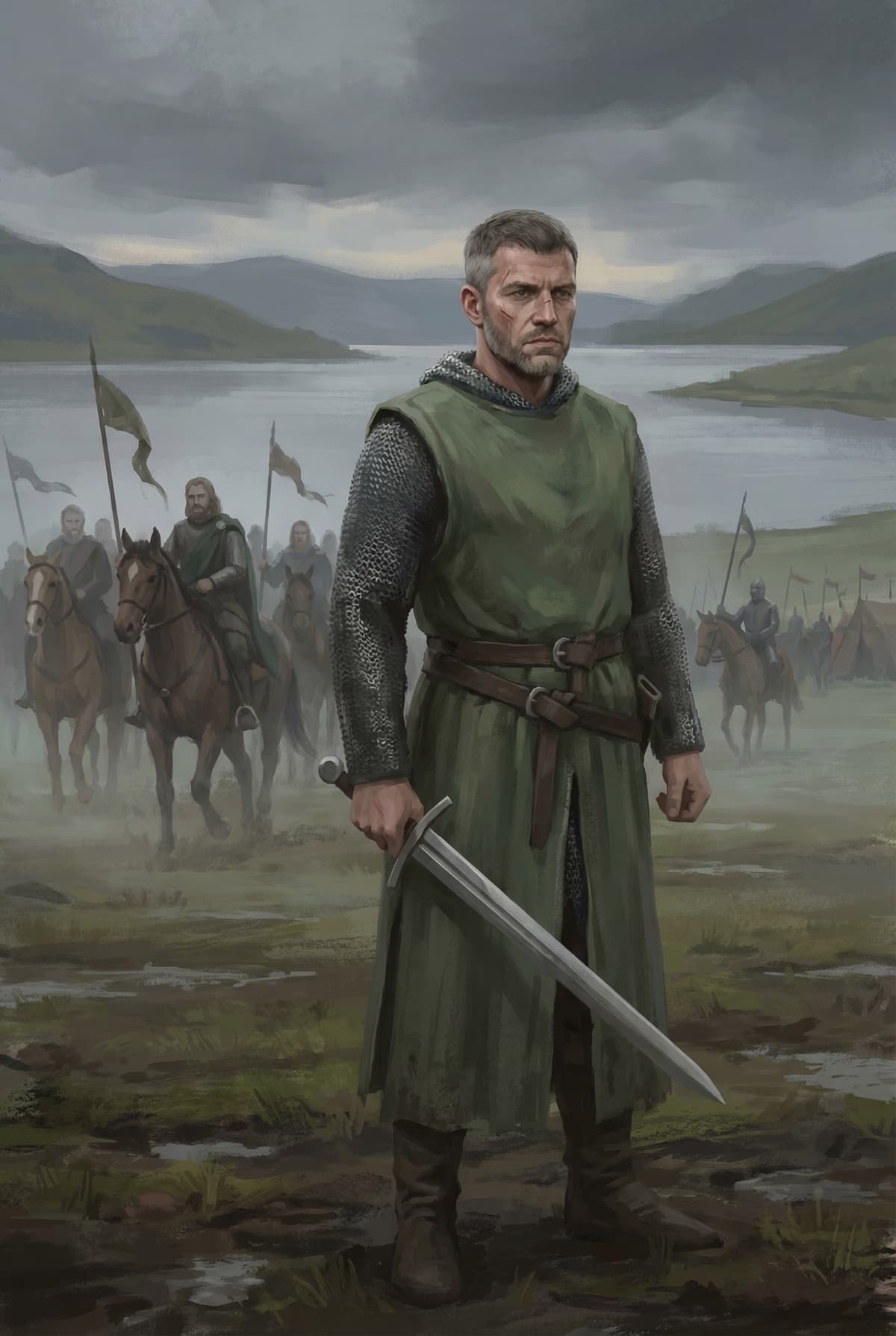
Lundie's fatal flaw was not disloyalty. It was legibility. Every move he made was rational, defensible, even correct. But survival instincts that obvious make people nervous. When he left the Scottish cause at Irvine, every Scotsman who stayed behind took note. When he returned after Stirling Bridge, every Englishman who survived did the same. He had revealed himself as a man who would always choose the winning side, and that knowledge poisoned every alliance he would ever form.
After Falkirk, Lundie disappears from the historical record. No chronicle records his death. No document names his burial. No charter marks the transfer of his estates. He simply ceases to exist in the sources, a silence that could mean anything: death in an unrecorded skirmish, quiet retirement to his Fife lands, exile, or execution by one of the many men who had reason to distrust him.
The irony is that Lundie was right about nearly everything. He was right that the Scottish nobles at Irvine would not fight. He was right that the English should use the ford at Stirling. He was right to return to the Scottish side when Wallace proved the English could be beaten. He read every situation correctly, made the rational choice every time, and ended up forgotten while men who made worse decisions became legends. Scotland remembers Wallace, who lost at Falkirk and died on an English scaffold. It remembers Bruce, who murdered a man in a church. It remembers Comyn, who was stabbed to death for hedging his bets. Lundie hedged his bets better than any of them, and the reward for being right was silence.
Frequently Asked Questions
Yes. Sir Richard de Lundin, also spelled Lundie, was a real Scottish knight from Fife who played a documented role in the Wars of Scottish Independence. He appears in multiple medieval chronicles, English administrative records, and contemporary accounts of the battles at Stirling Bridge and Falkirk. His family, the Lundins of that Ilk, held lands in Fife dating back to the reign of William the Lion.
Lundie defected at the Capitulation of Irvine in July 1297. When Scotland's leading nobles, including Robert Bruce, James Stewart, and the Bishop of Glasgow, chose to negotiate surrender rather than fight, Lundie declared there was no safety in a divided army and rode to the English camp with his men. He likely calculated that the rebellion was doomed without noble support, and staying with it would cost him his lands and his life.
Lundie knew of a ford approximately two miles upstream from Stirling Bridge where sixty horsemen could cross the River Forth at the same time. He urged the Earl of Surrey to let him lead the English cavalry across this ford to strike the Scots in the flank while they watched the bridge. Hugh Cressingham, Edward I's treasurer, persuaded Surrey to reject the plan and cross the narrow bridge directly. The resulting disaster killed approximately 5,000 English soldiers.
The evidence strongly suggests he did. An English song written after the battle blames the defeat partly on Lundie's treachery, implying he either sabotaged the English effort or switched sides during the fighting. By the time Wallace was appointed Guardian of Scotland in late 1297, Lundie was listed among the Scottish nobles who endorsed his authority. He fought alongside Wallace at the Battle of Falkirk in July 1298.
Yes. Recent historical research, particularly from the University of Glasgow, has revealed that Lundie co-led the armed band that killed William de Heselrig, the English High Sheriff of Lanark, on May 3rd, 1297. This act, long attributed solely to William Wallace, was a joint operation. Lundie was Wallace's equal partner in one of the foundational events of the Scottish rebellion.
Multiple sources place him there. After returning to the Scottish side following Stirling Bridge, Lundie fought with Wallace at Falkirk on July 22nd, 1298. He was among a small group of Scottish leaders, including Malcolm Earl of Lennox and Ramsay of Auchterhouse, who maintained order during the retreat after the Scottish schiltrons were broken by English longbow fire.
Nobody knows. After the Battle of Falkirk in 1298, Lundie vanishes from the historical record. No chronicle records his death, no document marks the transfer of his estates, and no source mentions him in the political events that followed. His fate remains one of the minor mysteries of the Scottish Wars of Independence.
The sword attributed to Sir Richard de Lundie is held at Drummond Castle in Perthshire, the ancestral home of the Earls of Perth, who descended from the Lundin line. The sword gained fame when it was displayed at the laying of the Wallace Monument's foundation stone on June 24th, 1861, alongside the swords of William Wallace, Robert the Bruce, Sir John de Graham, and the Black Douglas.
Lundie was the laird of Lundin, head of the Lundin (or Lundie) family of Fife. The clan claimed descent from William the Lion, King of Scotland. In 1669, King Charles II formally recognized this lineage, granting the Lundin lairds the rare privilege of displaying the Royal Arms of Scotland on their shield, an honor shared by only six other Scottish families.
Lundie's double defection made him difficult to claim for either side. English chroniclers remembered him as a traitor who cost them the Battle of Stirling Bridge. Scottish nationalist narratives, centered on Wallace and Bruce, had little use for a man who abandoned the cause at Irvine, even if he returned later. His story complicates the clean heroic narrative both traditions preferred. He was too pragmatic to be a martyr, too effective to be a villain, and too honest about his motives to be forgiven by anyone who needed their heroes simple.