- Known for
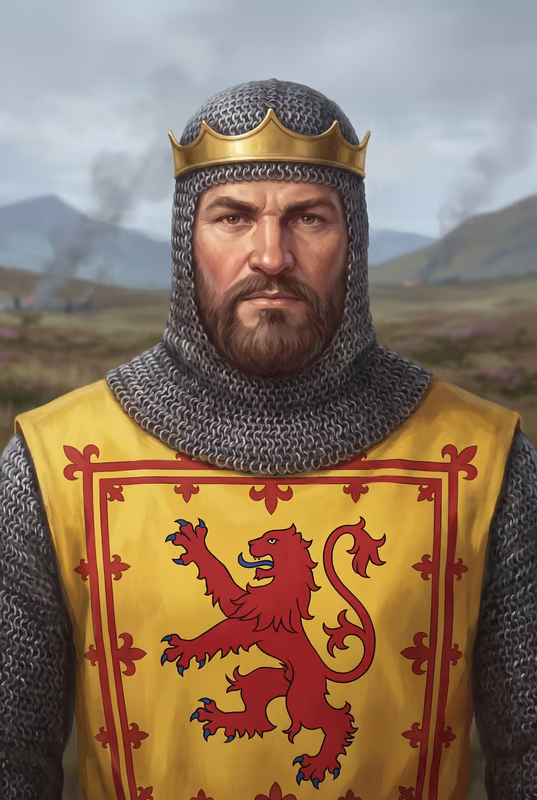
- King of Scots who murdered John Comyn, survived exile and excommunication, and won Scottish independence at the Battle of Bannockburn
- Fatal flaw
- A ruthless pragmatist who switched sides so many times that nobody trusted him, he built a kingdom on a foundation of betrayal and spent his reign paying for it
The Story
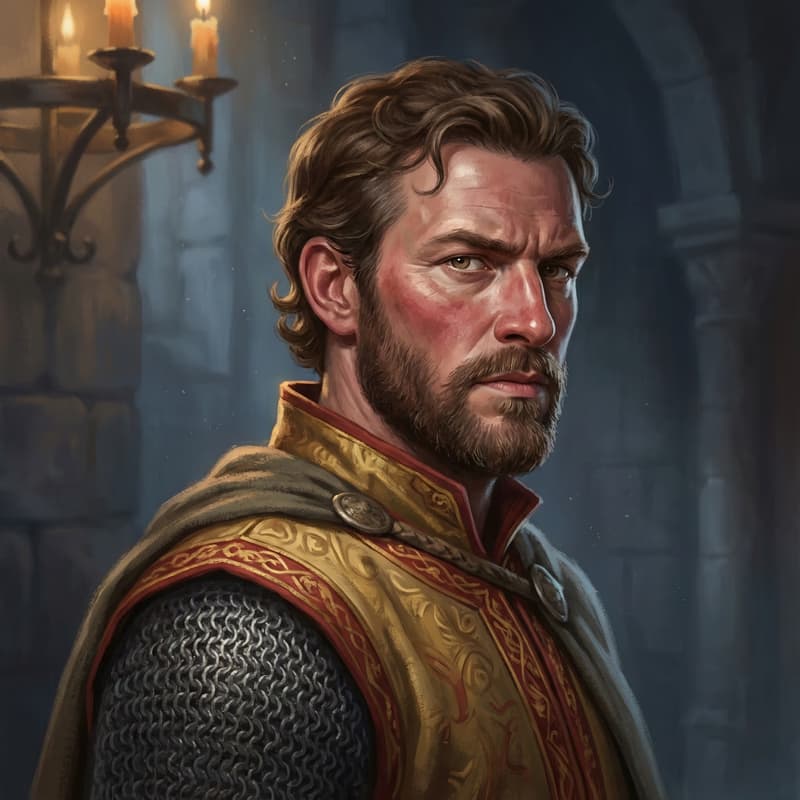
February 10th, 1306. Greyfriars Church, Dumfries. Two men stand before the high altar where no weapon is supposed to be drawn and no blood is supposed to be spilled.
Robert Bruce has asked John Comyn to meet him here. The two men are the last credible claimants to the Scottish throne. One of them is about to die. The chronicles disagree about what was said. Some claim Bruce proposed a deal: support my claim and take my lands. Others say Comyn had already betrayed Bruce to Edward I, had shown the English king a secret agreement and sold his rival for favor. What the chronicles agree on is the ending. Bruce's hand went to his dagger. The blade went into Comyn's chest before the altar, in full view of God and the attending friars.
Bruce stumbled outside, pale and shaking. His companions asked what happened. "I think I have killed the Comyn," he said. Roger Kirkpatrick drew his own blade and went back inside. "I'll mak siccar." I'll make sure. Comyn died crawling toward sanctuary he would never reach. His uncle Robert died trying to save him.
In a single act of violence, Bruce had committed murder, sacrilege, and guaranteed his own excommunication. He had also eliminated the only man who could challenge his claim to the throne. Six weeks later, on Palm Sunday, he was crowned King of Scots at Scone. The ceremony was rushed, improvised, and almost certainly illegal. But it happened. The murderer became a king. The question was whether he could survive long enough to keep the crown.
He very nearly did not. Within three months, the English smashed his army at Methven. His wife Elizabeth de Burgh, his daughter Marjorie, and his sisters were captured. His brother Neil was hanged, drawn, and quartered at Berwick. Two more brothers, Thomas and Alexander, were executed in February 1307. His sister Mary was locked in a cage suspended from the walls of Roxburgh Castle, exposed to the elements for four years. Edward I wanted the world to see what happened to those who followed the outlaw king.
By December 1306, Bruce was hiding on Rathlin Island off the coast of Ireland with a few dozen followers. No army. No treasury. No allies. Excommunicated by the Pope. Hunted by the English. Hated by the Comyn faction. He was thirty-two years old, and everything he had gambled on was gone.
Personality & Motivations
Bruce was not Wallace. Wallace fought from rage, from principle, from the bone-deep refusal to kneel. Bruce fought from ambition. He wanted the crown because he believed it was his by right, through his descent from King David I, and he was willing to do whatever it took to claim it. That included serving Edward I when it suited him, rebelling when it didn't, switching sides repeatedly during the early years of the wars, and ultimately murdering his rival in a church.
This is the contradiction at the heart of Robert Bruce. He was a calculating opportunist who became a genuine revolutionary. A man who fought for England against his own countrymen in 1296, who swore fealty to Edward I at Berwick alongside fifteen hundred other Scots, who marched with the English army as a young earl of twenty-one. Then something shifted. Whether it was Wallace's example, or Comyn's scheming, or the simple realization that Edward would never treat Scotland as anything but a conquered province, Bruce crossed a line he could not uncross.
Once he committed, he committed absolutely. The man who had hedged every bet for a decade became the man who would lose his family, his freedom, his lands, and three brothers to the English executioner rather than submit. He learned from every defeat. Methven taught him never to fight a pitched battle he could not win. He adopted guerrilla tactics, striking English garrisons and vanishing into the hills, learning the terrain-based warfare that Wallace had pioneered. He was patient, methodical, and merciless. The pragmatist who had once played both sides became the most dangerous man in Britain precisely because he understood both sides from the inside.
What Most People Get Wrong
The popular image of Robert Bruce is the noble patriot, the Braveheart figure who fought for Scottish freedom against English tyranny. The reality is far more complicated. For the first decade of the Scottish wars, Bruce was on England's side as often as he was against it.
In 1296, he swore loyalty to Edward I at Berwick. In 1297, he joined the Scottish revolt, then submitted again to the English within months. He served as a Guardian of Scotland alongside John Comyn, then resigned. He appeared at English court, accepted English lands, and gave every impression of being a loyal subject. His father had been even more consistently pro-English, fighting for Edward against the Scots at the Battle of Dunbar.
Bruce did not wake up one morning and decide to free Scotland. He maneuvered, calculated, and waited until the moment was right, and when the moment came, it arrived not as a noble declaration but as a murder in a church. The hero of Scottish independence built his kingdom on the corpse of a man he killed before an altar. It is a far more interesting story than the legend, because it asks the question that legends prefer to avoid: can a good king be built from a bad act?
Key Moments
Berwick, August 1296. The twenty-one-year-old Earl of Carrick stood among fifteen hundred Scottish nobles and swore an oath of fealty to Edward I. His father stood beside him. The Bruce family had sided with England during the Scottish revolt, calculating that English favor would advance their claim to the throne better than Scottish rebellion. It was a cold choice. It was also the moment that would haunt Bruce for the rest of his life, because every enemy he ever made would remind him that he had once knelt to the man he later fought.
Greyfriars Church, February 10th, 1306. The murder of John Comyn was the hinge point of Scottish history. Bruce went into that church as an earl with a disputed claim. He came out as a murderer with no options left except the crown. Whether the killing was premeditated or the result of a confrontation that spiraled beyond control, the effect was the same. Within six weeks, Bruce was crowned at Scone. Within three months, he was a fugitive. The single most reckless act of his life turned out to be the one that made everything else possible.
Methven, June 19th, 1306. Bruce's first battle as king was a disaster. Aymer de Valence caught the Scottish army in a dawn attack, scattering Bruce's forces before they could form up. Bruce barely escaped into the Perthshire hills. Days later, the MacDougalls, allies of the murdered Comyn, ambushed him again at Dalrigh. His brooch was torn from his cloak. His companions were killed. By winter, he was hiding on Rathlin Island with nothing but a handful of loyal men and the knowledge that his wife, his daughter, and his sisters were in English prisons.
Loudoun Hill, May 10th, 1307. The turning point. Bruce returned to the Scottish mainland in February 1307 and began a guerrilla campaign in the southwest. At Loudoun Hill in Ayrshire, he chose his ground carefully, digging trenches to channel the English cavalry into a narrow front where their numbers meant nothing. Aymer de Valence, the same commander who had smashed Bruce at Methven, rode into a trap. The English heavy horse floundered in the trenches while Scottish spearmen cut them apart. It was a small battle, but it proved that Bruce had learned. He would never again fight on ground that favored the enemy.
Bannockburn, June 23rd-24th, 1314. The battle that secured Scottish independence. Edward II marched north with twenty-five thousand men to relieve the besieged English garrison at Stirling. Bruce waited with six thousand on ground he had chosen with obsessive care: wooded terrain where English cavalry could not charge, boggy ground where armored knights would flounder, prepared pits to break horses' legs. On the first day, the English knight Henry de Bohun spotted Bruce riding ahead of his army and charged, lance leveled, dreaming of glory. Bruce sidestepped the lance on his smaller horse, rose in his stirrups, and split de Bohun's helmet with a single stroke of his battleaxe. The handle cracked from the force. His commanders criticized him for the risk. Bruce only regretted the broken axe. On the second day, his schiltrons advanced into the English army, pushing them back into the Bannock Burn, where thousands drowned in the mud. Edward II fled the field. Scotland was free.
The Detail History Forgot
The title "Braveheart" does not belong to William Wallace. It belongs to Robert Bruce.
When Bruce lay dying at his manor in Cardross in June 1329, he called for his most trusted companion, Sir James Douglas, called the Black Douglas. Bruce had a dying wish. He had never fulfilled his vow to go on crusade to the Holy Land, a failure that weighed on a man already excommunicated for murder in a church. He asked Douglas to carry his heart to the Holy Land and present it before the Holy Sepulchre.
Douglas agreed. After Bruce's death on June 7th, 1329, his heart was removed, embalmed, and placed in a silver casket that Douglas wore on a chain around his neck. Douglas sailed for the Holy Land but stopped in Spain, where King Alfonso XI of Castile was fighting the Moors of Granada. At the Battle of Teba in August 1330, Douglas found himself surrounded. He took the casket from his neck and hurled it into the enemy ranks, reportedly shouting, "Lead on, Brave Heart, as thou wert wont to do, and Douglas will follow thee or die."
Douglas was killed in the charge. The casket was recovered from the battlefield and returned to Scotland. Bruce's heart was buried at Melrose Abbey, where it remains today. In 1996, archaeologists found the lead casket during excavations. It was reburied in a private ceremony in 1998. The brave heart that gave a kingdom its freedom rests under Scottish soil, carried home by the loyalty of a dead friend.
The Downfall
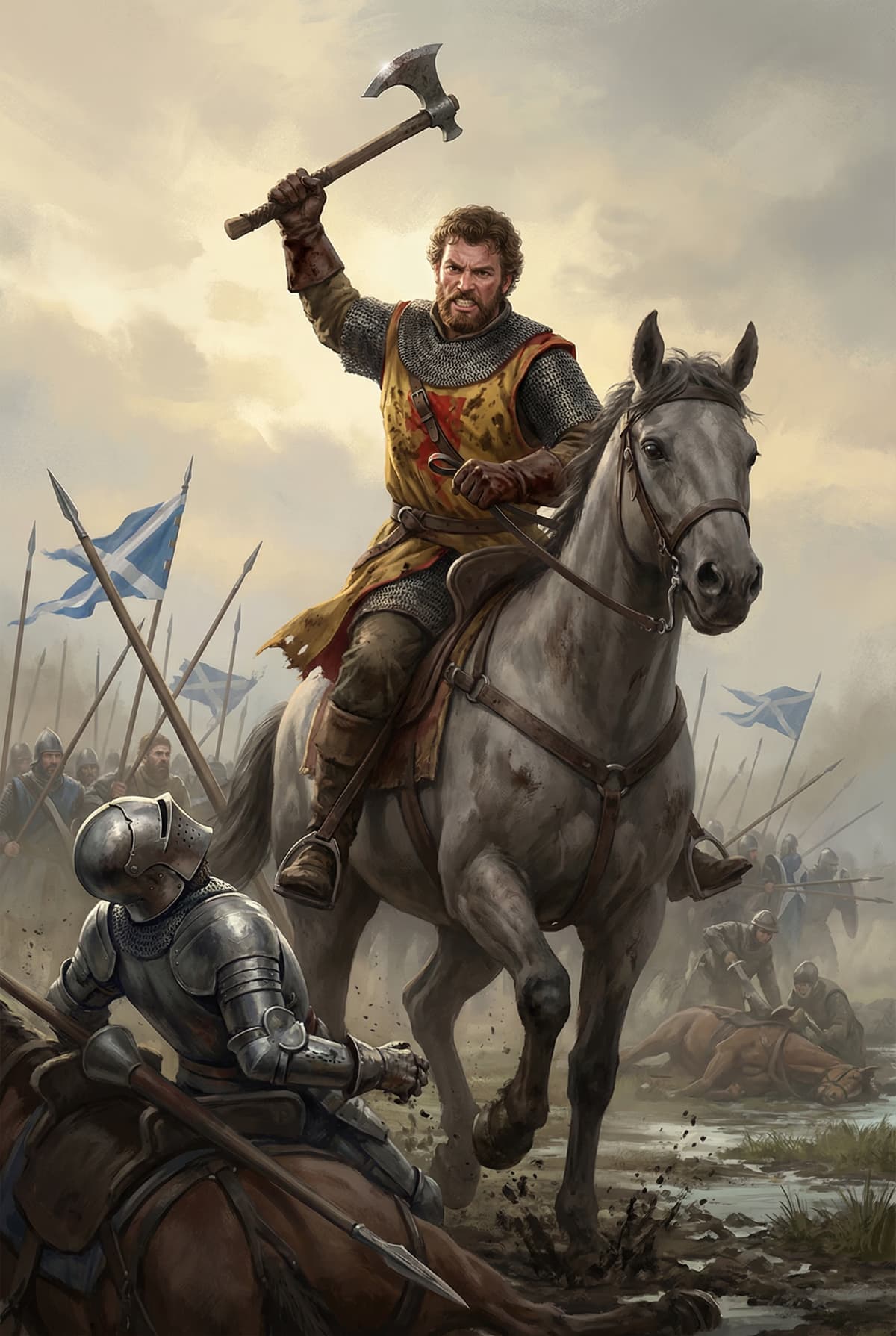
Bruce won his kingdom, but he paid for it with his body. The years of hiding in caves and heather, of sleeping in rain and fighting in mud, of wounds taken and fevers endured, broke him down long before old age should have claimed him. By the 1320s, the king who had split Henry de Bohun's skull with an axe was increasingly confined to his manor at Cardross, too ill to campaign, too weak to ride.
Contemporary sources describe "the King's sickness" in vague terms. The English chronicler Jean Le Bel called it "la grosse maladie," the great sickness, a phrase usually taken to mean leprosy. The Lanercost Chronicle agreed. Modern science is less certain. A cast of Bruce's skull, taken when his tomb at Dunfermline Abbey was opened in 1819, shows no evidence of leprosy on the bone. Whatever killed him, it was slow, debilitating, and robbed the greatest warrior king in Scottish history of the ability to fight.
He spent his final years securing what he had won. The Declaration of Arbroath in 1320, signed by fifty-one Scottish nobles and sent to Pope John XXII, asserted Scotland's ancient independence and named Bruce as its rightful king. It contained the most famous sentence in Scottish political history: "For as long as but a hundred of us remain alive, never will we on any conditions be brought under English rule." In 1328, the Treaty of Edinburgh-Northampton forced the new English king, Edward III, to formally recognize Scottish independence and Bruce as its sovereign. Bruce had won. The man who murdered his way to a throne had built it into something that even England could not deny. He died on June 7th, 1329, at the age of fifty-four. His body was buried at Dunfermline Abbey. His heart went further, carried by a dead friend's loyalty into a battlefield in Spain, and then home again to Melrose Abbey, where it waits still.
Frequently Asked Questions
Yes. Robert I, popularly known as Robert the Bruce, was born on July 11th, 1274, most likely at Turnberry Castle in Ayrshire. He served as King of Scots from his coronation on March 25th, 1306, until his death on June 7th, 1329. He is one of the most thoroughly documented figures in medieval Scottish history, with contemporary accounts from both Scottish and English chroniclers.
Yes. On February 10th, 1306, Bruce met John Comyn, Lord of Badenoch, at Greyfriars Church in Dumfries. Bruce stabbed Comyn before the high altar, and his companion Roger Kirkpatrick went back inside to finish the wounded man. The murder is recorded in multiple independent chronicles and is one of the best-attested events in medieval Scottish history. Bruce was excommunicated by Pope Clement V for the act.
The exact cause remains debated. Bruce's supporters claimed Comyn had betrayed a secret pact between them to Edward I. English sources suggest Bruce had already decided to seize the throne and needed to eliminate his chief rival. Most historians believe the meeting was planned but the killing was not, that a confrontation escalated beyond control. Whatever triggered it, the result was the same: Comyn's death left Bruce as the only credible claimant to the Scottish crown.
Yes. In August 1296, the twenty-one-year-old Bruce swore fealty to Edward I at Berwick alongside his father. He served in the English administration and held English lands. He briefly joined the Scottish revolt in 1297 but quickly submitted again. Over the next several years, he switched sides multiple times before his final break with England in 1306. His early pro-English service is one of the most uncomfortable facts in his biography.
They were captured by the English in 1306. His wife Elizabeth de Burgh was placed under house arrest in England. His daughter Marjorie was initially ordered caged in the Tower of London, though this was later commuted to a convent. His sister Mary was locked in a cage on the walls of Roxburgh Castle for four years. His sister Christina was imprisoned in a convent. Three of his brothers, Neil, Thomas, and Alexander, were executed between September 1306 and February 1307.
Almost certainly not. The legend says Bruce, hiding in a cave during the winter of 1306-1307, watched a spider repeatedly fail to anchor its web before finally succeeding, inspiring him to try again. The story first appears centuries after the events it describes and is not found in any contemporary source. Bruce did shelter on Rathlin Island off the Irish coast that winter, but the spider is a later addition to the narrative. The poet John Barbour, who wrote the first major account of Bruce's life in 1375, never mentions it.
Through meticulous preparation and superior tactics. Bruce chose the battlefield carefully: wooded, boggy terrain near Stirling where English cavalry could not charge effectively. He dug anti-cavalry pits and trenches to channel the enemy into a narrow front. His six thousand Scots fought in schiltrons, dense formations of spearmen that Wallace had pioneered at Stirling Bridge but that Bruce had trained to advance offensively. The English army of twenty-five thousand was trapped between the Scottish lines and the Bannock Burn, unable to deploy their superior numbers. Edward II fled the field, and Scotland's independence was effectively secured.
The evidence is inconclusive. English chroniclers Jean Le Bel and the authors of the Lanercost Chronicle described Bruce as suffering from "la grosse maladie," a term commonly associated with leprosy. However, medieval writers used "leprosy" loosely to describe many skin conditions. Scientific analysis of a cast taken from Bruce's skull in 1819 found no bone damage consistent with leprosy. Modern historians believe he suffered from a serious chronic illness, but its exact nature remains unknown.
The Declaration of Arbroath is a letter dated April 6th, 1320, sent by fifty-one Scottish nobles to Pope John XXII. Written at Arbroath Abbey, likely by Chancellor Bernard of Kilwinning, it asserted Scotland's independence and recognized Robert Bruce as its rightful king. Its most famous passage declares that the Scots would never submit to English rule "for as long as but a hundred of us remain alive." The letter helped lift Bruce's excommunication and paved the way for the Treaty of Edinburgh-Northampton in 1328, which formally ended the war with England.
The 1995 film gave the title to the wrong man. The historical "Braveheart" is Robert Bruce. When Bruce died in 1329, he asked his friend Sir James Douglas to carry his heart on crusade. At the Battle of Teba in Spain in 1330, the surrounded Douglas hurled the silver casket containing Bruce's heart into the enemy ranks, shouting "Lead on, Brave Heart." Douglas died in the charge. The heart was recovered and returned to Melrose Abbey in Scotland, where it was rediscovered during archaeological excavations in 1996 and reburied in 1998.