- Known for
- Charging Robert the Bruce in single combat at the opening of Bannockburn, only to be killed with a single axe blow that split his helmet and skull
- Fatal flaw
- Reckless ambition disguised as courage, a young knight who mistook a king on a small horse for an easy kill
The Story
June 23rd, 1314. The road south of Stirling Castle. Late afternoon sun cuts through the trees of New Park, throwing long shadows across the old Roman road where the English vanguard is pushing north.
A young knight in the front ranks sees something through the trees that stops his breath. A man on a small grey horse, riding ahead of the Scottish lines, wearing a gold crown over his helmet. Robert Bruce, King of Scots, mounted on a palfrey instead of a warhorse, armed with nothing but a battle-axe. No lance. No shield wall around him. Just a king on a pony, inspecting his troops before the killing starts.
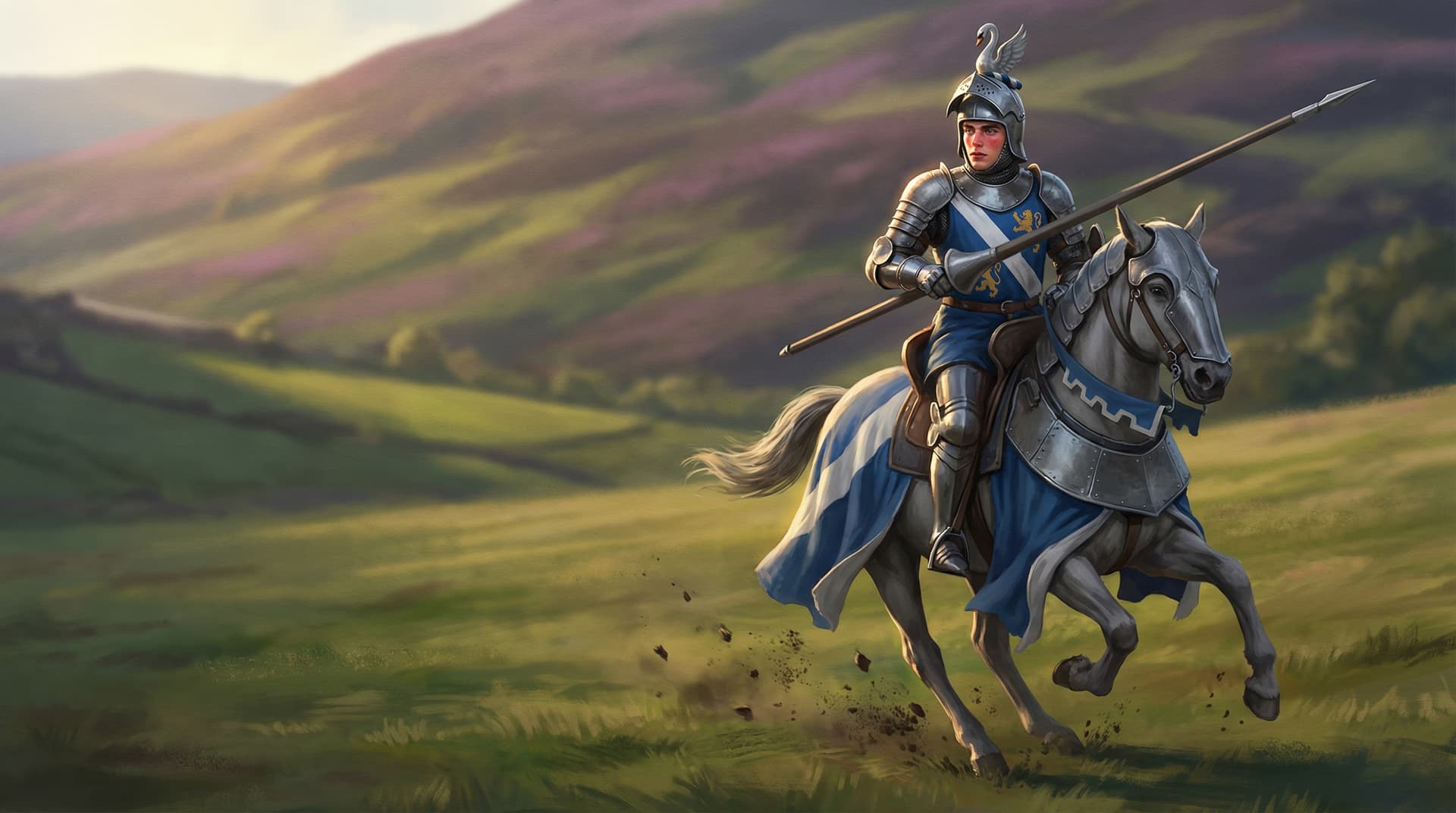
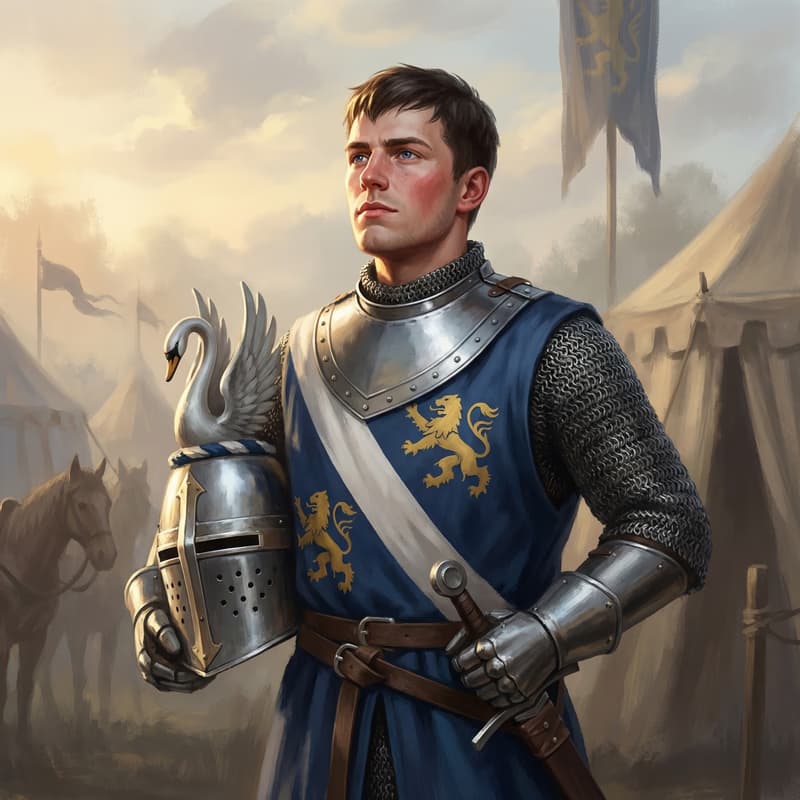
Henry de Bohun does not hesitate. He is young, perhaps twenty-two, the nephew of the Earl of Hereford, Hereditary Constable of England. He carries the blood of a family that helped force King John to sign Magna Carta. He rides a destrier bred for war, carries a lance made for killing, wears armor forged to turn any blade. And ahead of him sits the most wanted man in Britain, alone and exposed and mounted on a horse the size of a mule.
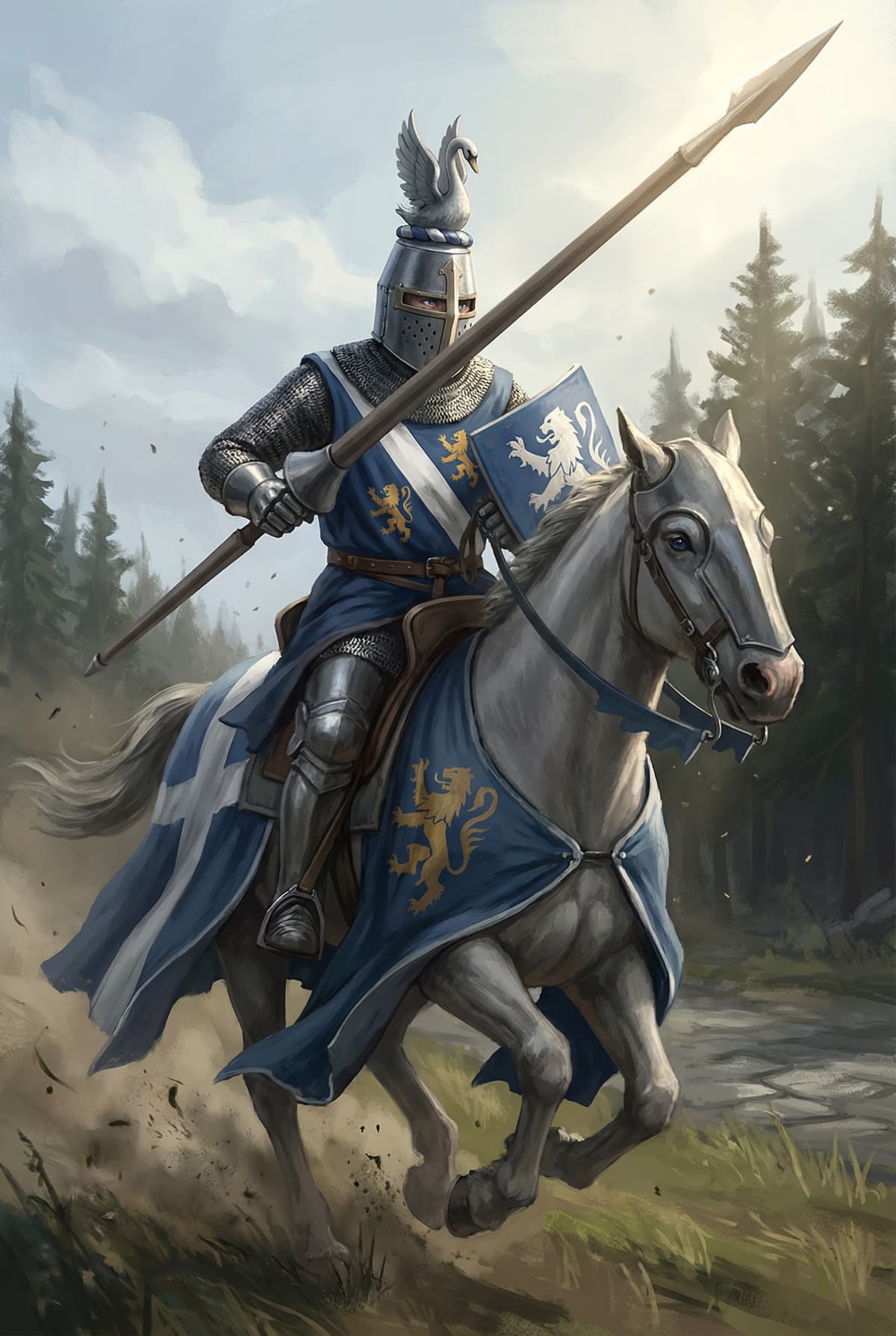
He lowers his lance. He spurs his warhorse forward. The distance closes at a combined speed that turns the world into a blur of hooves and dust and steel. Every English soldier in the vanguard watches. Every Scottish spearman in the tree line holds his breath. This is the moment. One lance thrust and the war ends. One kill and Henry de Bohun becomes the most famous knight in Christendom.
Bruce waits. He does not run. He does not raise a shield. At the last instant, as the lance point reaches for his chest, Bruce turns his palfrey to the side and lets the steel slide past. Then he rises in his stirrups, brings his axe down with the full weight of his body, and splits Henry de Bohun from helmet to jaw.
The knight is dead before he hits the ground. The shaft of Bruce's axe shatters from the impact. When his commanders rush forward to rebuke him for risking his life in single combat, the king looks down at the broken handle in his fist and says the only words history records from the moment: "I have broken my good axe."
Personality & Motivations
Henry de Bohun was born into a family that expected greatness. The de Bohuns were Anglo-Norman aristocracy of the highest order, Earls of Hereford, Hereditary Constables of England, descendants of men who stood at Runnymede and forced a king to bend. His uncle Humphrey de Bohun, the 4th Earl, commanded the English vanguard at Bannockburn. Henry rode in his uncle's shadow, a younger son of a younger branch, carrying a famous name but holding no title of his own.
That is the pressure that explains the charge. A young man from a dynasty of soldiers and statesmen, watching a king sit exposed on a pony, realizing that one act of courage could write his name into history forever. He was not stupid. He was ambitious. He had spent his life watching older men inherit the titles and the glory and the songs. Here was a chance to earn something that could never be inherited, something that belonged to him alone.
The tragedy is that he was right about one thing. His name did enter history forever. Just not the way he imagined.
What Most People Get Wrong
The popular version of this story frames de Bohun as a fool, a reckless idiot who threw his life away on a suicidal charge. That misses the military logic of the moment entirely. In 1314, a mounted knight in full armor on a trained warhorse was the most lethal weapon on any battlefield. A single lance charge could, and regularly did, kill kings. Bruce was mounted on a light riding horse, wearing minimal armor, carrying a short-handled weapon with no reach. By every calculation of medieval combat, de Bohun should have won.
What de Bohun could not calculate was Bruce himself. Robert Bruce was forty years old in 1314. He had been fighting since his twenties, had survived ambushes, betrayals, and years of guerrilla war in the Scottish highlands. He was not a king playing at soldier. He was a killer who happened to wear a crown. De Bohun charged a target. Bruce fought a man. The difference was fatal.
Key Moments
Childhood in the de Bohun household, 1280s-1290s. Henry grew up in one of England's most powerful families. The de Bohuns had held the Earldom of Hereford since 1200 and the hereditary office of Constable of England even longer, tracing their authority back through the Norman Conquest to their estates in the Cotentin Peninsula of Normandy. His ancestor Henry de Bohun, 1st Earl of Hereford, was one of the twenty-five barons who enforced Magna Carta in 1215. The family's Welsh Marcher lordships made them military men by necessity, always ready to ride, always close to war.
The English march north, June 1314. Edward II assembled the largest English army since his father's invasion of Scotland in 1296. Estimates vary, but somewhere between fifteen and twenty thousand men marched north to relieve the besieged English garrison at Stirling Castle. De Bohun rode in the vanguard under his uncle Humphrey, the Earl of Hereford. The army was vast, confident, and deeply contemptuous of the Scots who had spent eight years fighting a guerrilla war they could never win in open battle. Or so the English believed.
The afternoon of June 23rd, 1314. The English vanguard reached the Bannock Burn in the late afternoon. As they moved through the woodland near the old Roman road, de Bohun spotted Bruce ahead of the Scottish positions. The king wore his crown over his helmet, a gesture of defiance and identification that made him unmistakable. De Bohun saw his moment. He broke from the English line and charged alone.
The charge and the axe blow. The two men closed at full speed. De Bohun's lance was leveled, aimed at Bruce's chest. Bruce sat motionless on his grey palfrey until the last second, then swerved. The lance missed. Bruce rose in his stirrups and brought his axe down in a single arc that cut through steel, bone, and brain. John Barbour, writing in "The Bruce" decades later, recorded that the blow was so powerful it shattered the axe handle. Henry de Bohun was dead. The Battle of Bannockburn had begun.
The aftermath. De Bohun's death sent a shockwave through both armies. The Scottish troops erupted in cheers. The English vanguard, stunned by the loss, pulled back. Bruce's commanders swarmed him, furious that he had risked his life in single combat before the battle was even joined. The king ignored their anger. The psychological damage was done. Every English soldier who watched that charge knew that their best knight, armored and mounted and carrying every advantage, had been killed by a man on a pony with a hand axe. The next morning, when the real battle began, that knowledge sat in every English chest like a stone.
The Detail History Forgot
Henry de Bohun married Joan de Plugenet, but the marriage produced no children. When he died at Bannockburn, his line died with him. There was no son to avenge his father, no heir to carry the name forward, no descendant to reshape the story. His uncle Humphrey, the 4th Earl, was captured at Bannockburn and later exchanged for Bruce's queen, Elizabeth de Burgh, and other Scottish prisoners. The de Bohun earldom continued through Humphrey's children, but Henry's branch vanished completely. He became a footnote in his own family's history, remembered only for the manner of his death. The coat of arms he carried into that charge, azure with a bend between six golden lions, was never passed to another generation. It died on the field with him.
The Downfall
Henry de Bohun's fatal flaw was not courage. It was the particular kind of blindness that courage creates in young men who have never been tested. He saw a king on a small horse and calculated the odds the way a tournament knight calculates a joust: weight of horse, length of lance, thickness of armor. By those numbers, he could not lose. What he failed to calculate was the man inside the crown.
Bruce had spent eight years learning how to survive when every advantage belonged to his enemies. He had fought in bogs and forests and mountain passes where heavy cavalry was useless. He had learned to wait, to watch, to let an enemy's momentum become a weapon against him. The swerve that killed de Bohun was not luck. It was the product of a decade of desperate combat against opponents who always had more men, more armor, more horses.
De Bohun charged with everything his family name and his English training had given him. Bruce answered with everything Scotland's war of survival had taught him. The young knight trusted his equipment. The old king trusted his timing. In the space between those two instincts, an axe fell, and the Battle of Bannockburn began with a prophecy of how it would end. England brought its finest knights, its heaviest armor, its largest army. Scotland brought men who had learned to fight with what they had. On June 24th, 1314, the day after de Bohun's death, Bruce's spearmen destroyed the English army in the most decisive Scottish victory in history. Henry de Bohun was the first to learn what twenty thousand Englishmen would discover the following morning: that the war had changed, and the old advantages no longer applied.
Frequently Asked Questions
Yes. Sir Henry de Bohun was a real English knight who died on June 23rd, 1314, at the Battle of Bannockburn. His death at the hands of Robert the Bruce is recorded in multiple contemporary and near-contemporary sources, including John Barbour's "The Bruce" (c. 1375) and the "Vita Edwardi Secundi," an anonymous Latin chronicle of Edward II's reign written by a contemporary observer.
He was killed by Robert the Bruce in single combat on the first day of the Battle of Bannockburn. De Bohun charged Bruce on his warhorse with a leveled lance. Bruce, mounted on a small grey palfrey, swerved at the last instant, rose in his stirrups, and brought his battle-axe down on de Bohun's head. The blow split his helmet and skull, killing him instantly. The force was so great it shattered the wooden shaft of Bruce's axe.
De Bohun saw Bruce riding ahead of the Scottish lines on a small horse, wearing his crown but carrying only a battle-axe. To a young knight trained in mounted combat, this looked like the opportunity of a lifetime: kill the Scottish king in a single lance thrust, end the war before it began, and win eternal fame. By the conventions of medieval cavalry warfare, his calculation was not unreasonable. He simply underestimated his opponent.
Yes. Henry was the nephew of Humphrey de Bohun, 4th Earl of Hereford, who commanded the English vanguard at Bannockburn. Henry was likely the son of John de Bohun, making him a grandson of the 2nd Earl of Hereford. The de Bohun family held the Earldom of Hereford and the hereditary office of Constable of England, making them one of the most powerful noble houses in England.
According to John Barbour's "The Bruce," when Bruce's commanders rushed to rebuke him for risking his life in single combat, the king's only expressed regret was that he had broken the shaft of his good axe. The remark has become one of the most famous lines in Scottish history, capturing Bruce's cool composure and battlefield confidence in a single sentence.
Bruce was mounted on a small grey palfrey, a light riding horse used for travel rather than combat. Barbour describes it as "ane gay palfray, litill and joly" (a fine palfrey, small and spirited). This was in stark contrast to de Bohun's destrier, a heavy warhorse bred specifically for mounted combat. The mismatch in horses made Bruce's victory even more remarkable and became a central element of the legend.
The de Bohuns were one of England's most powerful Anglo-Norman families. They held the Earldom of Hereford from 1200 and the hereditary office of Constable of England. Henry de Bohun, 1st Earl of Hereford, was one of the twenty-five barons who enforced Magna Carta in 1215. The family controlled extensive Welsh Marcher lordships and played major roles in English politics and warfare for over two centuries.
No. Henry married Joan de Plugenet, but the marriage produced no children. When he died at Bannockburn, his line ended. The de Bohun earldom continued through his uncle Humphrey, the 4th Earl, whose descendants held the title until 1373 when the last male de Bohun earl died. Henry's branch of the family vanished completely with his death.
De Bohun's death demoralized the English vanguard, which withdrew for the evening. The next day, June 24th, the full battle was fought. Bruce's Scottish schiltrons, dense formations of spearmen, advanced against the English army and routed it in one of the most decisive battles in British history. Henry's uncle, the Earl of Hereford, was captured and later exchanged for Bruce's queen and other Scottish prisoners.
The battle took place near Stirling Castle in central Scotland, along the Bannock Burn (a small river) south of the castle. The English army had marched north to relieve the besieged English garrison at Stirling. The first day's fighting, including de Bohun's charge, occurred near the woodland of New Park along the old Roman road from Falkirk. The main battle on June 24th was fought on the low ground between the Bannock Burn and the River Forth.