- Known for
- Catastrophic defeat at the Battle of Bannockburn, devotion to favorites over barons, and becoming the first English king deposed since the Norman Conquest
- Fatal flaw
- He craved intimacy over authority, pouring the kingdom's power into the hands of men he loved while the men he needed turned against him

The Story
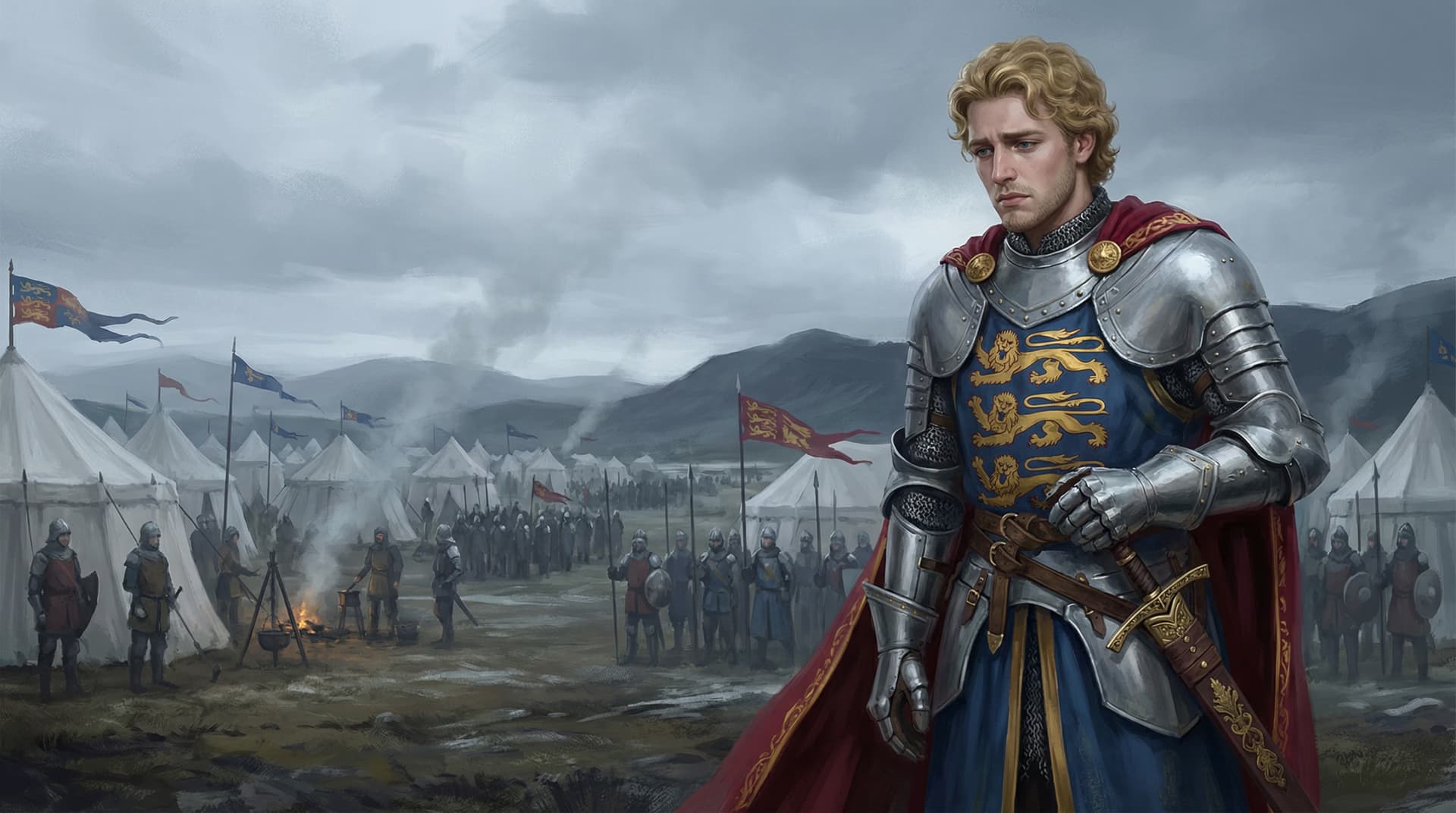
July 7, 1307. Edward of Caernarfon kneels beside his father's body in a sweat-stained tent on the marshes of Burgh by Sands. The old king is still warm. The eyes that once blazed with cold fury are closed. The hands that tore out handfuls of his son's hair lie still. Edward is twenty-three years old. He is now King of England, Lord of Ireland, and Duke of Aquitaine. He has inherited the largest military machine in Christendom, a war against Scotland that his father spent a decade prosecuting, and a treasury emptied by that same war.
His first act as king is not to push north into Scotland. It is not to consolidate the garrisons his father had positioned along the border. It is to recall Piers Gaveston from exile. The Gascon knight his father had banished, the man Edward I warned his son against with his dying breath, is summoned back to England before the old king's body is cold.
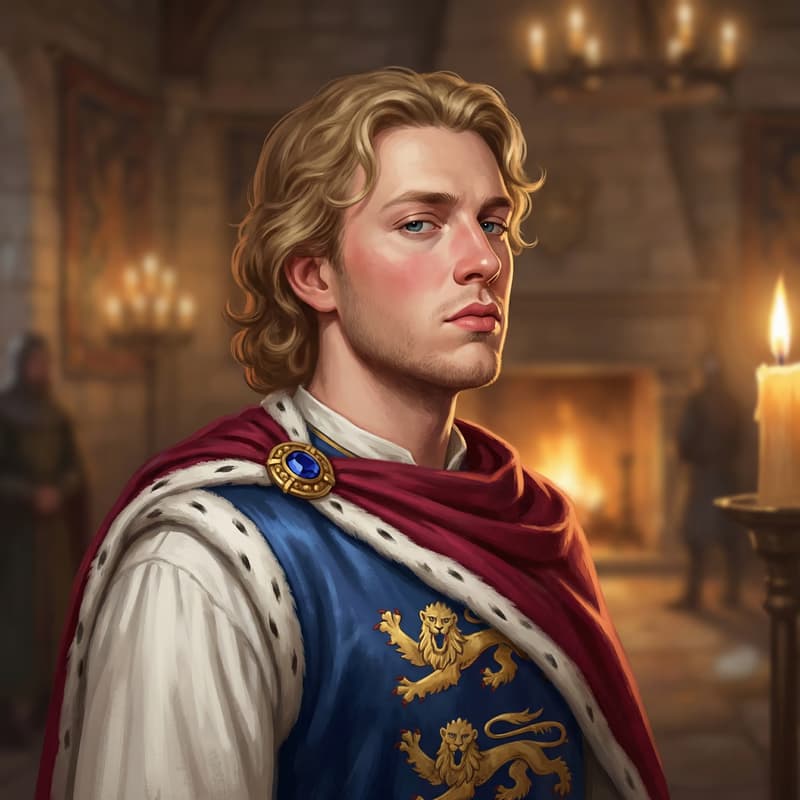
Within a month, Gaveston is Earl of Cornwall. Within six months, he is regent of England while Edward crosses to France to marry Isabella, the twelve-year-old daughter of Philip IV. The barons who fought beside Edward I, who bled for the conquest of Scotland, who expected the new king to finish his father's war, watch in disbelief as the crown's power flows not to them but to a single Gascon favorite who calls them by insulting nicknames. Gaveston dubbed the Earl of Lancaster "the Churl," the Earl of Pembroke "Joseph the Jew," the Earl of Warwick "the Black Dog of Arden." He beat them in tournaments and mocked them at feasts. It was not politics. It was provocation.
Edward II was not stupid. He was not, as the old histories claimed, a simpleton who stumbled into kingship by accident of birth. He was tall, strong, reportedly handsome, fluent in several languages, and capable of real administrative competence when he chose to exercise it. But he did not choose to exercise it. He chose Gaveston. Then, after Gaveston was murdered, he chose the Despensers. And the pattern that destroyed his reign was set before the crown touched his head: Edward would pour everything he had into the men closest to him and ignore the political world that demanded he spread his favor wide.
Personality & Motivations
The chroniclers hated him, and their contempt has echoed for seven centuries. They called him frivolous, degenerate, unfit. They were appalled that he preferred swimming, rowing, and digging ditches to jousting and hunting. He thatched roofs. He bred horses. He kept company with craftsmen and laborers when a king was supposed to surround himself with warriors and bishops. In an age that measured kings by their ferocity in war and their magnificence in court, Edward measured himself by the affection of the people he loved.
This was not weakness in the simple sense. It was a different kind of strength directed at the wrong targets. Edward showed real tenacity in defending his favorites, enduring exile, excommunication, and civil war rather than abandon them. He showed political cunning in the aftermath of Bannockburn, surviving a defeat that should have ended his reign. He held onto his crown for thirteen years after the worst military disaster in English history. That requires a certain stubborn resilience that his critics never acknowledged.
But resilience in the wrong cause is still ruin. Edward could not understand, or would not accept, that medieval kingship was a collective enterprise. A king ruled through his barons. He distributed patronage widely to keep the magnates loyal. He took counsel, even when he disagreed with it. Edward I understood this instinctively, spreading lands and offices across dozens of noble families. Edward II concentrated everything in one or two men and dared the rest of the kingdom to object. They objected. Then they rebelled. Then they killed him.
What Most People Get Wrong
The popular image of Edward II is a weak, effeminate man who could not hold a sword, a soft prince crushed by his father's shadow. The reality is more complicated. Edward was physically impressive, tall and strong like his father, and capable of genuine military action when motivated. In 1322, after years of humiliation, he personally led the campaign that crushed Thomas of Lancaster's rebellion at the Battle of Boroughbridge. Lancaster, the most powerful earl in England and the man who had dictated terms to the king for a decade, was captured, subjected to a mockery trial, and beheaded. Edward watched. For the next four years, Edward ruled as an effective autocrat, annulling the Ordinances that had constrained him, seizing Lancaster's vast estates, and governing with an iron grip through the Despensers.
The man who lost at Bannockburn also won at Boroughbridge. The king who let Gaveston run wild also crushed the most powerful baronial coalition of the fourteenth century. Edward II was not incapable. He was inconsistent, brilliant in short bursts and catastrophic over the long term, a king who could win battles but never win loyalty.
Key Moments
Coronation, February 25, 1308. The ceremony at Westminster Abbey should have unified the kingdom. Instead, it became the first public scandal of the reign. Edward gave Gaveston the honor of carrying the crown of St. Edward, a role traditionally reserved for the highest-ranking English earl. He seated Gaveston at the coronation banquet above Queen Isabella's own relatives. The French delegation, representing Isabella's father Philip IV, was so offended that they reportedly threatened to leave. The barons watched their new king humiliate his queen and elevate a foreign favorite above the entire English nobility. The marriage was barely a month old.
The Ordinances, 1311. Twenty-one Lords Ordainers, led by Thomas of Lancaster, imposed a set of reforms that stripped Edward of his ability to appoint ministers, wage war, or leave the country without baronial consent. The Ordinances demanded Gaveston's permanent exile. Edward signed under duress and spent the next decade trying to undo them. The document was not just a political check on royal power. It was a public declaration that the barons considered their king unfit to govern. No English king since John had been so openly humiliated by his own nobility.
The murder of Gaveston, June 19, 1312. Gaveston had been exiled and recalled multiple times. This time, cornered at Scarborough Castle, he surrendered to the Earl of Pembroke on a guarantee of safe conduct. Pembroke left him under guard at Deddington in Oxfordshire. Guy de Beauchamp, Earl of Warwick, the man Gaveston had nicknamed "the Black Dog," seized him, dragged him to Warwick Castle, and had him beheaded on Blacklow Hill. Two Welshmen ran him through with swords first, then struck off his head. Edward received the news and did not speak for days. He never forgave Warwick. He never forgot Gaveston. And the grief hardened into something that would eventually consume everyone around him.
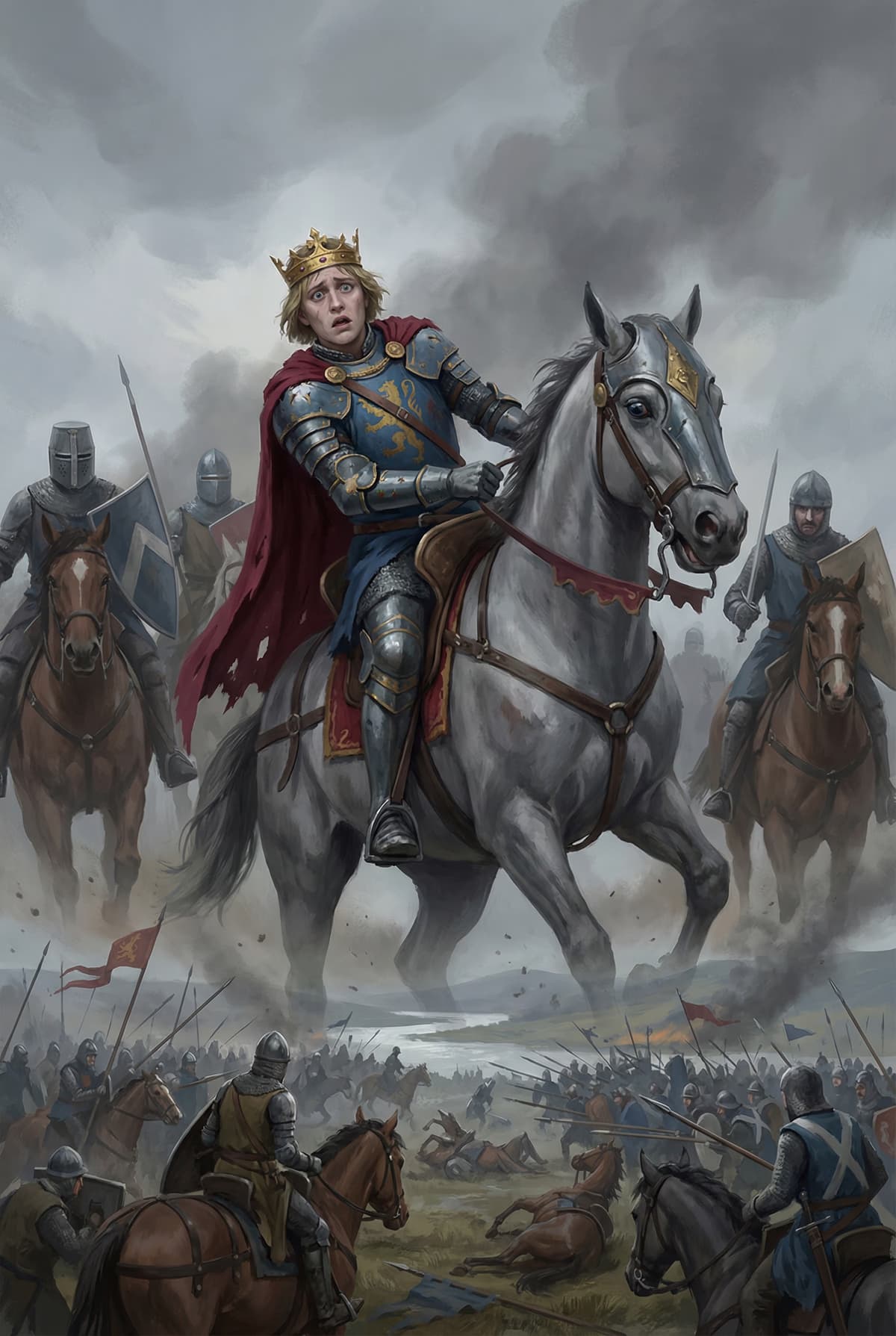
Bannockburn, June 23-24, 1314. Edward marched the largest English army ever assembled into Scotland, perhaps twenty thousand men, to relieve the besieged garrison at Stirling Castle. Robert Bruce chose the ground carefully, a boggy field between the Bannock Burn and the River Forth where English cavalry could not maneuver. On the first day, Bruce himself killed Sir Henry de Bohun in single combat, splitting his skull with a battle-axe. On the second day, the Scottish schiltrons advanced into the disordered English ranks, and the rout began. Edward fled the field with his bodyguard. Of his army, fewer than three thousand made it back to England. The defeat did not just lose Scotland. It destroyed what remained of Edward's authority over his own barons.
Boroughbridge, March 16, 1322. Lancaster's rebellion ended at a bridge in Yorkshire. Edward's forces, led by Andrew Harclay, caught Lancaster's army trying to cross the River Ure. Harclay's pikemen held the bridge while archers cut down the rebels in the water. Lancaster was captured, condemned in a trial that was little more than a formality, and beheaded at Pontefract Castle. Edward had him executed in the same manner Lancaster had used on Gaveston, on a small hill outside the castle walls, forced to kneel facing Scotland. It was revenge, precise and deliberate, served ten years cold.
The Detail History Forgot
Edward II kept detailed household accounts, and they reveal a man utterly unlike the warrior-king template of his era. He paid regular wages to his ditch-diggers. He tipped bargemen and swimmers who entertained him. He once rewarded a man for "making the king laugh." He purchased iron tools for his own use, not for servants, because he worked with his hands alongside laborers. In 1316, during the Great Famine that killed perhaps ten percent of England's population, his accounts show purchases of food for the poor at a time when many lords were hoarding grain.
The same accounts record payments for elaborate theatrical performances and for musicians who traveled with the court. Edward loved spectacle and performance, but not the martial kind. He preferred plays to tournaments, actors to knights. In a century that celebrated men who killed well, England was ruled by a man who preferred men who performed well. The chroniclers recorded this as degeneracy. A modern reader might see something else entirely.
The Downfall
By 1325, Edward had been king for eighteen years. Gaveston was dead. Lancaster was dead. The Ordinances were annulled. The Despensers controlled the government. Edward had won, or so it seemed. But the victory was hollow. Hugh Despenser the Younger had accumulated power and land on a scale that dwarfed even Gaveston's excesses, seizing estates across Wales and southern England, intimidating rivals, and monopolizing access to the king. The barons who had tolerated the Despensers as the lesser evil now hated them as the greater one. And Isabella, sent to France on a diplomatic mission, refused to come back.
She had reason. Despenser had systematically stripped her of her lands, her income, and her household. Her children had been placed in the custody of Despenser's wife. She had been publicly humiliated for years by a husband who preferred his chamberlain to his queen. In Paris, she found Roger Mortimer, an exiled English baron with an army and a grudge. They became lovers. In September 1326, they invaded England with a force of barely 1,500 men.
The kingdom collapsed around Edward like a house built on sand. No one rallied to his defense. London opened its gates to Isabella. The Despensers were captured and executed with the same spectacular cruelty that Edward I had inflicted on Wallace, hanged, drawn, and quartered. Edward fled west into Wales, was captured in November, and was forced to abdicate in favor of his fourteen-year-old son in January 1327. He was the first anointed King of England to be deposed since the Norman Conquest. They took him to Berkeley Castle in Gloucestershire and held him there through the spring and summer. On September 21, 1327, he was dead. The official cause was natural illness. The persistent rumor, recorded by multiple chroniclers, was murder ordered by Mortimer and Isabella, carried out in a manner designed to leave no marks on the body. He was forty-three years old. He had spent his entire reign trying to love the wrong people in the wrong way, and in the end, there was no one left who loved him back.
Frequently Asked Questions
Yes. Edward II was King of England from 1307 to 1327. Born April 25, 1284, at Caernarfon Castle in Wales, he was the fourth son of Edward I and Eleanor of Castile, and the only one to survive to adulthood. His reign, deposition, and death are extensively documented in multiple contemporary chronicles including the Vita Edwardi Secundi, the Brut chronicle, and the writings of Geoffrey le Baker.
Edward II died on September 21, 1327, at Berkeley Castle in Gloucestershire. The official notification, sent by his jailer Thomas de Berkeley, claimed he died of natural causes. However, multiple chroniclers reported that he was murdered on the orders of Roger Mortimer and Queen Isabella. The most infamous account, from Geoffrey le Baker writing decades later, describes a particularly brutal method of execution. Modern historians debate whether he was murdered, died of illness or neglect, or possibly even escaped, based on a controversial document known as the Fieschi Letter.
The precise nature of their relationship remains debated. They met around 1300 when both were teenagers. A contemporary chronicler wrote that Edward "felt such love for him that he entered into a covenant of constancy, and bound himself with him before all other mortals with a bond of indissoluble love." Whether they were lovers, sworn brothers in a medieval bond of companionship, or simply extraordinarily close friends cannot be determined with certainty from surviving sources. What is certain is that Edward's devotion to Gaveston was so total and so public that it destabilized the kingdom.
Multiple factors combined to produce the disaster. Edward marched a massive but unwieldy army into terrain that Robert Bruce had carefully chosen to neutralize English cavalry superiority. The boggy ground between the Bannock Burn and the River Forth prevented the English knights from charging effectively. Bruce's disciplined schiltrons, dense formations of spearmen, advanced into the disordered English ranks rather than waiting to receive a charge. Edward also lacked his father's battlefield command ability and failed to coordinate his cavalry and infantry. The result was the worst English military defeat since Hastings.
Hugh Despenser the Elder and his son Hugh Despenser the Younger were English barons who became Edward II's favorites after Gaveston's death. The younger Despenser became royal chamberlain around 1318 and accumulated enormous power and wealth, seizing lands across Wales and southern England. Their greed and arrogance alienated the barons, Queen Isabella, and eventually the entire kingdom. Both were captured and executed in 1326 during Isabella and Mortimer's invasion. The younger Despenser was hanged, drawn, and quartered at Hereford.
The Ordinances were a set of restrictions imposed on Edward II by twenty-one Lords Ordainers, a committee of barons, bishops, and earls led by Thomas of Lancaster. They required the king to appoint ministers only with baronial consent, banned him from leaving the country or waging war without permission, demanded annual parliaments, and ordered the permanent exile of Piers Gaveston. Edward accepted them under duress and spent over a decade working to overturn them, finally annulling them after Lancaster's defeat and execution in 1322.
Yes, according to multiple contemporary sources. Chroniclers recorded with disapproval that Edward enjoyed swimming, rowing, digging ditches, thatching roofs, and working with blacksmiths and craftsmen. His household accounts confirm payments to laborers and entertainers who worked alongside him. In an age when kings were expected to demonstrate their status through martial pursuits like jousting and hunting, Edward's preference for manual labor and common company was seen as a scandalous rejection of royal dignity.
Isabella and her lover Roger Mortimer effectively ruled England as regents for the young Edward III from 1327 to 1330. In October 1330, the seventeen-year-old Edward III staged a coup at Nottingham Castle, seizing Mortimer and having him executed for treason. Isabella was spared, possibly because Edward III could not bring himself to punish his own mother. She retired from public life and lived comfortably until her death in 1358 at the age of sixty-two. She chose to be buried with Edward II's heart on her chest.
This is one of medieval history's enduring mysteries. A document known as the Fieschi Letter, written by an Italian priest named Manuel Fieschi to Edward III, claims that Edward II escaped Berkeley Castle with the help of a sympathetic servant, fled through Europe, and eventually became a hermit in the Holy Roman Empire. Most historians consider the letter unreliable, but some scholars have argued its details are too specific to dismiss entirely. The mainstream historical consensus remains that Edward died at Berkeley Castle in September 1327.
They were almost perfect opposites. Edward I was a warrior-king who stood six foot two, personally led his armies, conquered Wales, and spent his life projecting power through force and intimidation. Edward II was tall and strong but preferred leisure to warfare, favorites to councils, and intimacy to authority. Edward I spread patronage widely to maintain baronial loyalty. Edward II concentrated it on a handful of men he loved. Edward I died marching toward Scotland. Edward II died imprisoned in an English castle. The contrast was so stark that contemporaries struggled to believe they were father and son.