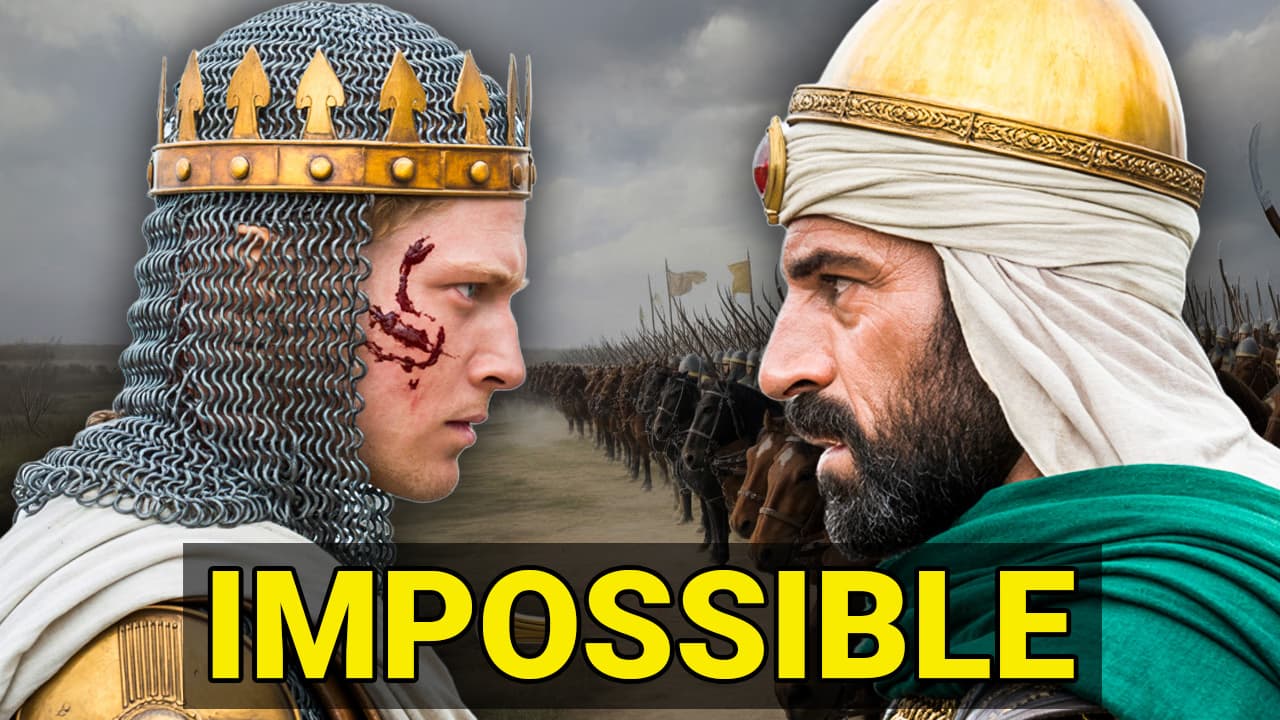
- Known for
- Defeating Saladin at the Battle of Montgisard while suffering from leprosy
- Fatal flaw
- A body that betrayed him. Leprosy stole his strength year by year, and he could not secure the succession before it took the rest

The Story
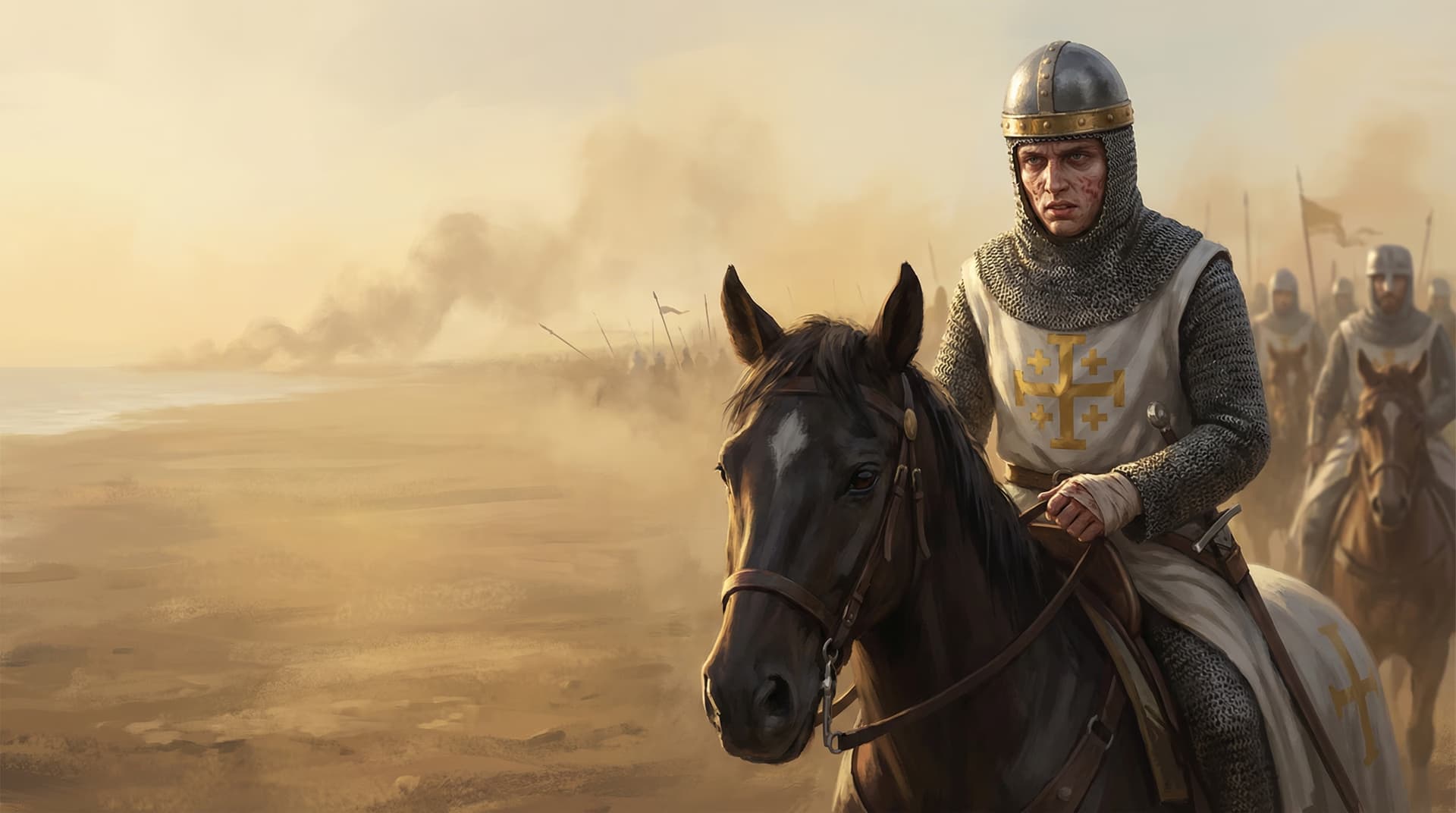
November 25, 1177. A sixteen-year-old king rides out of Ascalon with 375 knights. His right arm is already going numb. His skin is beginning to thicken and crack. He has leprosy, and everyone in the kingdom knows it.
Ahead of him, spread across the plains near Montgisard, Saladin commands twenty-six thousand men. The sultan has split his forces to raid freely across the coastal plain, certain that the Crusader kingdom is too weak and its king too sick to respond. He is wrong.
Baldwin orders the charge. The True Cross is raised. The Templar knights under Odo de St Amand hit first, smashing into Saladin's bodyguard before the sultan can reassemble his scattered army. Baldwin fights from the saddle despite hands that can barely grip a sword. Within hours, Saladin's army is destroyed. The sultan himself flees on a racing camel, escaping into the Sinai with a handful of Mamluk bodyguards. He leaves behind the wreckage of the largest army he has ever assembled.
The boy who won that battle had been diagnosed at nine years old. His tutor, the archbishop William of Tyre, noticed it during a game. The other boys were pinching each other's arms, yelping and laughing. Baldwin felt nothing. William, a learned man, recognized the sign immediately. He wrote later that he wept.
Baldwin was born in 1161, the son of King Amalric I of Jerusalem and Agnes de Courtenay. His parents' marriage had been annulled on grounds of consanguinity before Amalric took the throne, but Baldwin's legitimacy was preserved. When Amalric died in 1174, the boy was crowned king at thirteen. The kingdom he inherited was a narrow strip of coastline surrounded by enemies, held together by fragile truces and feuding nobles. It needed a warrior king in his prime. It got a child whose body was already beginning to eat itself alive.
What it also got was one of the most remarkable rulers of the medieval world. Baldwin was not a figurehead. He governed, he commanded, he made decisions that veteran lords twice his age could not. He understood that the kingdom's survival depended on a balance between diplomatic caution and military decisiveness, and he maintained that balance even as leprosy stripped away his ability to hold a pen, mount a horse, or see the faces of his own court.
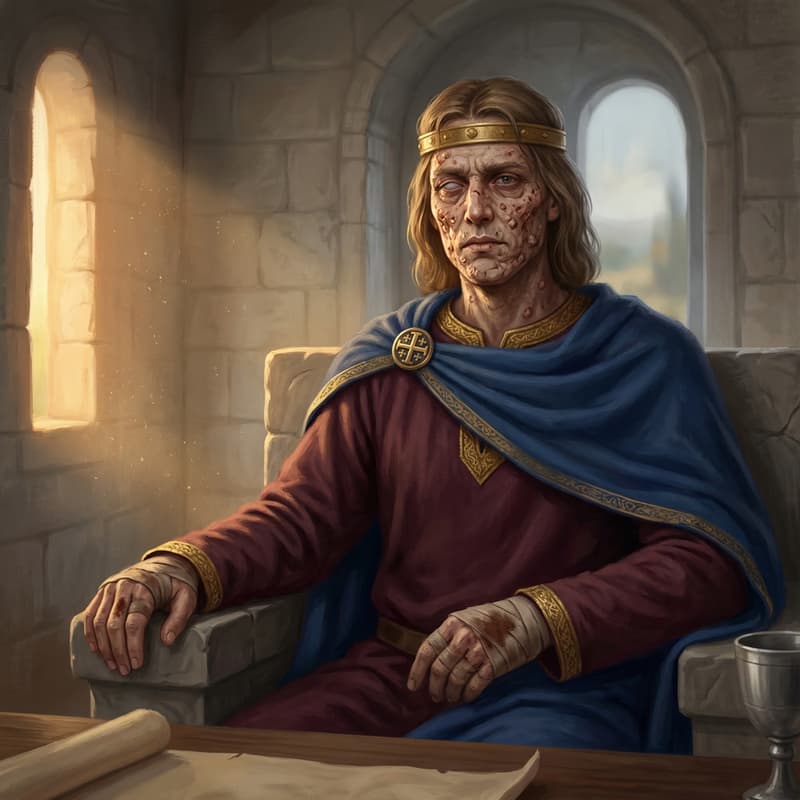
By his late teens, his hands were bandaged stumps. By twenty, he was going blind. By twenty-two, he could no longer walk and had to be carried into council meetings on a litter. He still ruled. When his brother-in-law Guy de Lusignan proved incompetent as regent, Baldwin dragged himself from his sickbed, revoked Guy's authority, and resumed personal command of the kingdom. He was twenty-three, blind, unable to stand, and more effective than any able-bodied man in the realm.
He spent his final years in a desperate race against his own disintegration. He needed to secure the succession before he died, and the only viable heir was his infant nephew, Baldwin V. He crowned the child co-king, appointed Raymond III of Tripoli as regent, and tried to prevent Guy de Lusignan from ever touching the crown again. He failed. Within two years of his death, Guy would be king, and within three, the kingdom would fall.
Baldwin IV died in Jerusalem in the spring of 1185. He was twenty-three years old. His body was ravaged beyond recognition. His hands and feet had rotted away. He was blind, bedridden, and in constant agony. He had held his kingdom together for eleven years through sheer force of will, and the moment that will left the world, everything he had built began to collapse.
Personality & Motivations
Baldwin was not driven by ambition. He had no future and he knew it. What drove him was duty: a grinding, relentless sense of obligation to a kingdom that had no one else capable of holding it together. He could have retreated into comfortable seclusion, let regents govern, and spent his remaining years in the relative mercy of a darkened room. He refused.
There was stubbornness in him that bordered on fury. When Guy de Lusignan bungled a military campaign in 1183, Baldwin rode out in a litter to take personal command, blind and unable to hold a weapon. When his own mother Agnes and sister Sibylla maneuvered to install Guy as his successor, Baldwin fought them with the same tenacity he showed at Montgisard. He was a dying man waging war on two fronts: against Saladin outside the walls and against his own family within them.
He also had a quality rare in medieval monarchs: he inspired genuine loyalty. His knights followed a king they had to carry. His commanders deferred to a man who could not see their faces. William of Tyre, who watched the disease consume his former student year by year, wrote of Baldwin with something close to awe. The leper king earned respect not by hiding his condition but by refusing to let it define him.
What Most People Get Wrong
Most people believe Baldwin IV wore an iron mask to hide his disfigurement. This image comes from Ridley Scott's 2005 film Kingdom of Heaven, where Edward Norton played Baldwin behind a polished silver mask. It is entirely fictional.
No contemporary source mentions Baldwin wearing any kind of face covering. William of Tyre, who knew him personally and described his condition in clinical detail, never references a mask. In the 12th-century Crusader states, leprosy was understood as a disease, not a curse. Leper kings were rare but not unthinkable. Baldwin appeared in public, held court, and rode into battle with his face exposed. The mask is a Hollywood invention that, ironically, undermines the real story. The truth is more striking: a young man with a visibly disintegrating face who refused to hide from the world or from his enemies.
Key Moments
Jerusalem, 1174. Baldwin is crowned King of Jerusalem at thirteen. He is already showing early signs of leprosy: numbness in his right arm, thickening of the skin. The kingdom's barons know what the diagnosis means. They crown him anyway, because the alternatives are worse.
Montgisard, November 25, 1177. The defining battle. Baldwin rides out with 375 knights and several thousand infantry against Saladin's 26,000. The Templars under Odo de St Amand lead the charge. Saladin's army, scattered and overconfident, is annihilated. It is the greatest Crusader victory in a generation, won by a sixteen-year-old leper who had to be helped onto his horse.
Jacob's Ford, August 1179. Baldwin authorizes the construction of a castle at Chastellet, controlling a critical Jordan River crossing. Saladin besieges it before construction is complete and destroys it utterly. Baldwin arrives too late to relieve the garrison. Odo de St Amand is captured. The loss haunts Baldwin. It was one of the few strategic gambles he lost.
Kerak Castle, November 1183. Saladin besieges Kerak during the wedding of Humphrey IV of Toron and Isabella of Jerusalem. Baldwin, now blind, paralyzed, and carried on a litter, personally leads the relief force. Saladin withdraws without battle. It is Baldwin's last military command, and perhaps his most symbolically powerful: a king who cannot walk driving an army away by his presence alone.
Jerusalem, November 1183. Baldwin crowns his five-year-old nephew Baldwin V as co-king, formally bypassing his sister Sibylla and her husband Guy de Lusignan. He appoints Raymond III of Tripoli as regent and Joscelin III of Edessa as the boy's guardian. It is Baldwin's last political act of significance, a desperate attempt to control the succession from beyond the grave.
The Detail History Forgot
When Baldwin was nine and William of Tyre first discovered his leprosy, the archbishop recorded the scene with unusual specificity. The boys were playing a game common among noble children, where they would dig their fingernails into each other's arms and hands, trying to make each other flinch. Baldwin's companions were crying out in pain and laughing. Baldwin felt nothing. His arm showed the marks but registered no sensation.
William wrote that he initially hoped it was simple nerve numbness. He consulted physicians. They confirmed what he feared. The passage in William's chronicle is one of the most human moments in medieval historiography: a teacher realizing that the bright, energetic boy in his care was going to die slowly and horribly, and that nothing in his twenty years of European education had prepared him for this moment. William would spend the next fifteen years watching that boy become a king, win battles, and disintegrate before his eyes.
The Downfall
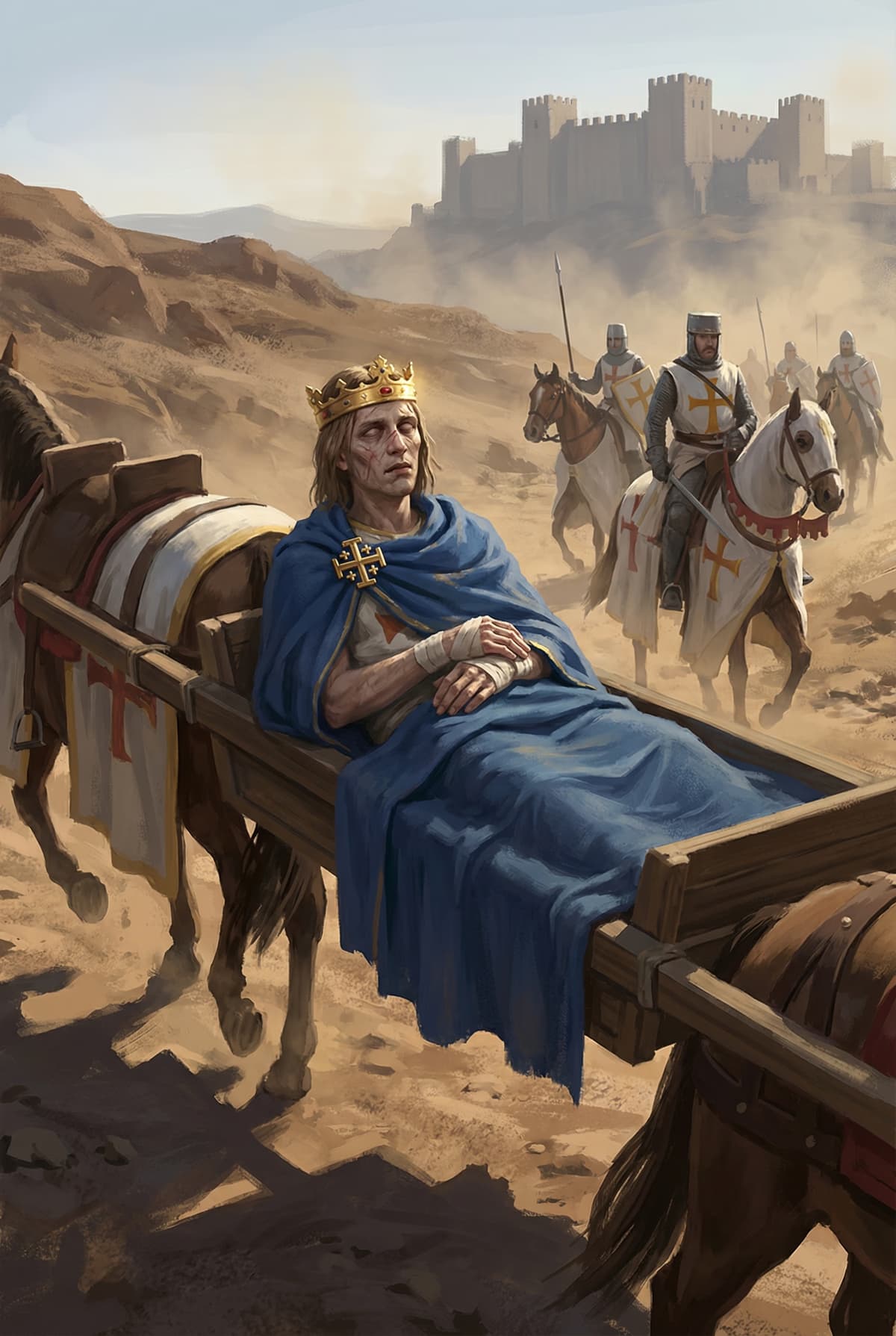
Baldwin's fatal flaw was not a character deficiency. It was biology. Leprosy gave him a ticking clock, and the kingdom's politics ensured that no amount of brilliance could outrun it.
His body failed in stages. First the numbness spread from his right arm through both hands. Then the skin began to break down: lesions, nodules, tissue death. His fingers curled and fused. His eyesight dimmed, then vanished. His feet rotted. By his early twenties, he was a mind trapped in a collapsing body, still sharp, still commanding, but increasingly unable to enforce his will through physical presence.
The political collapse tracked the physical one. Baldwin needed a strong, competent successor. What he had was his sister Sibylla, married to the handsome, empty-headed Guy de Lusignan. Baldwin tried everything to prevent Guy's succession: revoking his regency, crowning the infant Baldwin V, building a coalition of nobles to uphold the arrangement after his death. None of it held. Within months of Baldwin IV's death, his nephew Baldwin V also died. Sibylla seized the crown, placed it on Guy's head herself, and undid everything her brother had spent his dying years building.
Two years later, Guy de Lusignan led the kingdom's army into a trap at the Horns of Hattin. Saladin destroyed it completely. Jerusalem fell in October 1187. The kingdom that Baldwin IV had held together through eleven years of agony was erased in a single afternoon by the man he had tried to keep from power. The leper king had been right about everything. He had just run out of time.
Frequently Asked Questions
No. The silver mask is an invention of the 2005 film Kingdom of Heaven. No contemporary source mentions Baldwin wearing any face covering. William of Tyre, who knew him personally, described his visible disfigurement in detail but never referenced a mask. Baldwin appeared in public with his face uncovered throughout his reign.
About nine years old. His tutor William of Tyre discovered the condition when he noticed that Baldwin felt no pain during a game where boys pinched each other's arms. William consulted physicians who confirmed the diagnosis of leprosy.
Yes. On November 25, 1177, Baldwin led approximately 375 knights and several thousand infantry against Saladin's army of roughly 26,000 near Montgisard. The Crusader charge, led by the Templars, shattered Saladin's scattered forces. Saladin barely escaped on a racing camel. It was one of the most lopsided Crusader victories of the era.
Based on William of Tyre's descriptions, modern medical historians believe Baldwin had lepromatous leprosy, the more severe form. His symptoms (progressive numbness, skin lesions, tissue destruction, loss of extremities, and eventual blindness) are consistent with this diagnosis. The disease progressed relatively quickly, likely accelerated by the physical demands of kingship and warfare.
Baldwin IV died in 1185. His nephew and co-king Baldwin V died the following year at age eight. Baldwin's sister Sibylla then crowned herself queen and her husband Guy de Lusignan king. In 1187, Guy led the Crusader army to catastrophic defeat at the Battle of Hattin. Saladin captured Jerusalem that October, ending 88 years of Crusader control.
Medieval succession law and legitimacy prevented it. Baldwin was the rightful king, and leprosy, while feared, did not legally disqualify a monarch. Additionally, Baldwin proved so effective as a ruler and military commander that replacing him would have been politically destabilizing. The kingdom's barons recognized that a competent leper was preferable to an incompetent replacement.
Partially. The film captures his intelligence, authority, and the tragedy of his condition, but takes significant liberties. Baldwin did not wear a mask. He was not alive during the events surrounding the fall of Jerusalem in 1187; he died two years earlier. His relationship with Balian of Ibelin is largely fictionalized. The real Baldwin was, if anything, more impressive than the film version.
Baldwin IV was buried in the Church of the Holy Sepulchre in Jerusalem, alongside the other kings of Jerusalem. When Saladin captured the city in 1187, he left the Christian tombs undisturbed. The exact location of Baldwin's remains within the church is no longer known.