- Known for
- Writing the definitive chronicle of the Crusader states
- Fatal flaw
- A scholar's faith in reason and institutions in a kingdom where power belonged to whoever grabbed it hardest
The Story
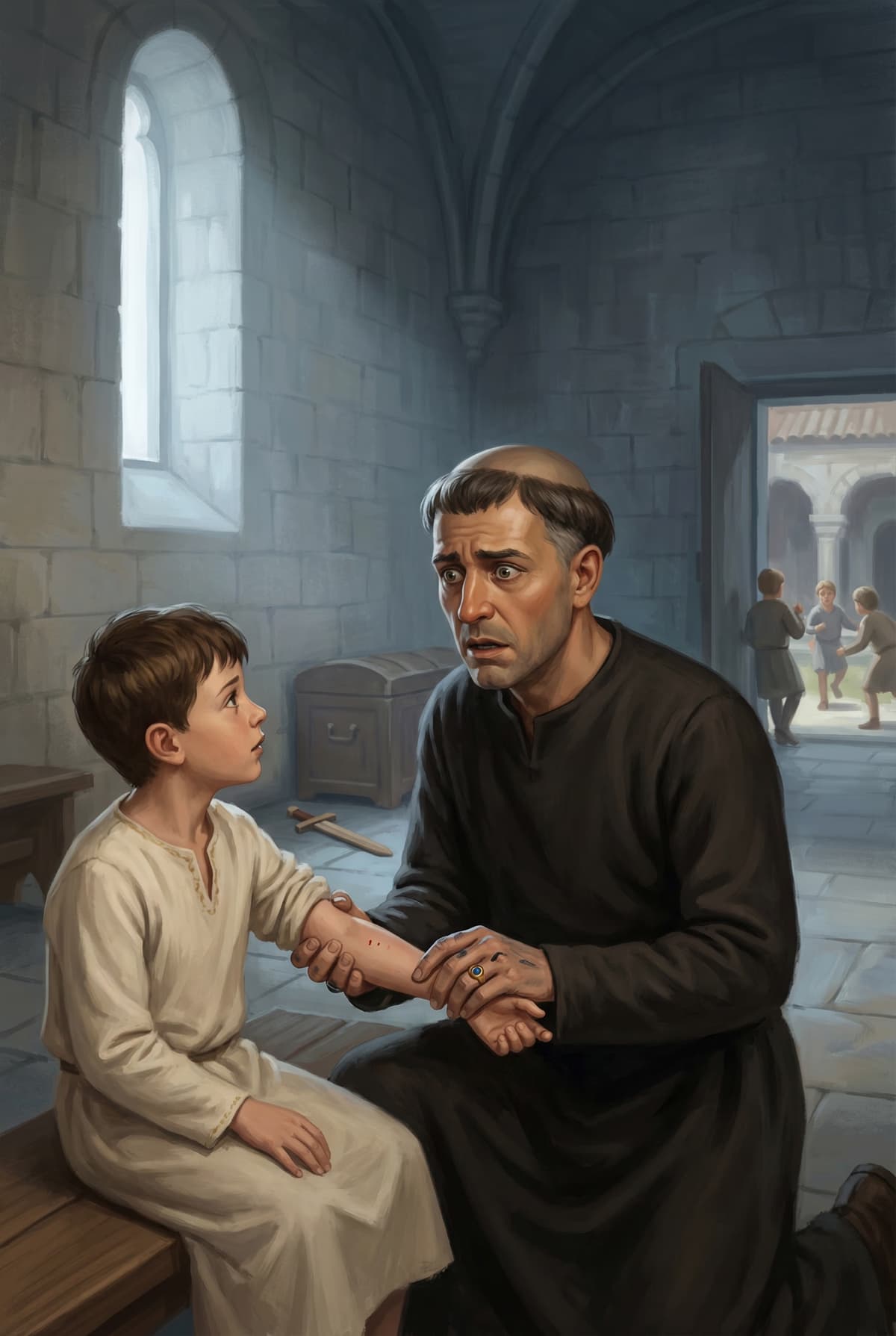
Sometime around 1170, in the royal palace in Jerusalem, a boy is playing with his friends. They are pinching each other's arms, a rough game, seeing who can stand the most pain. The other boys yelp, laugh, pull away. One boy does not react. His tutor, watching from nearby, notices. He walks over, takes the boy's arm, and pinches it himself. The boy looks up, curious. He feels nothing.
The tutor is William, Archbishop of Tyre. The boy is Baldwin, heir to the throne of Jerusalem. The disease is leprosy. William writes later that he wept. He has just diagnosed the future king of Jerusalem with a death sentence, and he will spend the next fifteen years watching that boy reign, fight, and disintegrate, recording everything in the chronicle that will become the single most important document of the Crusader era.
William was born around 1130 in Jerusalem, a child of the Crusader kingdom itself. His parents were European settlers (Franks, as the Muslims called them) who had made the Holy Land their home. He grew up speaking French, Latin, and Arabic in a city where churches stood next to mosques and the call to prayer mixed with cathedral bells.
At roughly twenty, he left for Europe to study. He would not return for nearly two decades. He studied at the finest schools the medieval world had to offer: Paris for theology, Orleans for classical literature, Bologna for law. He earned a degree in liberal arts and another in canon law. He learned to read Greek. He studied history with a systematic rigor that would have impressed scholars in any century.
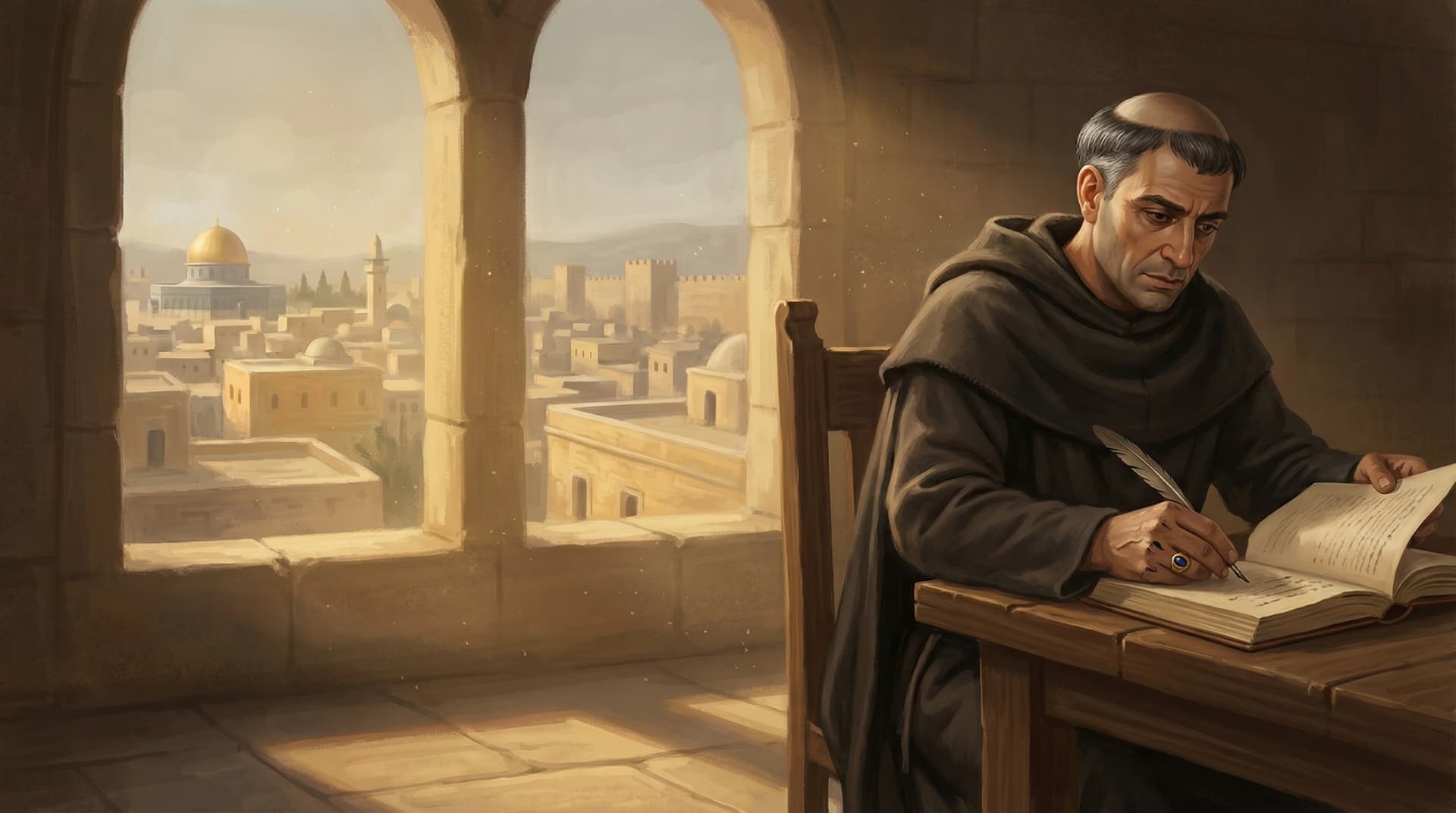
When he returned to the Holy Land around 1165, he was the most educated man in the kingdom. King Amalric I recognized this immediately. Amalric made William his court historian and commissioned him to write two works: a history of the Muslim East (now lost) and a history of the Latin Kingdom of Jerusalem. The second work, the Historia rerum in partibus transmarinis gestarum ("History of Deeds Done Beyond the Sea") would become William's life's work and the most valuable primary source for the entire Crusader period.
Amalric also entrusted William with the education of his son Baldwin. It was William who taught the young prince Latin, history, and statecraft. It was William who discovered the boy's leprosy. And it was William who, when Baldwin was crowned king at thirteen, stood beside the throne knowing what no treatment could prevent.
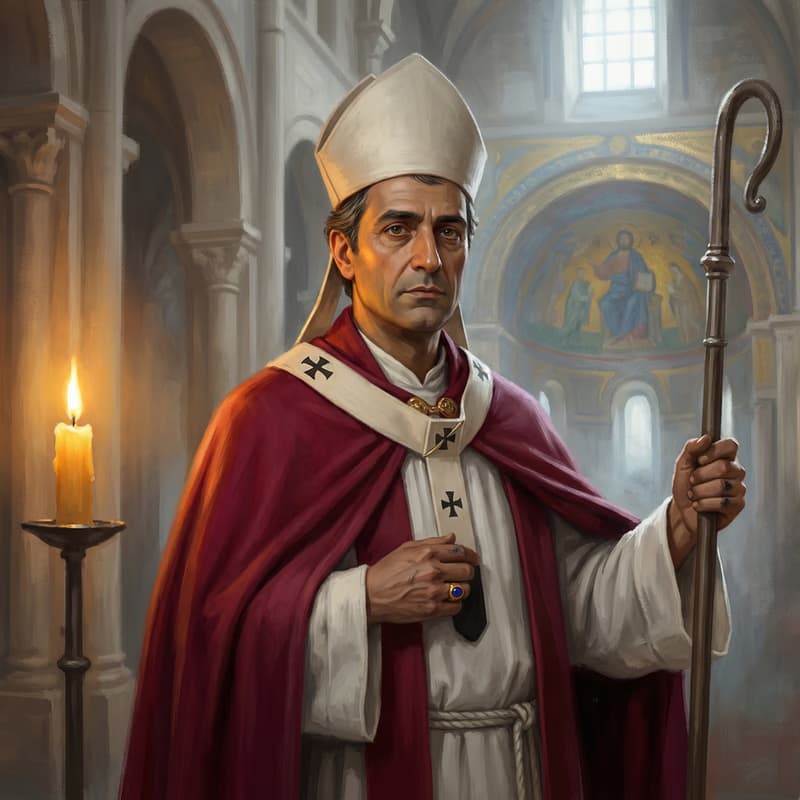
William rose through the church hierarchy. He became Archbishop of Tyre in 1175, the second most powerful churchman in the kingdom. He served as chancellor, effectively the kingdom's chief administrator. He attended the Third Lateran Council in Rome in 1179, representing the Crusader states before the Pope. He was, by any measure, one of the two or three most important figures in the kingdom.
He was also watching everything fall apart. His chronicle covers the years from 1095 to 1184, and its final chapters read like a slow-motion catastrophe. Baldwin IV grows weaker. The factions around the throne grow bolder. Guy de Lusignan marries Sibylla. Raynald of Chatillon raids at will. The truces fray. The Muslim world unifies under Saladin. William records it all with the precision of a man who knows exactly what is coming and cannot prevent it.
His chronicle breaks off abruptly in 1184. Within two years, William was dead.
Personality & Motivations
William was, first and foremost, a historian. Not in the modern academic sense. He was a participant in the events he described, deeply partisan, emotionally invested. But he had a historian's instinct for documentation, for getting the details right, for recording what actually happened rather than what people wished had happened. His chronicle is biased (he hated Raynald of Chatillon, despised the political maneuvering of Agnes de Courtenay, and admired Baldwin IV to the point of near-reverence) but it is honest. He told the reader his biases and let them judge.
He was driven by love for the kingdom. Not just loyalty, but love. He had been born there. He had spent twenty years in Europe and come back. The Crusader states were not an abstraction to him or a temporary military outpost. They were home. His chronicle is, beneath the Latin prose and the careful historical methodology, the story of a man watching his home be destroyed by people too selfish or too stupid to save it.
He was also ambitious, and honest enough to admit it. When the Patriarchate of Jerusalem became vacant in 1180, William expected to be elected. He was the most qualified candidate by a wide margin. Instead, the election went to Heraclius, a man of modest intellect and immodest personal habits, reportedly through the influence of Agnes de Courtenay. William never recovered from the defeat. His chronicle's tone darkens noticeably after 1180, and the portraits of his enemies grow sharper and more bitter.
What Most People Get Wrong
William of Tyre is often treated as a neutral, objective source for Crusader history, a medieval journalist simply recording events. He was nothing of the kind. He was a political actor, deeply embedded in the factional struggles of the kingdom, with strong opinions about who was virtuous and who was destroying everything.
His hatred of Agnes de Courtenay, Baldwin IV's mother, colors nearly every passage she appears in. His contempt for Guy de Lusignan is barely concealed. His portrait of Raynald of Chatillon emphasizes the man's brutality while downplaying his military capability. None of this makes William unreliable. It makes him a sophisticated source who must be read with his biases in mind. The fact that modern historians can identify and account for his biases is itself a testament to his transparency. He wrote well enough that, eight centuries later, we can still tell when he is being fair and when he is settling scores.
Key Moments
Jerusalem, c. 1170. William discovers Baldwin's leprosy during the arm-pinching game. It is the moment that defines the rest of his life. He becomes not just a tutor but a guardian, a political protector, and eventually the chronicler of a king whose reign was a race against biological destruction.
Tyre, 1175. William is consecrated Archbishop of Tyre, one of the most important sees in the Crusader states. The position gives him a seat on the High Court, political authority second only to the Patriarch, and a permanent role in the kingdom's governance. He combines this with his role as chancellor, making him simultaneously a spiritual leader and the head of the royal administration.
Rome, March 1179. William attends the Third Lateran Council, representing the Crusader states. He presents the kingdom's case for Western military aid, a case that is becoming increasingly desperate. He meets Pope Alexander III and participates in conciliar debates on church reform. The trip also brings him into contact with the wider European intellectual world, influencing the later chapters of his chronicle.
Jerusalem, 1180. The Patriarchate of Jerusalem falls vacant. William is the obvious candidate: educated, experienced, respected. The election goes to Heraclius instead, reportedly through the political maneuvering of Agnes de Courtenay and her allies. It is the defining political defeat of William's career and marks the beginning of his marginalization from power.
Jerusalem, 1183–1184. William's chronicle reaches its final chapters. He describes Baldwin IV's last years (blind, paralyzed, carried on a litter) with a tenderness that breaks through his usually measured prose. He records the crowning of the child Baldwin V, the political maneuvering of Guy and Sibylla, the gathering storm of Saladin's power. The chronicle stops mid-sentence in 1184. What interrupted it (illness, despair, death) is unknown.
The Detail History Forgot
William of Tyre did not just write the most important Crusader chronicle. He also wrote a history of the Islamic world, a work called Historia orientalium principum, based on Arabic sources he could read himself. The book is lost. It was known to exist because William references it in his main chronicle, and later writers mention having seen copies. But no manuscript survived the fall of the Crusader states.
The loss is staggering. A 12th-century Christian archbishop, fluent in Arabic, writing a history of the Muslim world from Muslim sources. This would be one of the most remarkable works of medieval historiography if it existed. William was one of the few men in the Crusader states who could read both Latin and Arabic scholarly traditions. His lost work suggests that the intellectual life of the Crusader kingdom was far more sophisticated and cross-cultural than most popular histories acknowledge.
The Downfall
William's downfall was not dramatic. There was no battle, no execution, no public disgrace. There was a lost election, a slow marginalization, and then silence.
The election of Heraclius as Patriarch of Jerusalem in 1180 was the turning point. William had expected the position. He had earned it by every measure the medieval church valued: education, administrative skill, moral authority, years of service. Heraclius had none of these qualifications, but he had the support of Agnes de Courtenay and the court faction that William had spent years opposing. The election was, to William, proof that the kingdom's institutions had been captured by unworthy people.
After 1180, William's influence waned. Baldwin IV grew weaker and less able to protect his old tutor's position. The court factions that William had criticized in his chronicle gained power. Some later sources, written after William's death, suggest he was poisoned, possibly by agents of Heraclius or Agnes. The claim is unverifiable but not implausible. What is certain is that William died around 1186, just a year before the kingdom's destruction at Hattin.
He did not live to see Jerusalem fall. He did not need to. His chronicle's final chapters are already an elegy for a kingdom he knew was dying. The last entries describe political maneuvers he recognized as suicidal, military decisions he knew were catastrophic, and a succession crisis he understood would be fatal. The most educated, most perceptive man in the Crusader states spent his final years writing the autopsy of a patient who was still, technically, alive. The kingdom he chronicled outlived him by one year. His chronicle has outlived the kingdom by eight centuries.
Frequently Asked Questions
William wrote the Historia rerum in partibus transmarinis gestarum ("History of Deeds Done Beyond the Sea"), a 23-book chronicle covering the Crusader states from 1095 to 1184. It is the single most important primary source for the history of the Crusader kingdom of Jerusalem. He also wrote a now-lost history of the Muslim world based on Arabic sources.
William noticed that the young Baldwin felt no pain during a game where boys were pinching each other's arms. While the other children cried out, Baldwin showed no reaction. William recognized the loss of sensation as a symptom of leprosy and had physicians confirm the diagnosis. Baldwin was approximately nine years old at the time.
He was reliable but not neutral. William was deeply embedded in the political factions of the Crusader kingdom and had strong opinions about the people he described. His biases are identifiable: he favored Baldwin IV, disliked Agnes de Courtenay, and despised Raynald of Chatillon. But his chronicle is detailed, specific, and transparent about its perspective, making it invaluable to modern historians even when his judgments are partisan.
The election of 1180 went to Heraclius instead, reportedly through the political influence of Agnes de Courtenay and her court faction. William had antagonized Agnes in his chronicle and in court politics. Heraclius was less qualified but had the right political connections. The loss embittered William and marked the beginning of his political decline.
William died around 1186, but the exact circumstances are unknown. Some later sources suggest he was poisoned, possibly by agents connected to Patriarch Heraclius or Agnes de Courtenay. The claim cannot be verified. His chronicle breaks off in 1184, suggesting illness or other disruption in his final years.
Yes. William was one of the few Crusader intellectuals who could read Arabic. He wrote a history of the Islamic world based on Arabic sources, though this work is now lost. His linguistic abilities (he also knew Latin, French, and Greek) made him unusually well-equipped to understand both sides of the Crusader conflict.
The reason is unknown. The chronicle breaks off abruptly, possibly mid-composition. Possible explanations include William's declining health, his political marginalization after the 1180 patriarchal election, or the simple pressure of events as the kingdom spiraled toward crisis. William died around 1186, so the break may reflect the onset of his final illness.