
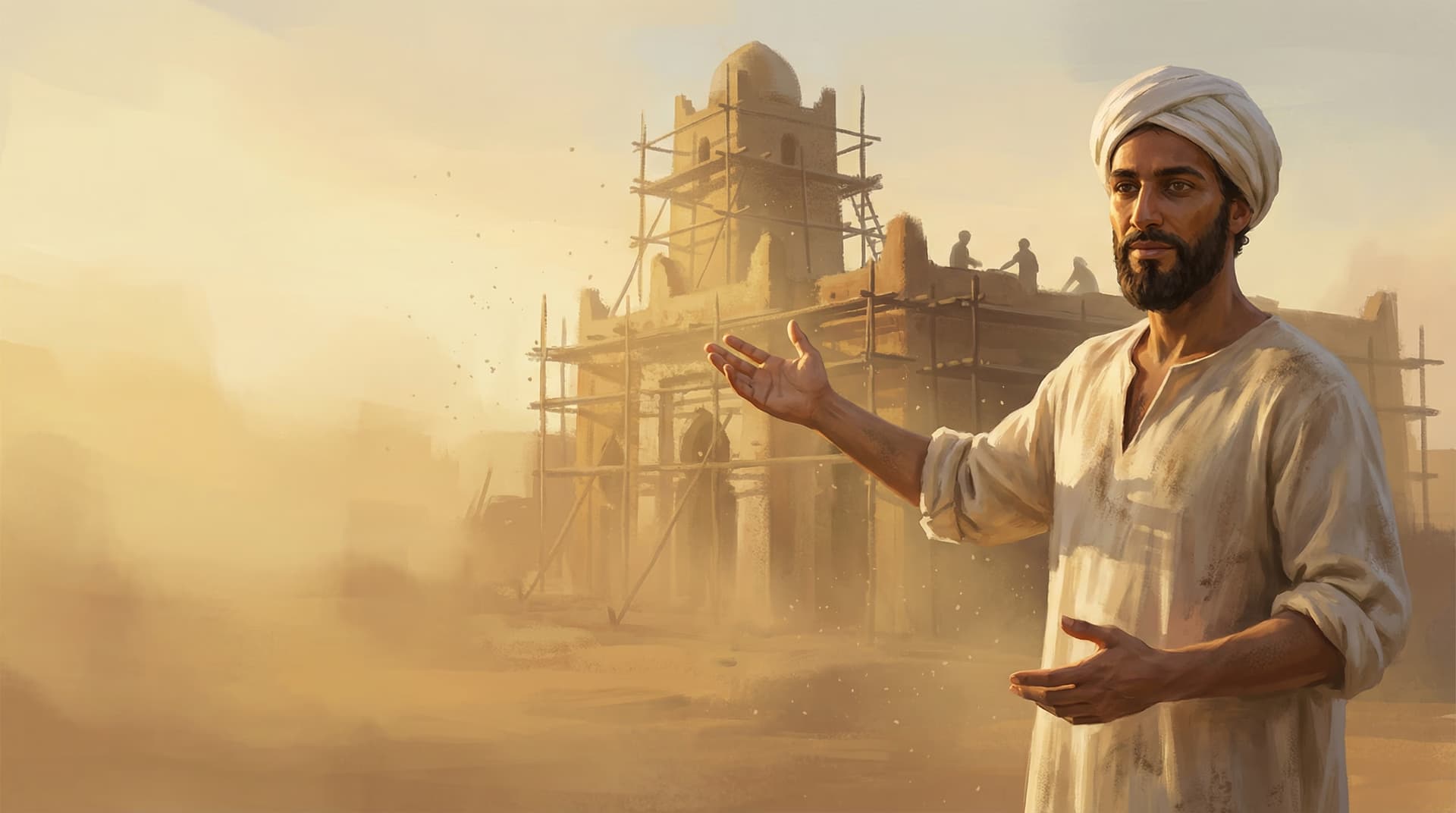
- Known for
- Designing the Djinguereber Mosque in Timbuktu for Mansa Musa
- Fatal flaw
- A talent so thoroughly absorbed into another man's vision that his own legacy became inseparable from, and subordinate to, his patron's
The Story
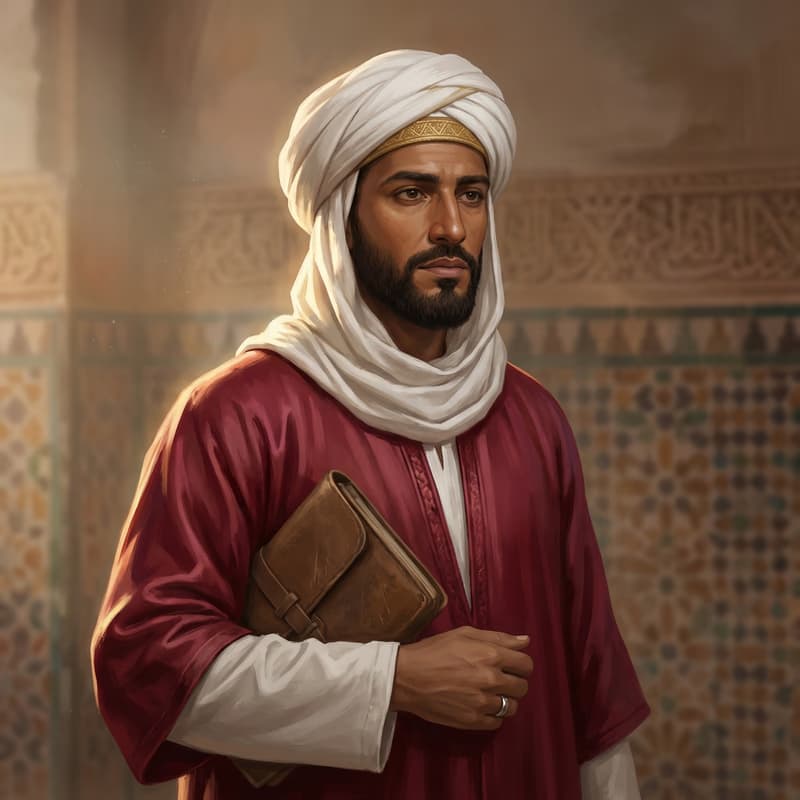
In 1324, a poet from Granada met an emperor from Mali on the road to Mecca. The poet's name was Abu Ishaq Ibrahim al-Sahili, known also as al-Tuwayjin. He was an educated man from an educated family, his father the head of the perfume guild of Granada, trained in jurisprudence. Al-Sahili himself had gained a reputation in al-Andalus as a man of letters and an eloquent poet. He had left the Emirate of Granada around 1321 and traveled east through Mamluk Egypt, Syria, Iraq, and Yemen before arriving at the hajj.
The emperor was Mansa Musa, and he was impossible to miss. A caravan of 60,000 people, 80 camels loaded with gold dust, and 12,000 slaves in silk. Musa enjoyed al-Sahili's conversation, his learning, his poetry. When the hajj ended and the emperor turned toward home, he invited the Andalusi to come with him. Al-Sahili accepted. It was the decision that would define both their legacies.
In Mali, Musa put al-Sahili to work. The architect, or perhaps more accurately the design consultant, directed the construction of a royal audience chamber in the imperial capital. Musa paid him 12,000 mithqals of gold for this work, roughly 51 kilograms, and on one occasion gave him an additional 4,000 mithqals in a single day. The design reportedly echoed the Alhambra in Granada, bringing Iberian Islamic aesthetics to the banks of the Niger River.
But it was Timbuktu that made al-Sahili immortal. He is traditionally credited with designing the Djinguereber Mosque, built between 1325 and 1327, the structure that anchored Musa's transformation of Timbuktu from a trading post into a center of Islamic learning. The mosque still stands today, nearly seven centuries later.
Personality & Motivations
Al-Sahili was, by every surviving account, a man of deep learning and personal charm. Musa did not hire him for his architectural credentials, which were uncertain at best. He hired him because al-Sahili was brilliant company. The decision to follow an African emperor from Mecca to a kingdom most people in al-Andalus had never heard of suggests a man with considerable intellectual curiosity and relatively little attachment to convention.
He was also pragmatic. Granada in the early 14th century was the last Muslim emirate on the Iberian Peninsula, surrounded on all sides by Christian kingdoms that would eventually devour it. The Islamic world's center of gravity had shifted east and south. A poet with ambition needed patronage, and Musa offered patronage on a scale that no ruler in shrinking al-Andalus could match. Al-Sahili traded the fading courts of Iberia for the wealthiest empire in West Africa. It was, by any measure, a shrewd calculation.
What Most People Get Wrong
The popular narrative credits al-Sahili with "inventing" the Sudanese architectural style, the distinctive mud-brick construction with protruding wooden beams (toron) that defines the great mosques of West Africa. This claim, originally made by the French colonial historian Maurice Delafosse, has been largely rejected by modern scholars.
The architectural style of the Djinguereber Mosque and similar structures derives primarily from existing mosque designs in the Sahara and from traditional West African building techniques that predated al-Sahili's arrival by centuries. Al-Sahili may have introduced certain decorative or structural elements inspired by Maghrebi and Andalusi architecture, but the fundamental building methods were local. The colonial narrative of a foreign architect bringing civilization to Africa has been replaced by a more nuanced understanding: al-Sahili was one contributor to a building tradition that was already sophisticated.
Key Moments
Granada, c. 1290. Al-Sahili is born into the scholarly elite of the Emirate of Granada, the last Muslim state in Iberia. His father, Muhammad, is trained in jurisprudence and heads the perfume guild. The young al-Sahili grows up in a culture of poetry, Islamic law, and Andalusi refinement, a world shaped by the Alhambra's courtyards and the libraries of Cordoba's fading memory.
The Journey East, c. 1321. Al-Sahili leaves al-Andalus and travels through the Islamic world, visiting Mamluk Egypt, Syria, Iraq, and Yemen. The journey is a kind of scholarly grand tour, common among educated Muslims of the era. He is building a reputation, collecting knowledge, and networking with the intellectual establishment of the wider Islamic world.
Mecca, 1324. Al-Sahili encounters Mansa Musa during the hajj. The African emperor, fresh from crashing Egypt's gold market, is the most talked-about pilgrim in a generation. Al-Sahili's learning and eloquence attract Musa's attention. The two men develop a rapport, and Musa invites the poet to return with him to Mali. Al-Sahili agrees, joining a caravan of scholars, architects, and holy men that Musa is recruiting for his kingdom.
Mali, c. 1325-1327. Al-Sahili directs the construction of a royal audience chamber and, traditionally, the Djinguereber Mosque in Timbuktu. The audience chamber reportedly incorporated design elements reminiscent of the Alhambra. The mosque, built of limestone, earth, and wood, becomes the centerpiece of Musa's intellectual capital. Musa pays al-Sahili staggering sums, cementing his position as one of the best-compensated architects in the medieval world.
Timbuktu, October 15, 1346. Al-Sahili dies in Timbuktu and is buried in the city he helped shape. When Ibn Battuta visits Timbuktu seven years later, in 1353, he notes al-Sahili's grave. The Andalusi poet who left Granada for Mecca and ended up in West Africa never returned to Iberia.
The Detail History Forgot
The total payment al-Sahili received from Musa, at least 12,000 mithqals (51 kg) of gold plus the 4,000-mithqal gift, was extraordinary by any standard. For context, the entire annual revenue of the Kingdom of England under Edward II was roughly 30,000 pounds sterling. Al-Sahili's single commission from Musa rivaled what European monarchs spent on major building projects. A poet from a declining emirate had stumbled into the wealthiest court on earth and been paid accordingly. The Djinguereber Mosque was built not just with mud and limestone but with the kind of budget that makes architecture immortal.
The Downfall
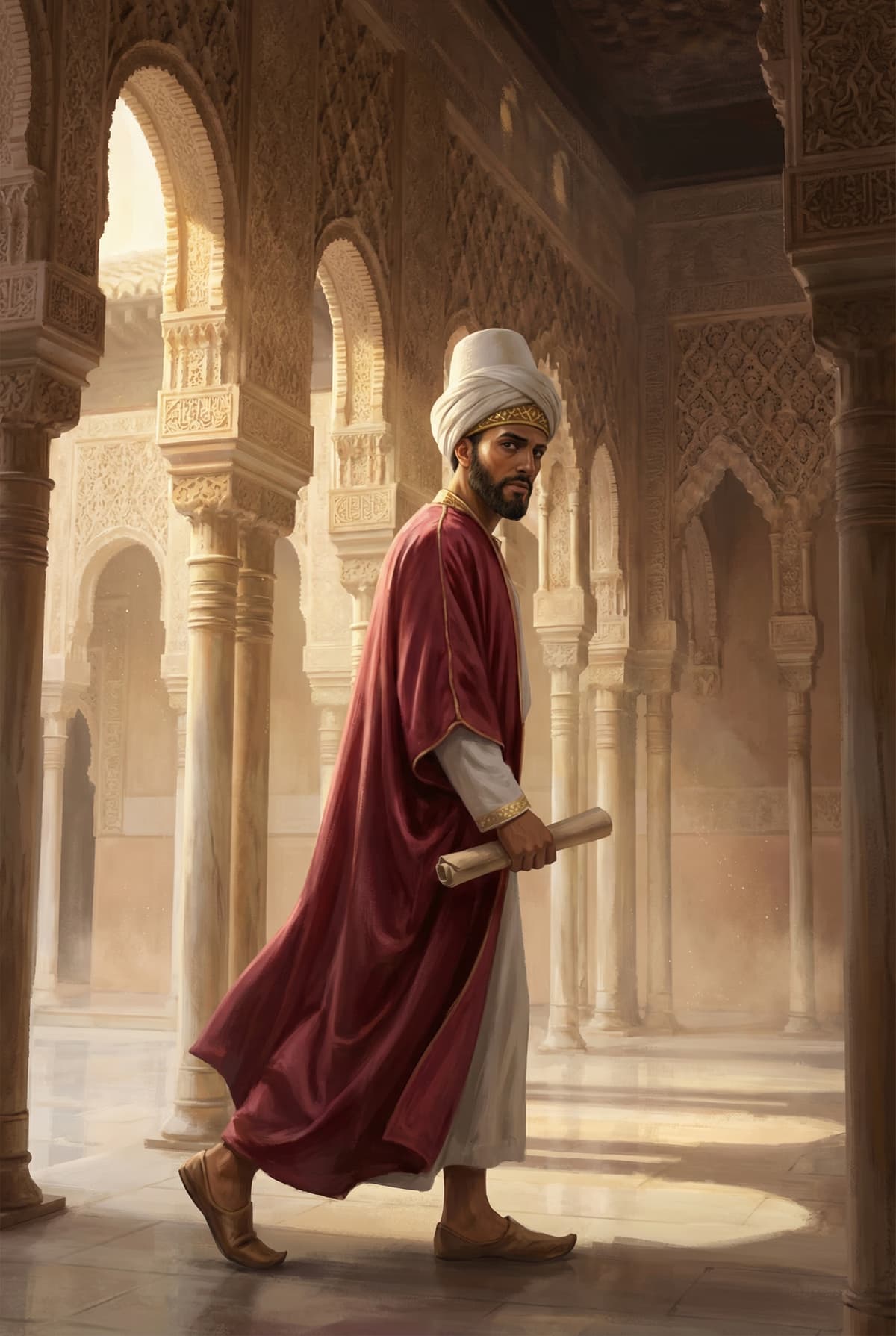
Al-Sahili's story does not end with a dramatic downfall. He died in Timbuktu in 1346, nine years after Musa's death, apparently of natural causes. But the question that haunts his legacy is a quieter one: how much of what he is credited with did he actually do?
Modern scholarship has steadily eroded the colonial-era narrative that al-Sahili was the genius architect who brought sophisticated building techniques to West Africa. The mud-brick and toron construction that defines Timbuktu's mosques existed before he arrived. The Djinguereber Mosque's fundamental design draws more from Saharan and West African traditions than from Andalusi or Maghrebi models. Al-Sahili may have been more of a coordinator and aesthetic consultant than a transformative architect.
This does not diminish his importance. Musa clearly valued him enormously, both as a companion and as a symbol of the connection between Mali and the wider Islamic world. Al-Sahili's presence in Timbuktu signaled that the city was not a provincial outpost but a legitimate center of Islamic culture, worthy of attracting talent from the most refined corners of the Muslim world. But the buildings he is famous for may owe less to his blueprints than to the traditions of the masons who actually raised the walls. Al-Sahili's legacy, like the mosque itself, rests on foundations that were already there.
Frequently Asked Questions
Abu Ishaq Ibrahim al-Sahili (c. 1290-1346) was an Andalusi poet, scholar, and architect from the Emirate of Granada. He met Mansa Musa during the 1324 hajj to Mecca and returned with him to Mali, where he is traditionally credited with designing the Djinguereber Mosque in Timbuktu and a royal audience chamber in the Malian capital.
He is traditionally credited with the design, but modern scholars have challenged this narrative. The mosque's fundamental architectural style derives from existing Saharan and West African building traditions, not from Andalusi or Maghrebi models. Al-Sahili may have contributed certain design elements or served as a coordinator, but the "foreign architect civilizes Africa" narrative has been largely rejected.
Musa paid al-Sahili at least 12,000 mithqals (approximately 51 kilograms) of gold for the construction of the royal audience chamber, and gave him an additional 4,000 mithqals in a single day on another occasion. These sums were extraordinary by medieval standards and reflect both al-Sahili's perceived value and Musa's legendary generosity.
Al-Sahili was born in the Emirate of Granada, the last Muslim state on the Iberian Peninsula (modern-day Spain). His father was trained in jurisprudence and headed the perfume guild of Granada. Al-Sahili left al-Andalus around 1321 and traveled through Egypt, Syria, Iraq, and Yemen before meeting Musa at the hajj.
Al-Sahili was drawn by Musa's extraordinary patronage and the intellectual opportunities in a growing empire. Granada in the early 14th century was a shrinking Muslim emirate under pressure from Christian kingdoms. Mali, by contrast, was at its peak, with vast wealth and an emperor actively recruiting scholars from across the Islamic world.
Yes. The Djinguereber Mosque still stands in Timbuktu, nearly seven centuries after its construction. It remains an active place of worship and is a UNESCO World Heritage Site. The mosque requires regular maintenance due to its mud-brick construction, with the community performing annual repairs during the dry season.
Al-Sahili died on October 15, 1346, in Timbuktu. The cause of death is not recorded. He was buried in the city, and his grave was noted by the traveler Ibn Battuta when he visited Timbuktu in 1353. Al-Sahili never returned to his native Granada.
The audience chamber al-Sahili built for Musa reportedly resembled the Alhambra in Granada, featuring plastered walls, decorative elements, and design principles from Iberian Islamic architecture. However, this Andalusi influence was blended with local building methods, and the extent of al-Sahili's architectural innovation versus his use of existing West African techniques remains debated.
Al-Sahili grew up in Granada, home of the Alhambra palace, and the audience chamber he designed for Musa reportedly incorporated stylistic elements from Andalusi architecture. This connection gave rise to the idea that al-Sahili imported a sophisticated foreign building style to West Africa, though modern scholars emphasize that local architectural traditions were already well-developed.
Yes. When Ibn Battuta visited Timbuktu in 1353, seven years after al-Sahili's death, he noted al-Sahili's grave. This confirms that al-Sahili was a recognized figure in Timbuktu's cultural life, important enough for a foreign traveler to remark upon his burial site decades after his death.