- Known for
- Refusing the regency of Jerusalem and his connection to the Holy Grail legend
- Fatal flaw
- An ambition that demanded territory, not responsibility. He wanted the rewards of kingship without the obligation of saving a kingdom that needed him
The Story
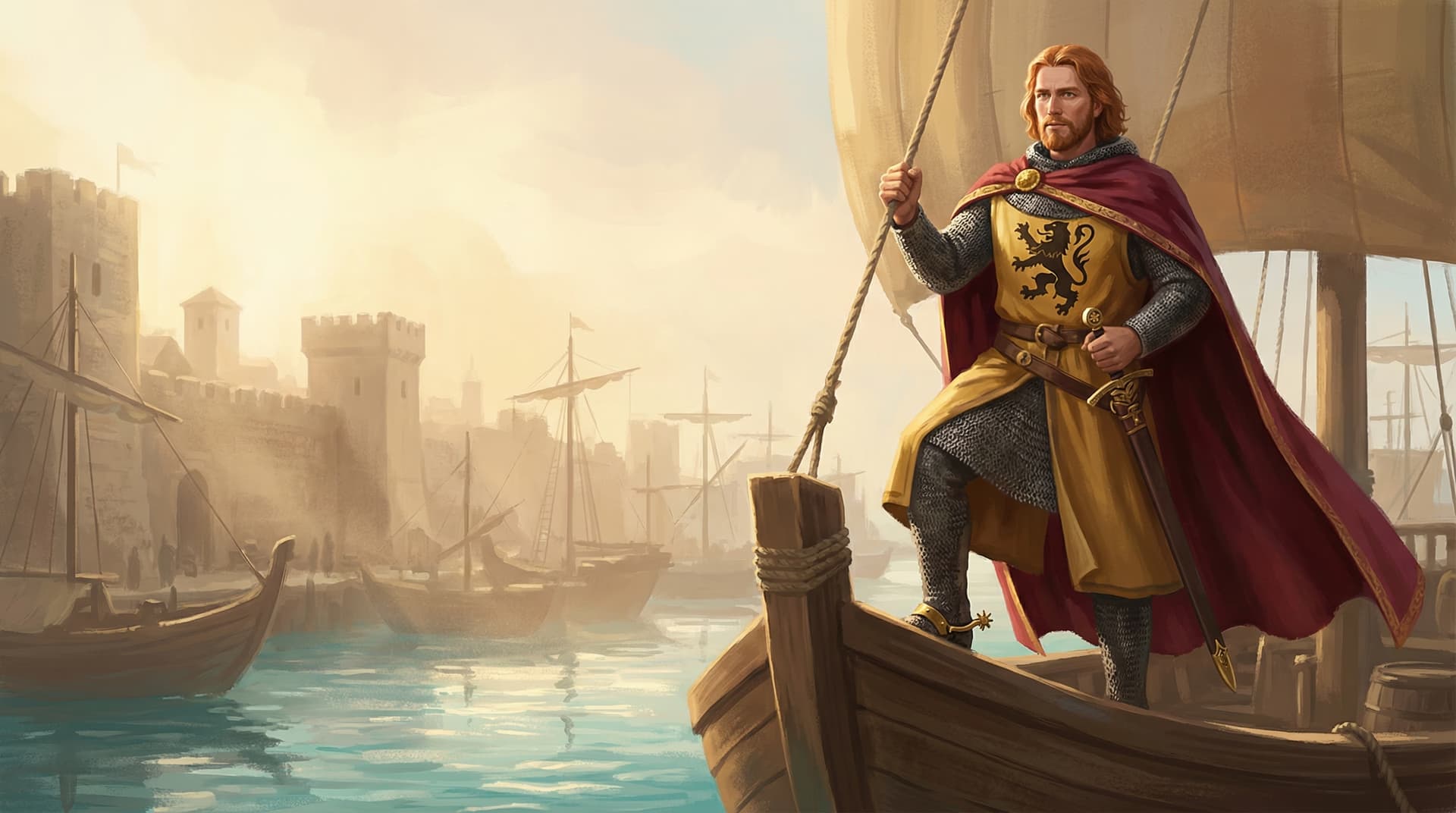
August 1177. A fleet carrying one of the most powerful men in Europe drops anchor in the port of Acre. Philip of Alsace, Count of Flanders, has arrived in the Holy Land. He commands wealth that dwarfs most Crusader lords combined. Flanders is the textile capital of Europe, its cities fat with trade money, its count richer than many kings. Philip has brought knights, money, and the expectation that the Crusader kingdom will reward his presence accordingly.
The kingdom is desperate. Baldwin IV is sixteen, already showing the unmistakable signs of leprosy. He needs a regent, someone to command the army, manage the barons, and hold the kingdom together while the boy-king's body fails. The High Court offers Philip the regency. It is, by any reasonable measure, the most important military and political position in Christendom.
Philip refuses.
Not because he lacks ambition. Philip of Alsace has ambition to burn. He refuses because the regency comes with obligations and no territory. Philip wants land. Specifically, he proposes a joint campaign to conquer Egypt, with himself as the new ruler of whatever territories are seized. The kingdom's barons, who need a defender not a conqueror, are appalled. The negotiations collapse. Philip takes his knights north to campaign in Syria with Raymond III of Tripoli instead.
While Philip besieges fortresses in the north, Saladin invades the south. Baldwin IV, with no regent and no Flemish reinforcements, rides out of Ascalon with 375 knights and wins the Battle of Montgisard without Philip's help. The count who could have commanded the Crusader army at its greatest victory was a hundred miles away, besieging a castle that did not matter.
Philip was born in 1143, the eldest son of Thierry of Alsace, Count of Flanders. His father was a Crusade veteran four times over. Thierry made more pilgrimages to the Holy Land than any other European lord of his generation. The family's connection to the Crusader states was deep and personal. Thierry's wife, Sibylla of Anjou, was the daughter of King Fulk of Jerusalem. Philip grew up hearing stories of the Holy Land from a father who had bled for it.
He inherited Flanders in 1168 at age twenty-five. The county was one of the wealthiest territories in Europe. Its cloth trade generated enormous revenue. Its cities (Ghent, Bruges, Ypres) were among the largest and most prosperous in the West. Philip ruled them with energy and political cunning, expanding Flemish influence through marriage alliances, military threats, and careful manipulation of his feudal relationships with the kings of France and England.
He was not a simple man. He patronized literature and the arts. The poet Chretien de Troyes dedicated Perceval, the Story of the Grail to Philip, the first work in which the Holy Grail appears as a literary object. Whether Philip commissioned the work or Chretien sought his patronage is debated, but the dedication connects Philip permanently to one of the most enduring legends in Western literature.
His pilgrimage to the Holy Land in 1177 was driven by a mix of genuine piety, family tradition, and political calculation. He was following his father's path. He was also escaping troubles at home. His first wife, Elisabeth of Vermandois, had been accused of adultery, and Philip had responded by having her alleged lover beaten to death. A pilgrimage was, among other things, a useful way to change the subject.
After the debacle of the refused regency, Philip campaigned in the north for several months, accomplished little of strategic value, and returned to Europe in 1178. He had spent enormous sums, achieved nothing lasting, and missed the battle that defined the era. The kingdom that had offered him its highest office continued to crumble without him.
He would return to the East one more time, fourteen years later, on the Third Crusade.
Personality & Motivations
Philip was a man who wanted to be great but could not accept the terms greatness demanded. He had the wealth, the military capability, and the political standing to play a decisive role in the Crusader states. What he lacked was the willingness to subordinate his personal ambition to someone else's kingdom.
The refused regency reveals the core of his character. A man motivated by duty (a Baldwin IV, an Odo de St Amand) would have accepted the position and its burdens. A man motivated purely by land-hunger would have joined Raynald in raiding caravans. Philip was somewhere in between: ambitious enough to want a crown, proud enough to refuse a regency, and calculating enough to know that campaigning in Syria was safer than fighting Saladin in the south.
He was also genuinely pious, within the parameters of 12th-century aristocratic piety. His father's four pilgrimages were acts of devotion as much as adventure. Philip's own pilgrimage included substantial donations to the Holy Sepulchre and other churches. But his piety did not extend to self-sacrifice. He would fight for the Cross. He would not die for someone else's kingdom when he had a perfectly good county of his own waiting at home.
What Most People Get Wrong
Philip of Alsace is often listed as one of the Crusader commanders present at the Battle of Montgisard. He was not. When Baldwin IV rode out of Ascalon to face Saladin's 26,000 men in November 1177, Philip was over a hundred miles north, campaigning in Syria with Raymond III of Tripoli. He had taken his knights, desperately needed in the south, on a strategically inconsequential northern campaign.
This absence is critical to understanding both Philip and the Battle of Montgisard. Baldwin won with 375 knights because that was all he had. If Philip's Flemish contingent had been available, the Crusader force would have been significantly larger and the battle less desperate. Philip's refusal of the regency and his subsequent departure for the north forced Baldwin to fight the most consequential battle of his reign without the reinforcements that were supposed to save him.
Key Moments
Flanders, 1168. Philip inherits the county at twenty-five upon his father Thierry's retirement to a monastery. He becomes one of the most powerful feudal lords in Western Europe, commanding wealth from the Flemish cloth trade that rivals the treasuries of kings. He immediately begins expanding Flemish influence through aggressive diplomacy and military posturing.
Acre, August 1177. Philip arrives in the Holy Land with a substantial military force. The Kingdom of Jerusalem, desperate for leadership during Baldwin IV's declining health, offers him the regency. Philip refuses, demanding territorial concessions, specifically proposing a joint conquest of Egypt with himself as ruler of captured lands. The negotiations fail, and Philip takes his forces north.
Northern Syria, Autumn 1177. While Baldwin IV fights and wins at Montgisard, Philip campaigns with Raymond III of Tripoli against Muslim positions in northern Syria. The campaign produces no significant results. Philip's Flemish knights, who could have tipped the balance at Montgisard, are wasted on minor sieges far from the decisive action.
Flanders, c. 1181–1190. Back in Europe, Philip navigates the complex feudal politics between the kings of France and England. He becomes embroiled in disputes over Vermandois after his first wife's death. Meanwhile, Chretien de Troyes dedicates Perceval, the Story of the Grail to him, the first appearance of the Grail in European literature. Whether Philip inspired the story or merely funded the poet remains debated.
Acre, 1191. Philip returns to the Holy Land on the Third Crusade, joining the massive siege of Acre alongside Philip II Augustus of France and, eventually, Richard the Lionheart. The siege camp is a pestilential nightmare. Disease kills more Crusaders than Muslim arrows. Philip of Alsace contracts an epidemic illness, probably dysentery or typhoid, during the siege.
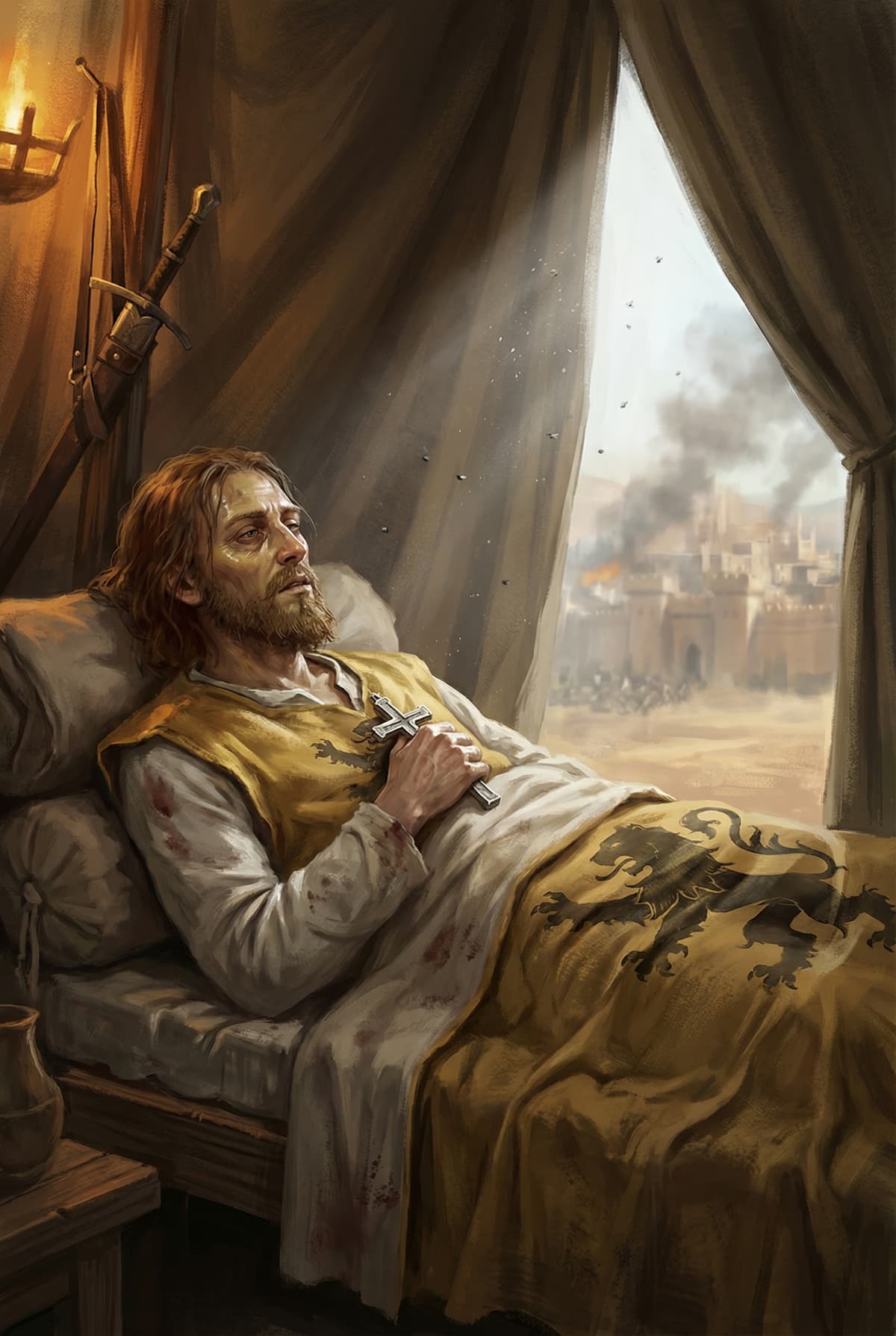
Outside Acre, June 1, 1191. Philip of Alsace dies of disease in the Crusader camp, weeks before Acre finally falls to the Crusaders. He is forty-eight years old. He dies without legitimate heirs, triggering a succession crisis in Flanders that Philip II of France will exploit to absorb Flemish territory. The count who refused a kingdom loses his own county from beyond the grave.
The Detail History Forgot
Chretien de Troyes's dedication of Perceval, the Story of the Grail to Philip of Alsace is one of the most consequential moments in literary history. The poem, written around 1180, is the first text to feature the Holy Grail, a mysterious object carried in a procession that Perceval witnesses but fails to ask about, triggering years of wandering and suffering.
Chretien died before finishing the poem. The Grail's nature is never explained in his text. Later writers turned it into the cup from the Last Supper, the vessel that caught Christ's blood, and eventually a cornerstone of Western mythology. But it started as a dedication to a Flemish count who had just returned from a failed pilgrimage to Jerusalem. Whether Philip brought back a story from the East that inspired Chretien, or whether the poet used Philip's crusading reputation as a frame for an independent invention, is one of medieval literature's great unsolved questions. Either way, the man who refused the regency of Jerusalem became, through Chretien's dedication, permanently woven into the most famous quest narrative in European culture.
The Downfall
Philip's story does not have the dramatic arc of a Baldwin or a Raynald. His downfall was not a single catastrophic moment but a slow accumulation of missed opportunities and declining relevance.
After returning from the Holy Land in 1178, he spent the next twelve years as a powerful but increasingly embattled European lord. His first wife Elisabeth died in 1183. He married Matilda of Portugal, but the marriage produced no surviving children. Without an heir, the vast wealth and political power of Flanders had no future beyond Philip's own lifetime. The county that had made him one of the most important men in Europe became a prize for others to fight over after his death.
When the Third Crusade was proclaimed following Saladin's capture of Jerusalem in 1187, Philip took the cross again. This time he would not refuse the fight. He joined the siege of Acre in 1190, where the combined armies of Christendom battered at the walls of a single city for two years while disease ravaged the camp. Philip had survived battles, political crises, and the intrigues of two royal courts. He could not survive the filth of a siege camp in the Levantine summer.
He died on June 1, 1191, of epidemic disease, likely dysentery or typhoid. He was forty-eight. Acre fell five weeks later. Philip II of France, who had been waiting for exactly this moment, moved to absorb Flemish territory through his claim to the Vermandois inheritance. The county that Philip had spent his life building and protecting was dismembered within a generation. He had crossed the sea twice to fight for the Holy Land. The first time, he refused the chance to save it. The second time, it killed him.
Frequently Asked Questions
Philip wanted territorial gains, not administrative responsibility. He proposed a joint conquest of Egypt with himself as ruler of the captured territories. The Kingdom of Jerusalem needed a regent to manage existing crises, not a new war of conquest. The negotiations failed, and Philip campaigned in northern Syria instead, far from the decisive battles in the south.
No. Despite sometimes being listed among the Crusader commanders, Philip was campaigning in northern Syria with Raymond III of Tripoli when Baldwin IV fought and won at Montgisard on November 25, 1177. His absence meant Baldwin had to face Saladin's 26,000 men without the significant Flemish military contingent.
The poet Chretien de Troyes dedicated Perceval, the Story of the Grail to Philip of Alsace around 1180. This unfinished poem is the first literary work to feature the Holy Grail. Whether Philip inspired the Grail story through tales from his pilgrimage or simply patronized the poet is unknown, but the dedication permanently connects him to the Grail legend.
Philip died on June 1, 1191, of disease, likely dysentery or typhoid, during the siege of Acre in the Third Crusade. Disease was rampant in the Crusader siege camp, killing more soldiers than combat. Acre fell to the Crusaders five weeks after Philip's death.
Philip died without legitimate heirs, triggering a succession crisis. Philip II of France exploited his claim to the Vermandois inheritance (from Philip of Alsace's first wife) to absorb significant Flemish territory. The county was eventually inherited by Philip's sister Margaret and her husband Baldwin VIII of Hainaut, but Flemish independence was permanently diminished.
Extremely wealthy. Flanders was the textile manufacturing center of medieval Europe, and its cities (Ghent, Bruges, Ypres) generated enormous revenue from the cloth trade. Philip's wealth allowed him to maintain a large military household, patronize literature and the arts, and finance two Crusading expeditions. His wealth was comparable to that of many European kings.
Thierry of Alsace made four pilgrimages to the Holy Land, in 1138, 1147 (the Second Crusade), 1157, and 1164. This is an extraordinary record. No other European lord of his era came close. Thierry's repeated journeys established the family's deep connection to the Crusader states and influenced Philip's own decision to take the cross.