
A man kneels in the sand, arrow shafts jutting from his chest, blood filling his mouth. Behind him, seventy-two bodies. In front of him, an army of thousands who will not remember his name in a week. But thirteen hundred years from now, entire nations will still be weeping for the way he dies.
Forty-eight years before this man bled into the sand, the Prophet Muhammad died -- and left behind a question that would split a faith in half.
The Grandson's Burden
He left no clear successor. One faction believed leadership should pass to the most capable man among his companions. Another believed it belonged to his bloodline -- specifically to Ali ibn Abi Talib, his cousin, his son-in-law, the father of his grandchildren. The first faction won. Abu Bakr became caliph. Then Umar. Then Uthman. Ali finally took power as the fourth caliph in 656, but by then the damage was done. He was murdered five years later, and the caliphate passed to a man named Muawiyah -- a shrewd political operator who moved the capital to Damascus and built something the Prophet never intended: a dynasty.
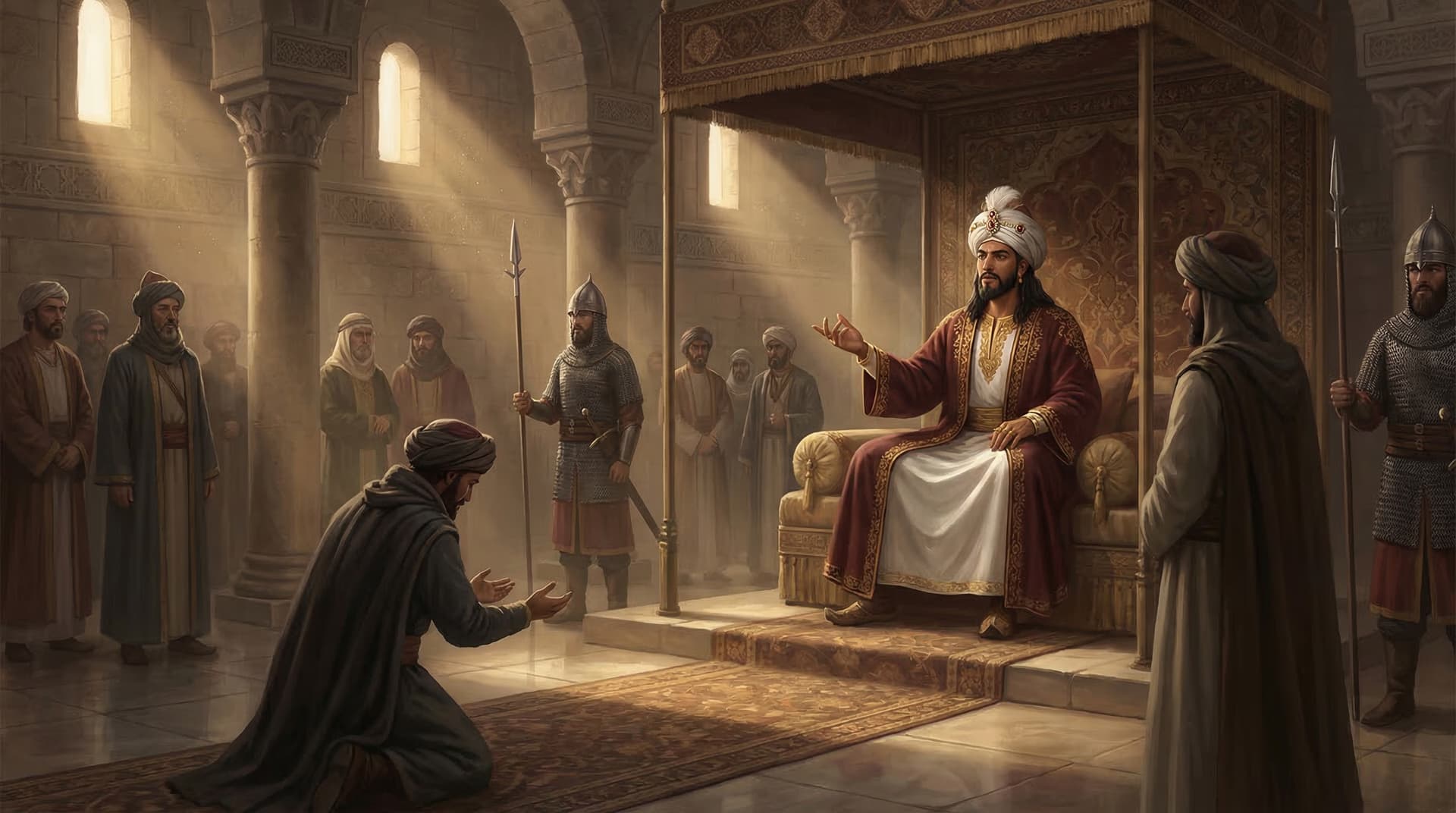
Muawiyah ruled for nearly twenty years, and when he died in 680, he handed the caliphate to his son Yazid -- the first hereditary succession in Islamic history. It was a direct violation of the principle that the community should choose its leader. Yazid immediately demanded allegiance from every notable Muslim, and most gave it. But two men refused. One was Abdullah ibn al-Zubayr. The other was Hussein ibn Ali -- the Prophet Muhammad's grandson.
Hussein's refusal was not a political calculation. It was a line he would not cross. To pledge allegiance to Yazid was to say that power mattered more than principle, that dynasty trumped faith. Hussein would not say it. And from the city of Kufa, in what is now Iraq, letters began to arrive -- hundreds of them. Twelve thousand men pledged their swords to Hussein if he would come and lead them.
He sent his cousin Muslim ibn Aqil ahead to verify the support. Muslim arrived in Kufa to a hero's welcome. Twelve thousand men pledged their allegiance in person. Then the Umayyad governor arrived with threats and bribes. Within days, forty thousand rallied to Muslim's side. Within weeks, they were gone -- every last one. Muslim was hunted through the streets and killed. His final message to Hussein was simple: turn back.
Before he left Mecca, Hussein said something strange. He said death had been destined for him the way a necklace is destined to hang from a girl's neck. He said he could already see his joints being cut apart on the plains between al-Nawawis and Karbala. He went anyway.
Subscribe to Nightfall History on YouTube
Join our community on YouTube for more historical deep dives and visual storytelling
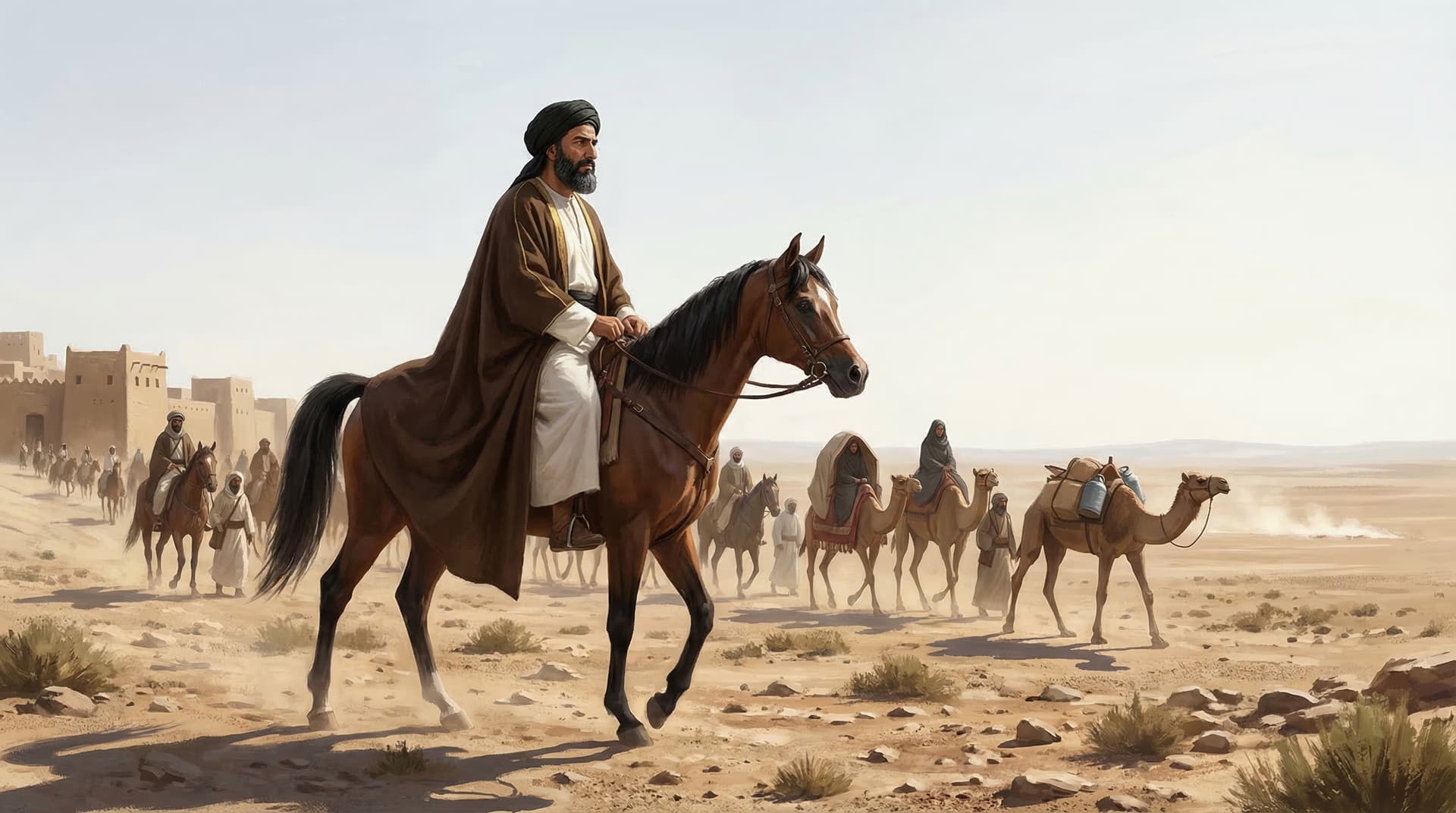
Hussein received that message somewhere on the eleven-hundred-mile road between Mecca and Kufa. His support had evaporated. His envoy was dead. There was no army waiting for him. And there was one man in Yazid's forces who could not stop watching Hussein's small caravan cross the desert -- a general named al-Hurr, who had been ordered to intercept him. Al-Hurr followed his orders. He blocked Hussein's path and forced the caravan off the road, onto a flat, empty plain seventy kilometers north of Kufa. A place called Karbala.
The Plain of No Return
What waited at Karbala was not the twelve thousand swords Hussein had been promised. It was an Umayyad army under the command of Umar ibn Sa'd -- four thousand at first, swelling within days to as many as thirty thousand. Hussein had seventy-two men. Among them were his brothers, his sons, his nephews, and his six-month-old infant.
On the seventh of Muharram, five hundred soldiers moved to the banks of the Euphrates River -- the only water source on the plain -- and sealed it off. For three days, no water reached Hussein's camp. The October sun hammered the desert flat. Women rationed what remained in the water skins, drop by drop. And then there was nothing left, and the children began to cry.
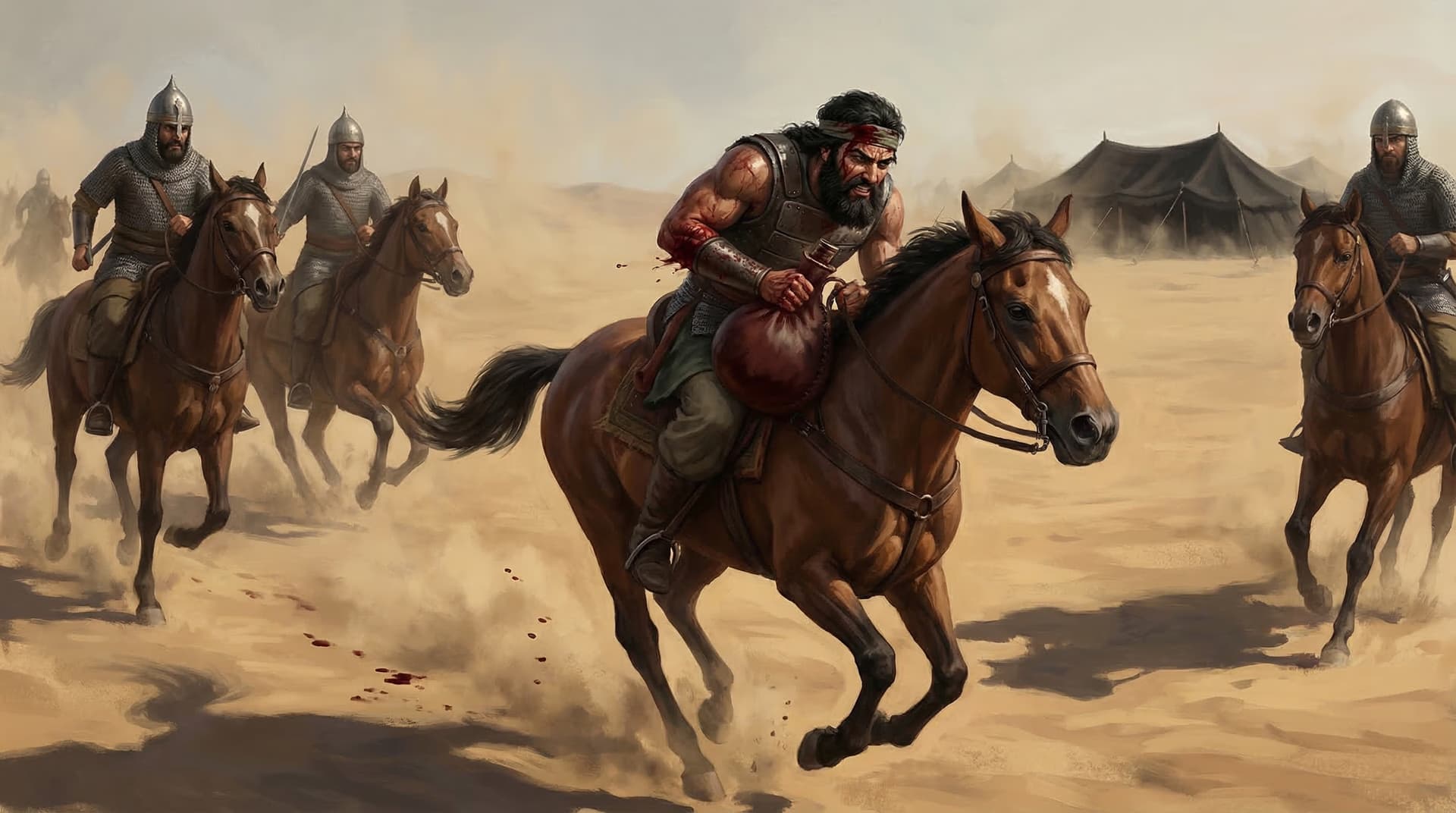
That sound -- infants screaming for water that did not exist -- was worse than any weapon Yazid's army could have deployed. Hussein's half-brother Abbas could not bear it. He mounted his horse and charged through enemy lines to reach the river. He filled a water skin. On the way back, they ambushed him. They severed his right arm. He held the water skin with his left. They severed that too. He gripped it in his teeth and rode, until an arrow punctured the skin and the water poured into the sand. Abbas fell beside it.
Hussein took his youngest son, Ali Asghar -- six months old, lips cracked, barely breathing -- and walked toward the enemy lines. He held the infant up. He asked for water. Not for himself. For a baby. An archer drew his bow and put an arrow through the child's throat.
The Night He Set Them Free
That night -- the ninth of Muharram, the last night any of them would live -- Hussein gathered his remaining companions in the darkness and said something no commander in history has ever said before a battle.
"The enemy is interested in none but me, me alone. I'll be most delighted to permit each and every one of you to go back, and I urge you to do so."
He told them they owed him nothing. He told them the night was dark enough to cover their escape. He told them no one would blame them -- not him, not God, not history. Then he extinguished the lamps.
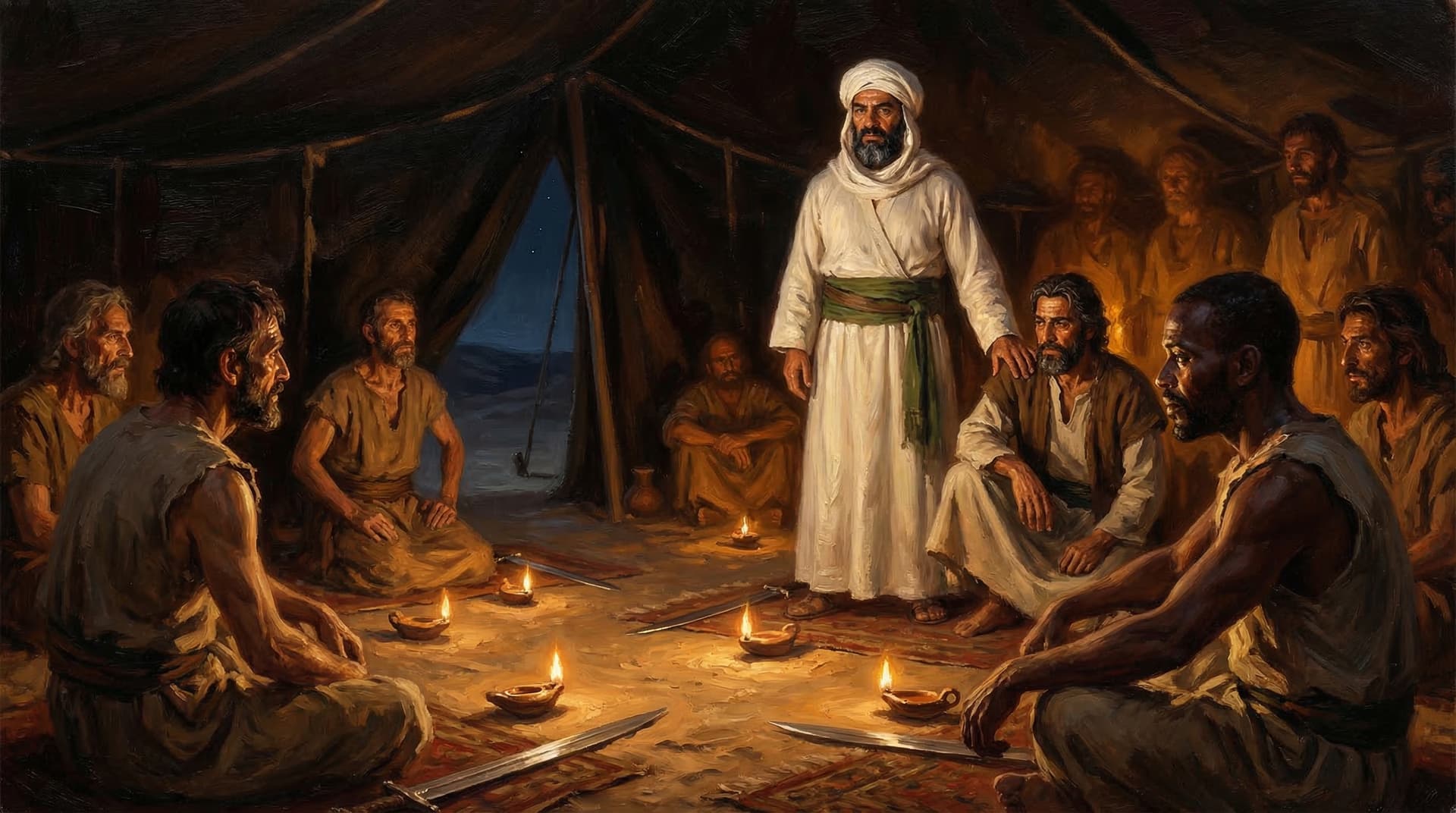
In the darkness, anyone who wanted to leave could slip away unseen, without shame, without witnesses. Hussein sat in the black silence and waited. Minutes passed. He could hear breathing, the rustle of cloth, the desert wind pulling at the tent flaps. He did not know how many would be there when the light returned.
He relit the lamps.
Every single person was still there.
Stay in the Loop
Get notified when new articles and videos drop. Unsubscribe anytime.
Not one had moved. Not one had taken the freedom he offered. They had chosen this -- not because Hussein demanded it, not because duty required it, but because something in them would not bend.
Some of them were old men. Some were barely old enough to hold a sword. One was a former slave who had no obligation to any bloodline, any dynasty, any faction. He stayed because he believed Hussein was right, and that was enough. In that moment, Karbala stopped being a military defeat. It became something else entirely. Every person in that tent had looked at the arithmetic -- seventy-two against thirty thousand -- and decided that dying on their feet was worth more than living on their knees.
That choice is the hinge on which thirteen centuries of history will turn.
Seventy-Two Against the World
Dawn broke over Karbala on the tenth of Muharram -- the day that would become Ashura, the holiest and most grievous day in the Shia calendar.
Before the fighting began, something happened that no one expected. Al-Hurr -- the Umayyad general who had intercepted Hussein on the road, the man who had forced this caravan onto this killing plain in the first place -- rode across the lines with thirty of his horsemen. He dismounted in front of Hussein and knelt. He asked forgiveness. He said he had not imagined it would come to this. Hussein forgave him. Al-Hurr turned his horse to face the army he had served, drew his sword, and charged. He was one of the first to die.
Then the killing started.
Seventy-two men against an army. They fought in groups, then in pairs, then alone. The first wave of Umayyad cavalry crashed into Hussein's line and was thrown back -- these seventy-two fought like men with nothing to lose, because they were. But numbers are numbers. The second wave took more. The third took more still. One by one, they fell. Hussein's companions went first, then his nephews, then his sons. Each one walked out knowing that no one was coming to save them, that the battle was already decided, and that the only thing left to choose was how they died.
By midday, the plain was quiet except for the moaning of the wounded and the creak of leather under the desert sun. Bodies lay scattered across the sand -- some in clusters where groups had made their last stand, some alone where a man had charged one final time into the ranks.
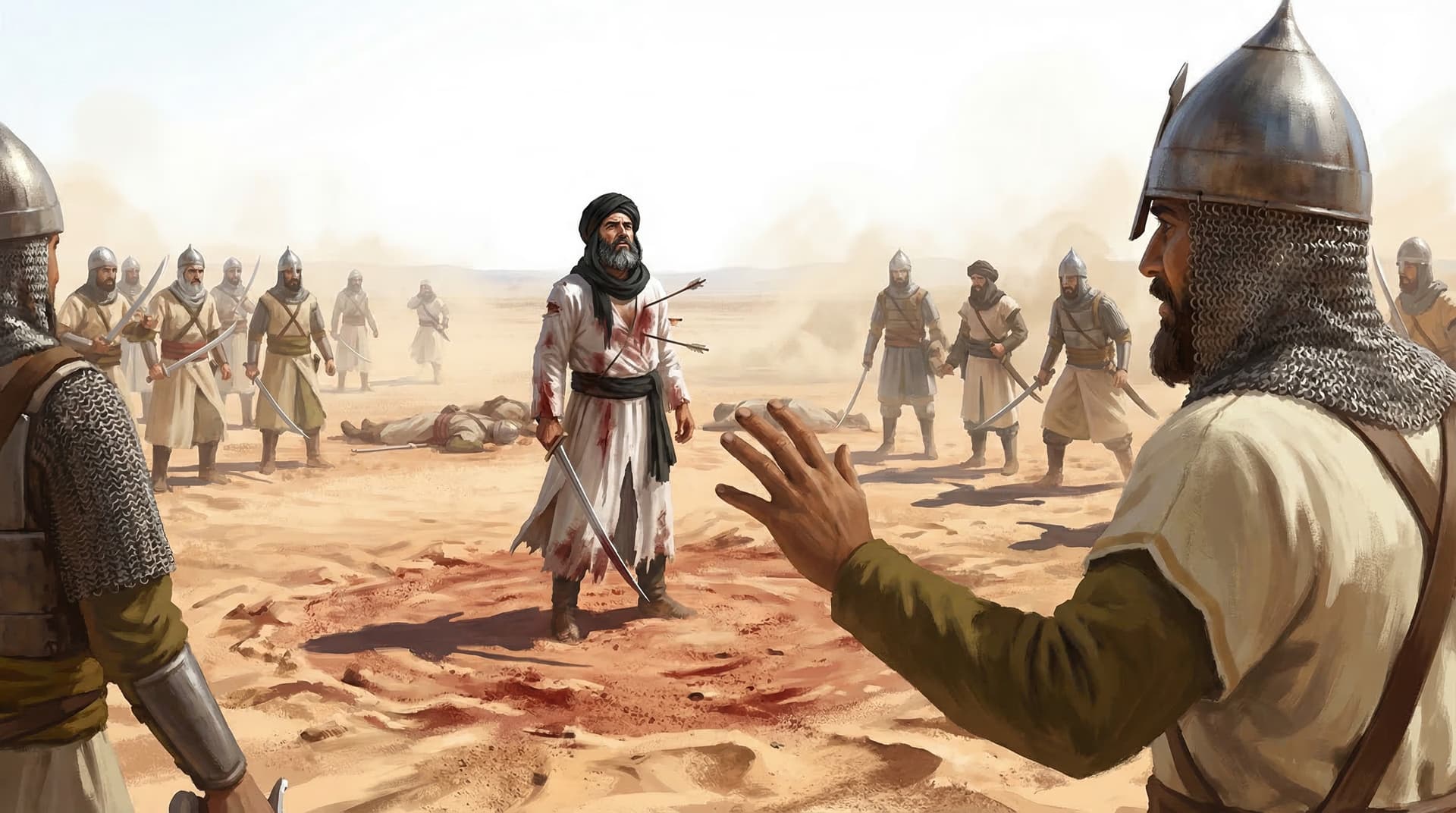
Hussein himself fought last. He was already wounded -- arrows buried in his armor, a gash across his forehead where a sword blow had split the skin. Blood ran into his eyes. He stood over the bodies of his family and fought until his arms could barely lift the blade. Soldiers circled him but hesitated. No one wanted to be the man who killed the Prophet's grandson. They knew what it meant. They could feel history watching.
"I have risen to reform the ummah of my grandfather," he had said. "I wish to bid the good and forbid the evil."
They brought him down with arrows and blades until he could no longer stand. Then a soldier named Shimr ibn Dhi al-Jawshan stepped forward and severed his head.
They decapitated all seventy-two. They mounted the heads on spears. They stripped the bodies and trampled them with horses. Then they gathered the women and children -- among them Hussein's sister Zainab -- chained them, and began the long march to Damascus, where Yazid waited to receive his trophy.
Yazid had won.
He had crushed the last credible challenge to his throne. He had killed the Prophet's grandson. He had wiped out the bloodline. By every measure that power understands, the matter was settled.
He had no idea what was coming.
The Woman Who Would Not Be Silent
When Zainab was brought before Yazid in his court in Damascus, she was supposed to be a symbol of submission -- the broken sister of a dead rebel, paraded before the throne to prove that resistance was futile.
Yazid had Hussein's head displayed before him. He was prodding the lips with a stick when Zainab began to speak.
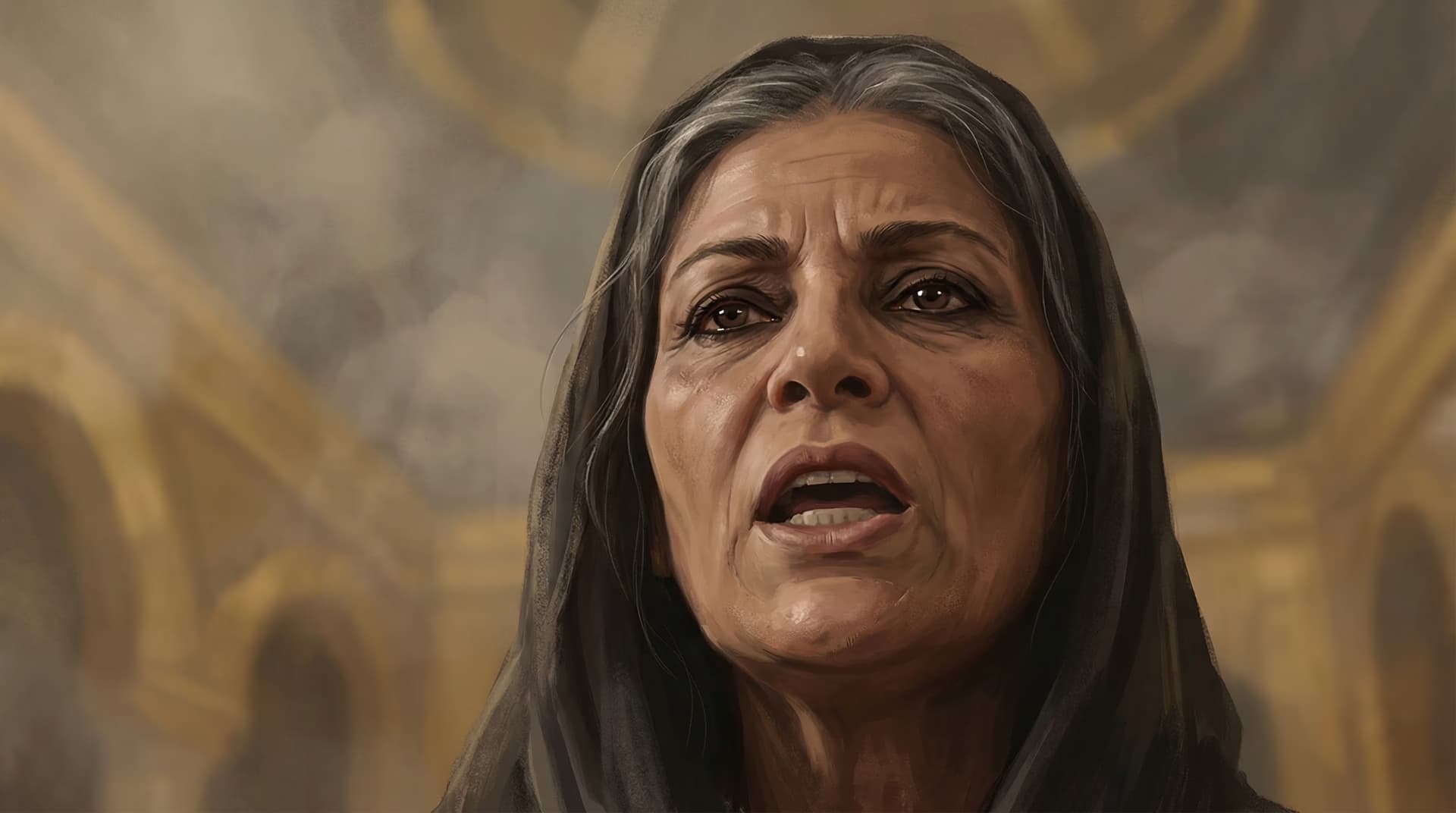
She did not beg. She did not weep. She told Yazid, to his face, in front of his entire court, exactly what he had done and exactly what it would cost him.
"You may employ your deceit and cunning efforts," she said, "but I swear by Allah that the shame and disgrace which you have earned by the treatment meted out to us cannot be eradicated."
She told him that he had not killed a man -- he had killed an idea, and ideas do not stay dead. She told him that the name of Hussein would outlast the name of Yazid for as long as human beings could speak. She was right.
Yazid, shaken, released the captives. Zainab returned to Medina and told the story of Karbala to every person who would listen. Others who survived did the same. Within months, the first mourners arrived at the site of the massacre. They wept. They beat their chests. They stayed the night by the graves. And the next year, they came back. And the year after that. And the year after that.
A man knelt in the sand with arrow shafts in his chest and blood filling his mouth. An army of thousands forgot his name within a week. Thirteen hundred years later, the world has not stopped saying it.
Before he left Mecca, Hussein said death was destined for him the way a necklace is destined to hang from a girl's neck. He saw it all -- the sand, the thirst, the blades. He went anyway. Not because he believed he could win the battle. Because he understood that some defeats outlast every victory, and the man who chooses to die for what he believes becomes impossible to kill.
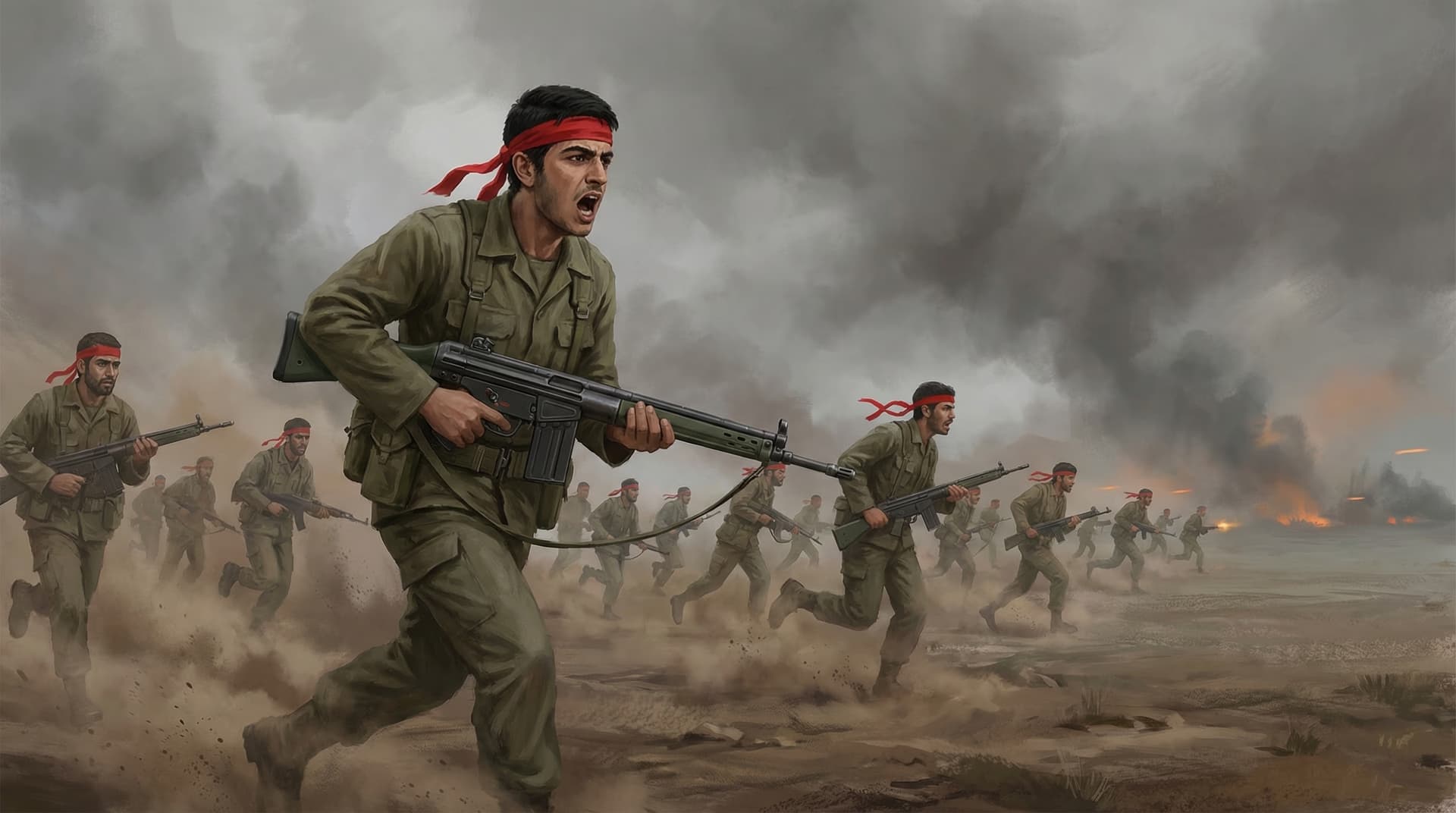
Every year, millions of Iranians march through the streets weeping for Hussein. They beat their chests. They mourn him as if he died yesterday, not thirteen centuries ago. Hussein's choice -- to die standing rather than live kneeling -- became more than a memory. It became a military doctrine. And in 1980, when Saddam Hussein sent his army across the Iranian border, the world was about to discover what happens when an entire nation goes to war believing that dying is winning.
