
Five English warships took up position in a harbour they had never sailed before, in a war that was not theirs to fight. They had come for silk and customs revenue. They stayed because a Persian shah had made them an offer they could not refuse.
The fortress above the harbour had held for a hundred and seven years. The Portuguese garrison inside numbered approximately three hundred men -- soldiers who had watched their relief ships fail to arrive, their walls crack from a century of salt wind, and their empire quietly abandon them at the edge of the world. Outside, nine thousand Persian troops waited on the shore. The English gunners loaded their cannon.
In ten weeks, the most impregnable fortress in the Persian Gulf would be rubble. An empire that had controlled the world's most important waterway for over a century would be gone. And Persia -- the country the world now calls Iran -- would reclaim the strait its rulers had always believed was theirs.
How that fortress got there -- and why the Persians wanted it back so badly -- began one hundred and fifteen years earlier, with the man who built it. His name was Afonso de Albuquerque, and in the autumn of 1507 he was about to attempt something every navigator in Europe would have called suicide.
The Jewel in the Ring
Six ships. That is all he has -- six warships anchored in a harbour so thick with merchant vessels the water smells of cinnamon and horse sweat. He is staring at a barren rock in the mouth of the Persian Gulf. No fresh water. No farmland. Nothing but salt and blinding heat. He will seize it in days. And within three months, his own men will drive him from it.
But that barren rock controls the most valuable piece of water on Earth. Every ship carrying silk from Persia, spices from India, pearls from Bahrain, and Arabian horses bound for the Deccan must pass through the strait beneath it. The Kingdom of Hormuz has grown so rich from taxing that traffic that visiting merchants repeat a saying older than any empire: if all the world were a golden ring, Hormuz would be the jewel in it.
Albuquerque knows this because his king told him. King Manuel I of Portugal has drawn a map of three choke points: Aden, to block the Red Sea. Malacca, to control trade with China. And Hormuz, to strangle the Persian Gulf. Capture all three, and Portugal -- a country smaller than most of its rivals' provinces -- will control the entire Indian Ocean. It is the most audacious colonial strategy ever conceived. And it depends on what Albuquerque does next, here, with six ships and four hundred men, against a kingdom with a fleet of over a hundred vessels and an army backed by Persian power.
But there is something Albuquerque carries that no one on this island has ever encountered: naval cannons mounted broadside. In the open harbours of the Indian Ocean, where merchant dhows are built for cargo, not combat, this is not a fleet. It is a weapon from the future.
One evening in the autumn of 1507, the Portuguese glide into Hormuz harbour. The King of Hormuz, a young figurehead controlled by his vizier Khwaja Attar, sends envoys to negotiate. Albuquerque's answer becomes legend. When the envoys ask what tribute Portugal will pay for trading rights, he orders his men to bring out cannonballs, swords, and shot. "This," he tells them, "is the currency struck in Portugal to pay such tributes."
Within days, the Portuguese guns shatter the Hormuzi fleet. Over a hundred vessels -- dhows, galleys, warships -- are burning or sinking in water so shallow the masts still stand above the surface. The King of Hormuz surrenders. He agrees to pay an annual tribute of fifteen thousand gold ashrafis and to allow Albuquerque to build a fortress on the island. Within weeks, the first stones of Fort Nossa Senhora da Vitoria are being laid. Albuquerque writes to King Manuel that he has seized the jewel.
But the jewel is already slipping from his fingers.
The Mutiny
The fort is only half-built when the trouble starts. Hormuz in winter is a furnace turned inside out -- the salt flats radiate heat that warps the air, fresh water must be shipped from the mainland, and the Portuguese soldiers, already months from home, are laying stone in conditions that kill men faster than combat. Albuquerque drives them without rest. He is obsessed with finishing the fortress before resistance can organize.
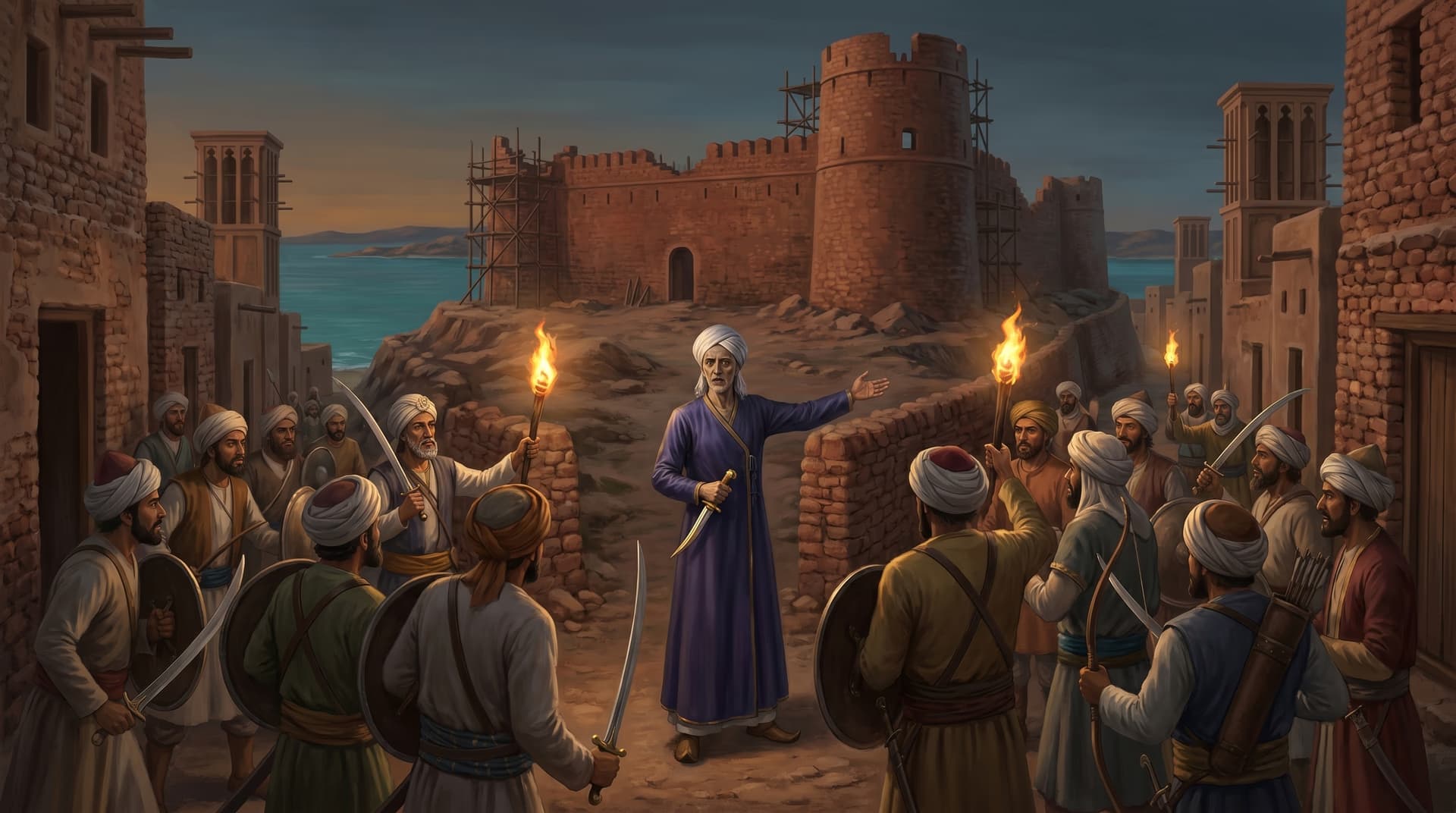
But three of his own captains -- Afonso Lopes da Costa, Antonio do Campo, and Manuel Teles -- decide they have had enough. They have watched Albuquerque burn an entire fleet to seize a rock with no water on it, and they think he is mad. In December 1507, four sailors desert to the Hormuzi vizier, Khwaja Attar, and reveal the truth: the Portuguese number barely four hundred, they are divided, and their commander's own officers want to leave.
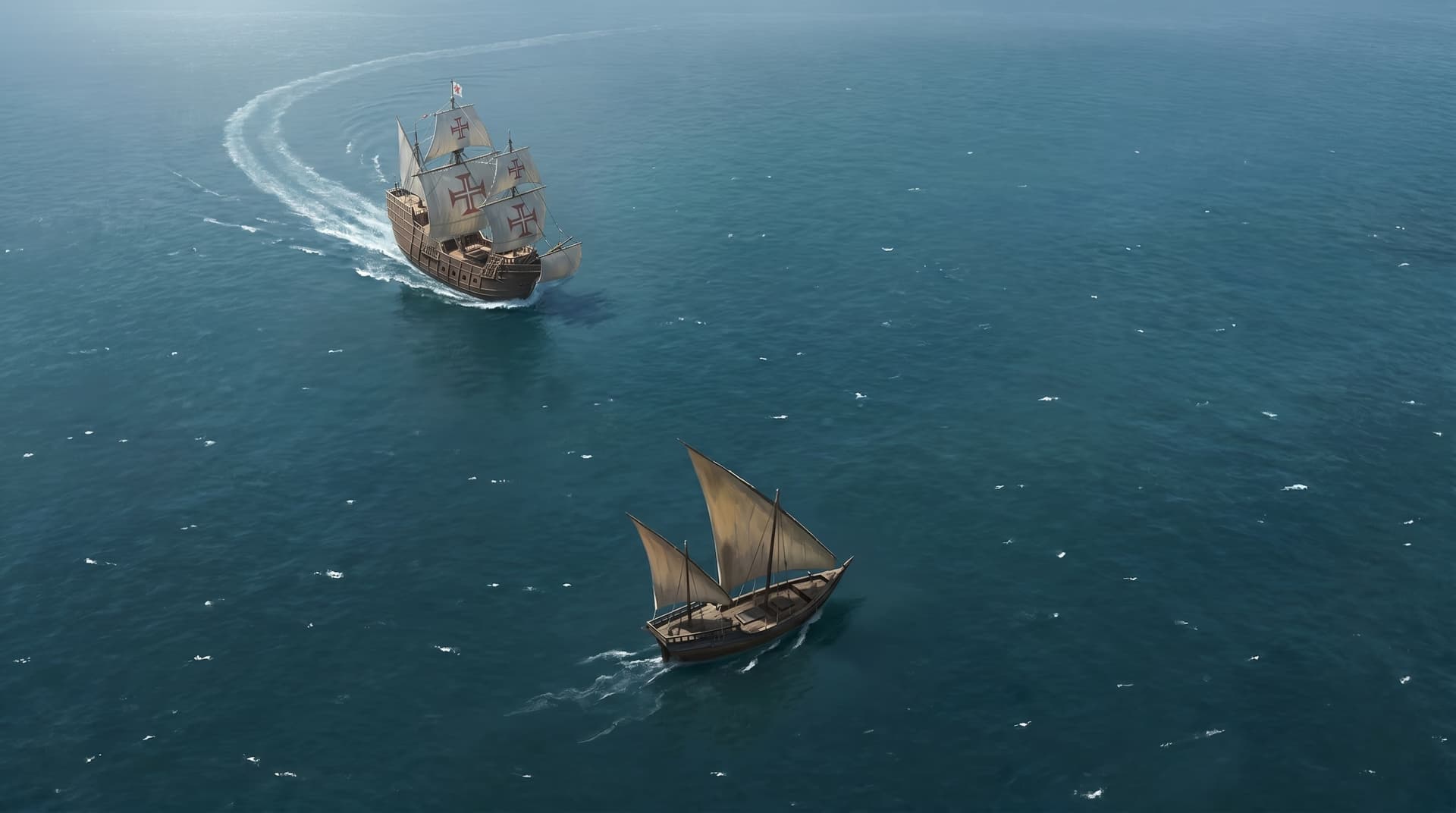
Attar acts immediately. He rallies local forces and begins probing attacks on the unfinished fort. And then, in January 1508, Albuquerque watches from the ramparts as three of his own ships weigh anchor without orders. The captains do not signal. They do not explain. They simply turn their sails toward India and leave him standing on a half-built wall with two vessels, a skeleton crew, and an enemy who now knows exactly how weak he is.
It is a complete collapse. Albuquerque fights for several days, but the mathematics are impossible. He abandons the fort, leaves the stones where they stand, and sails away in February 1508. Hormuz is free. The vizier tears down what the Portuguese built. The jewel in the ring of the world belongs to itself again.
Subscribe to Nightfall History on YouTube
Join our community on YouTube for more historical deep dives and visual storytelling
The Lion Returns
For seven years, Afonso de Albuquerque does not forget Hormuz. He cannot. King Manuel's entire strategy -- the three choke points that will give Portugal the Indian Ocean -- depends on it. And so, while he is driven from Hormuz, Albuquerque conquers the other two. Goa falls in 1510. Malacca in 1511. He builds fortresses at both. He installs garrisons. He proves, over and over, that a small number of Portuguese with superior cannon can hold territory thousands of miles from home.
And he develops a weapon even more powerful than his guns: the cartaz. A cartaz is a piece of paper -- a Portuguese trading pass. Any ship sailing the Indian Ocean without one is subject to seizure. Its cargo confiscated. Its crew enslaved. Ships that resist are burned where they float. It is a protection racket on an oceanic scale, and it works because Portugal's cannons can enforce it. The entire Indian Ocean, from Mozambique to Malacca, now operates under Portuguese permission.
But Hormuz remains unfinished business. The third choke point. The open wound.
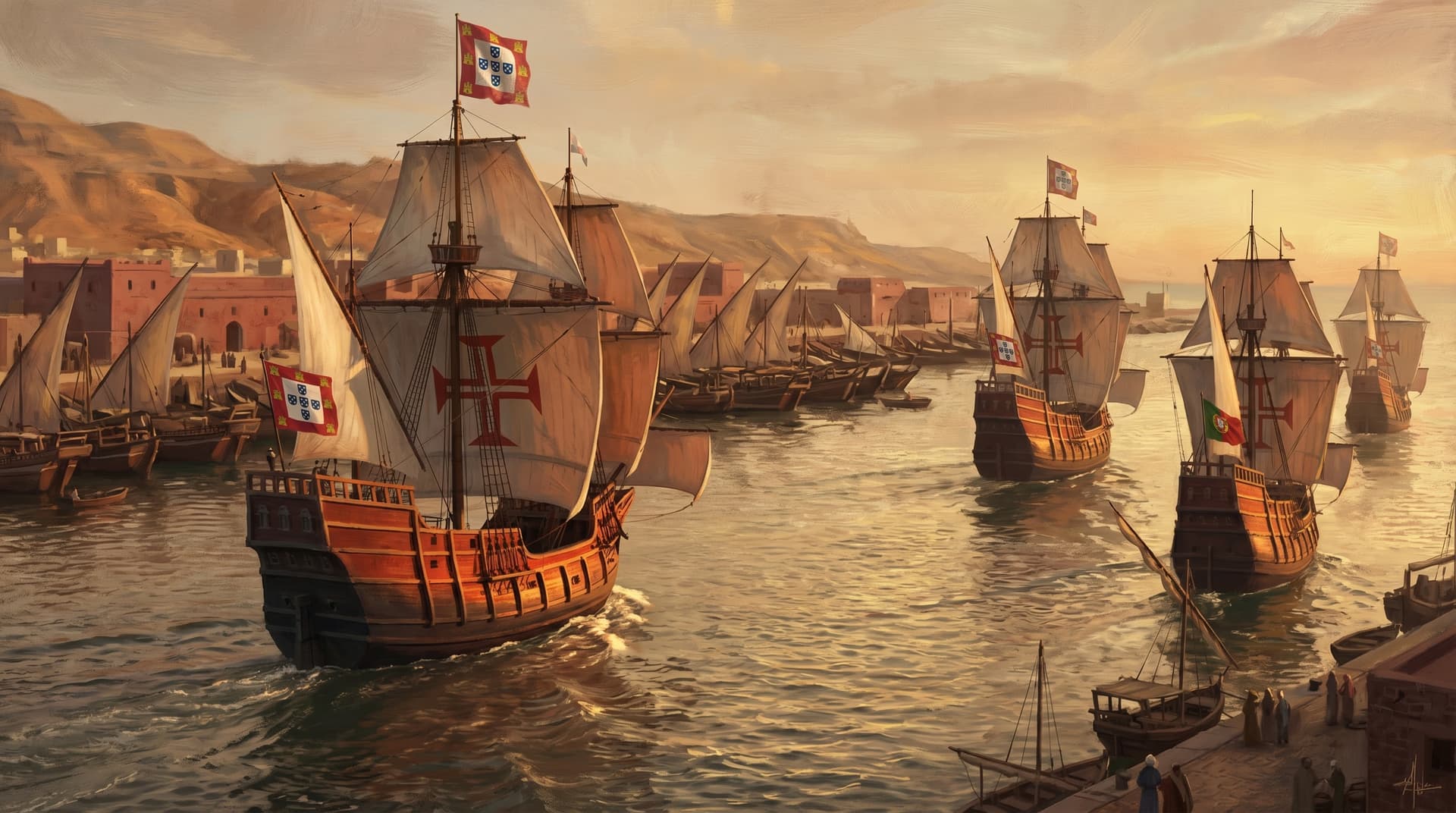
In March 1515, Albuquerque returns -- and this time he brings twenty-seven ships, fifteen hundred Portuguese soldiers, and seven hundred Malabar auxiliaries. The young King of Hormuz is still a puppet. But Albuquerque does not negotiate with the king. He sends for the vizier, Reis Ahmed -- the man who holds real power. When Reis Ahmed arrives, Albuquerque has him stabbed to death in front of the terrified king.
The message is clear: there will be no more viziers. There will be no more resistance. There will only be the fort.
By spring, the Portuguese occupy the completed fortress, now renamed Nossa Senhora da Conceicao -- Our Lady of the Conception. It is built from the same stone that Albuquerque's deserters abandoned seven years earlier. Remember those captains who sailed away, who thought seizing a waterless rock was madness? Every ship that now passes through the Strait of Hormuz must pay Portugal for the privilege. That waterless rock is generating more customs revenue than most European cities. The captains who deserted were not wrong about the danger. They were wrong about the madness. The madness was the point.
The Century of the Strait
For the next hundred and seven years, Portugal holds the throat of the world. The fortress at Hormuz becomes the anchor of an empire that stretches from Brazil to Japan. Every sack of pepper from Malabar, every bale of silk from Isfahan, every Arabian horse bound for the sultans of India -- all of it passes through the strait, and all of it pays. The customs revenue from Hormuz alone runs to hundreds of thousands of gold ashrafis per year. By 1542, the entire customs income of the island is assigned directly to the King of Portugal. A Venetian merchant visiting around 1565 describes a harbour choked with vessels from India, Persia, Arabia, and East Africa, trading in spices, drugs, silk, and the famous pearls of Bahrain. The cartaz system that Albuquerque perfected now governs every sea lane from Mozambique to the Malay Peninsula. Ships without Portuguese passes are seized, their crews enslaved, their hulls burned to the waterline. The Indian Ocean has become a Portuguese toll road. And Hormuz is the booth where the money stops.
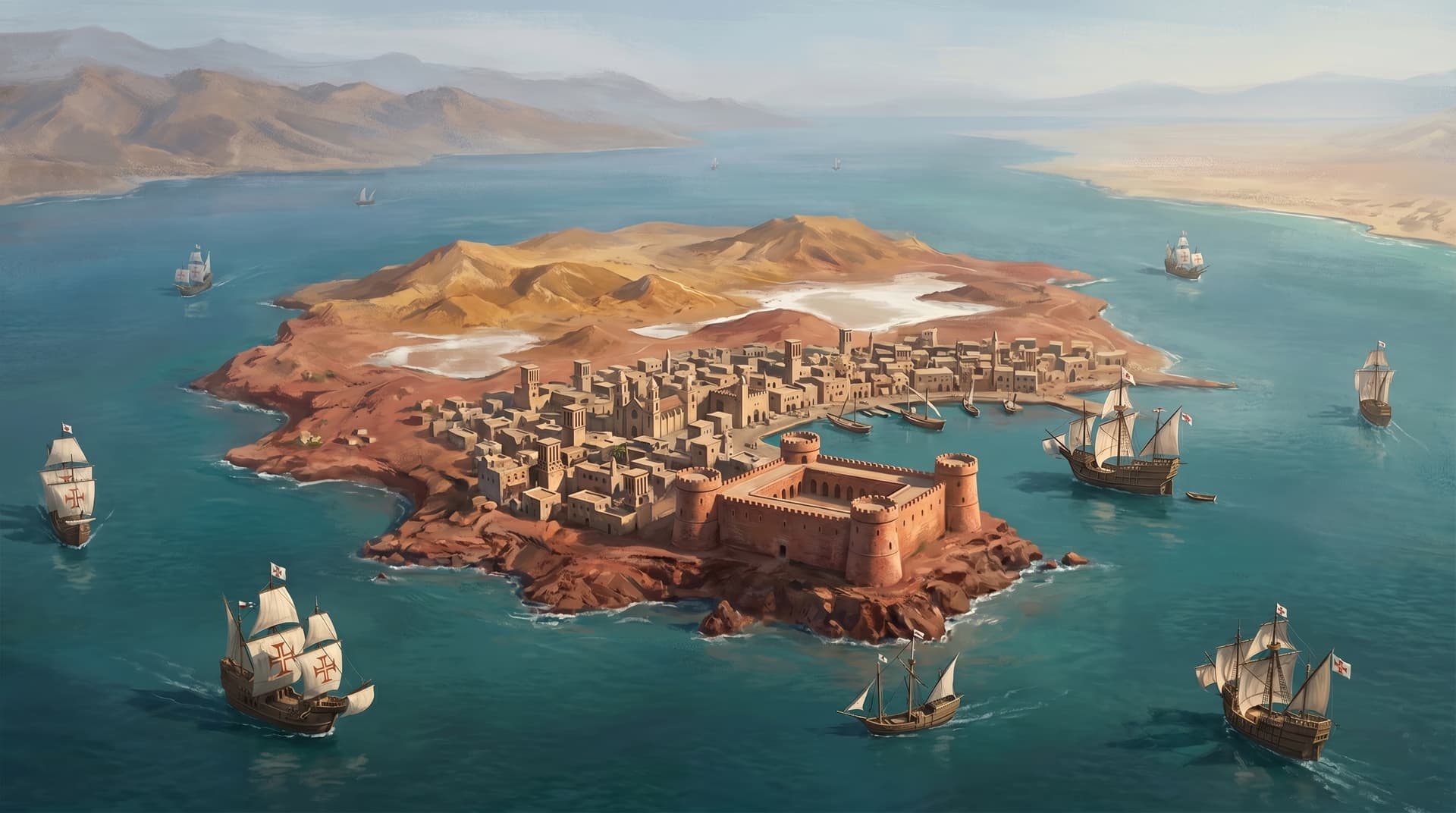
But empires built on chokepoints have a weakness that empires built on land do not: they require navies. And navies require money. And by the early 1600s, Portugal is bleeding. The Iberian Union of 1580 has yoked Portugal to the Spanish crown, dragging it into wars it did not choose -- in the Netherlands, in Morocco, across the Atlantic. The garrisons scattered from Goa to Macau cannot all be reinforced. The garrison at Hormuz shrinks to a skeleton force. The fortress walls, battered by salt wind for a century, crack and crumble. The fleet that once terrorized the Indian Ocean is aging, outgunned, and outnumbered by newer rivals -- the Dutch, the English -- who have built faster ships with heavier guns.
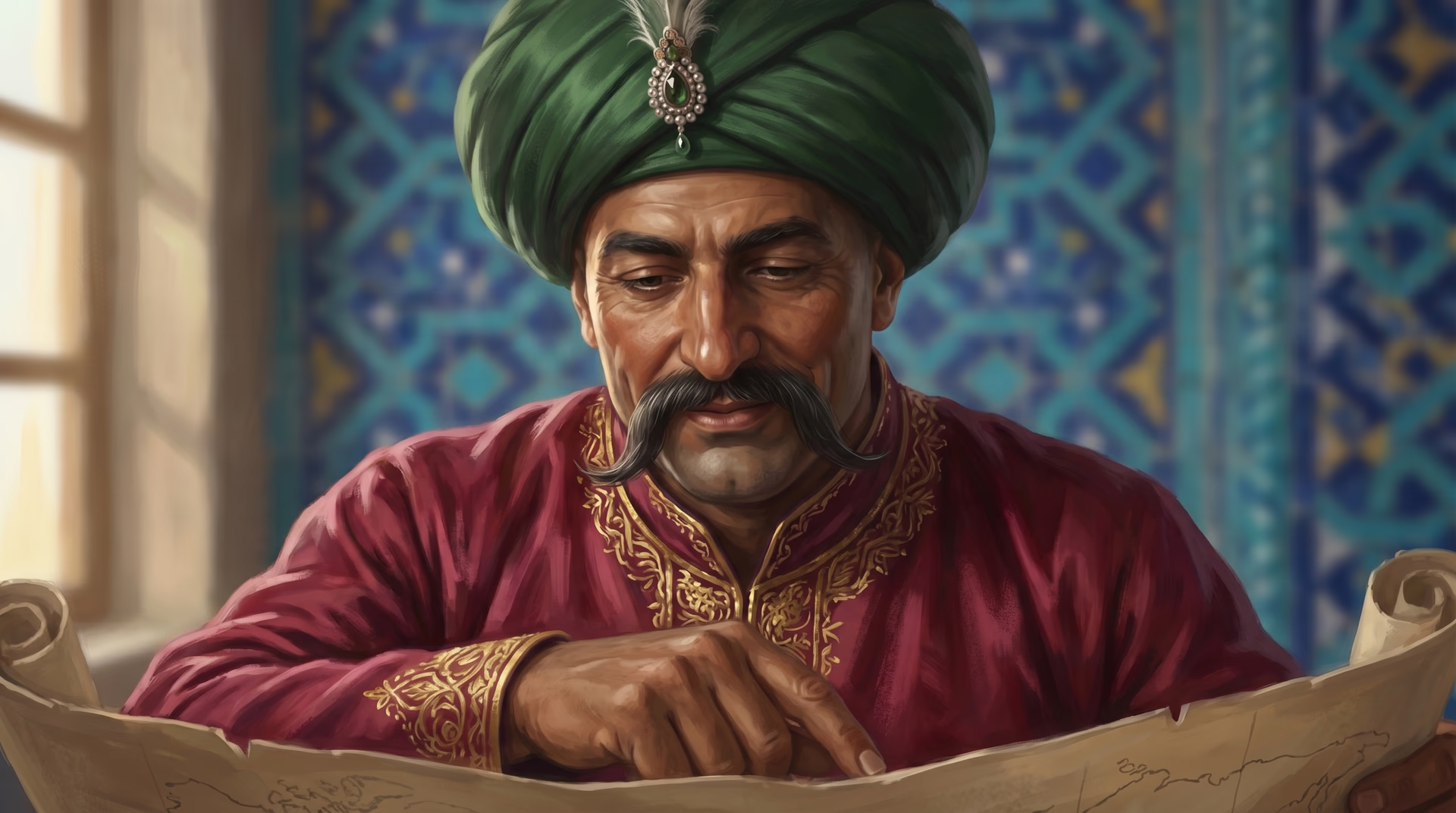
Shah Abbas I of Persia has been watching. Abbas is not the kind of ruler who sends envoys and waits for answers. He has already rebuilt the Persian army from scratch -- replacing tribal cavalry with a standing force of forty thousand ghulam soldiers, trained professionals loyal only to the crown, and adding five hundred cannon to his arsenal. He has crushed the Ottomans on his western border and the Uzbeks to the east. An English diplomat who spent time at his court described him as "wise, valiant, liberal, temperate, merciful" -- then added that he ruled "through general love and awful terror." Abbas understands something about Hormuz that Albuquerque also understood a century earlier: it is not an island. It is a lever. And he wants it back.
But Abbas has no navy. Persia has never had a navy. The Portuguese fortress, even crumbling, is surrounded by water, and you cannot take an island without ships. So Abbas does something that Albuquerque never anticipated -- something that will end Portuguese power in the Gulf forever. He makes a deal with the English.
Stay in the Loop
Get notified when new articles and videos drop. Unsubscribe anytime.
The Throat Reclaimed
The English East India Company had been circling the Persian Gulf for years, hungry for the Persian silk trade. Shah Abbas had been watching them circle -- and he understood something about merchants: they can be rented.
In the winter of 1621, Abbas sent Imam Quli Khan -- his governor of Fars -- to the English captains with a precise offer. Trading rights in Persia. Access to the finest silk in the world. A third of the customs revenue of Hormuz, once it was taken back. In exchange: five warships, the men to sail them, and their silence about whose war this actually was. Quli Khan made the alternative equally clear. Without Persian cooperation, there was no silk. No trading rights. No access to the Gulf. Nothing.
The English agreed.
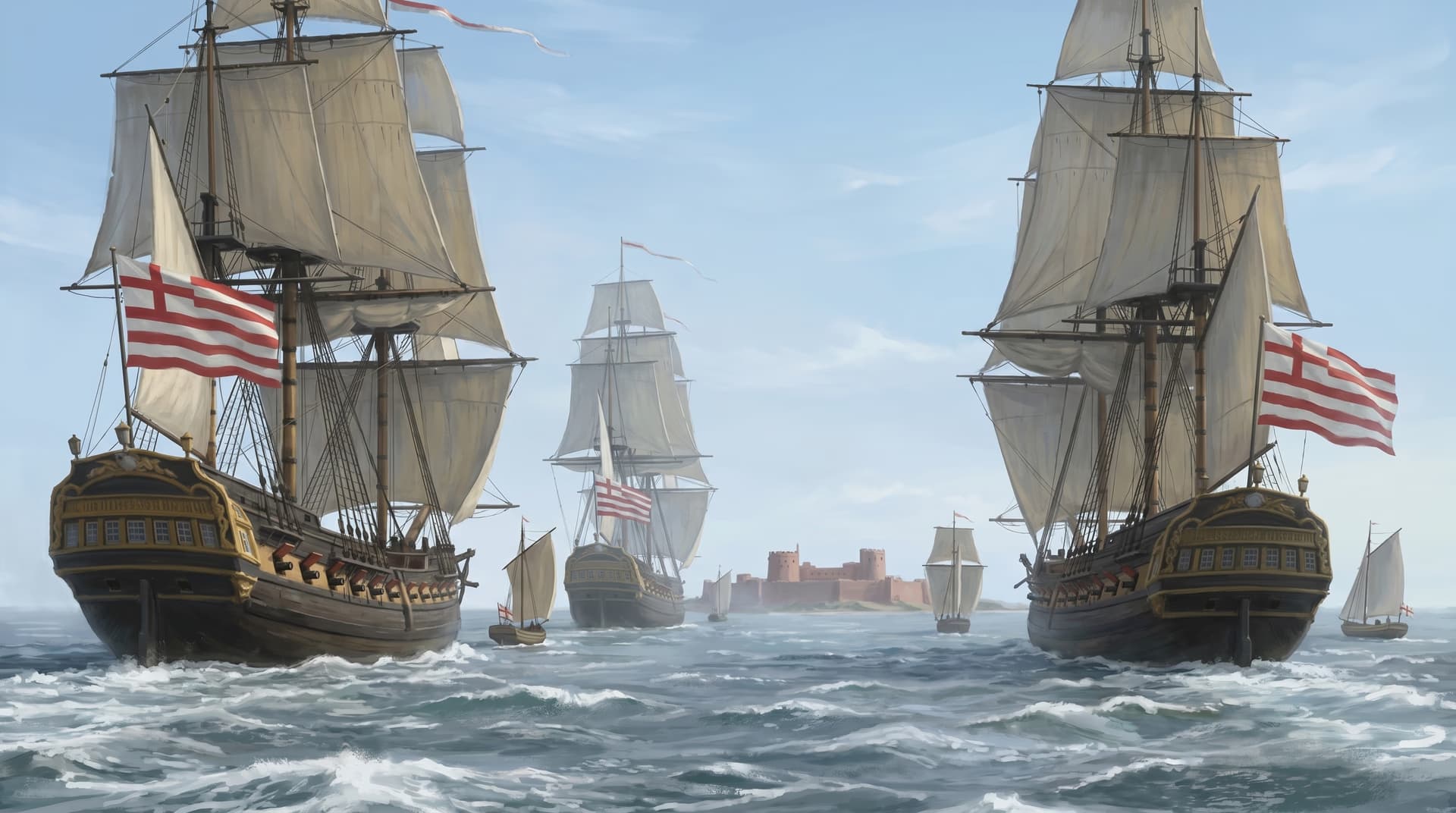
In February 1622, the siege begins. Five English warships and four pinnaces position themselves in the harbour where Albuquerque's six ships first anchored a hundred and fifteen years earlier. Nine thousand Persian troops, ferried across the strait on English vessels, land on the island. Inside the fortress, approximately three hundred Portuguese soldiers stand behind walls that Albuquerque built to last forever.
The English guns open fire. The bombardment is relentless -- hundreds of cannon shots hammering the stone walls that once made Hormuz untouchable. Portuguese ships anchored in the harbour are sunk or disabled within days, cutting off any hope of resupply. On land, the Persians press forward. The Portuguese make sorties -- six attacks in a single night -- killing an estimated eight hundred attackers at the cost of two hundred of their own. The defenders fight like men who know what the fortress means.
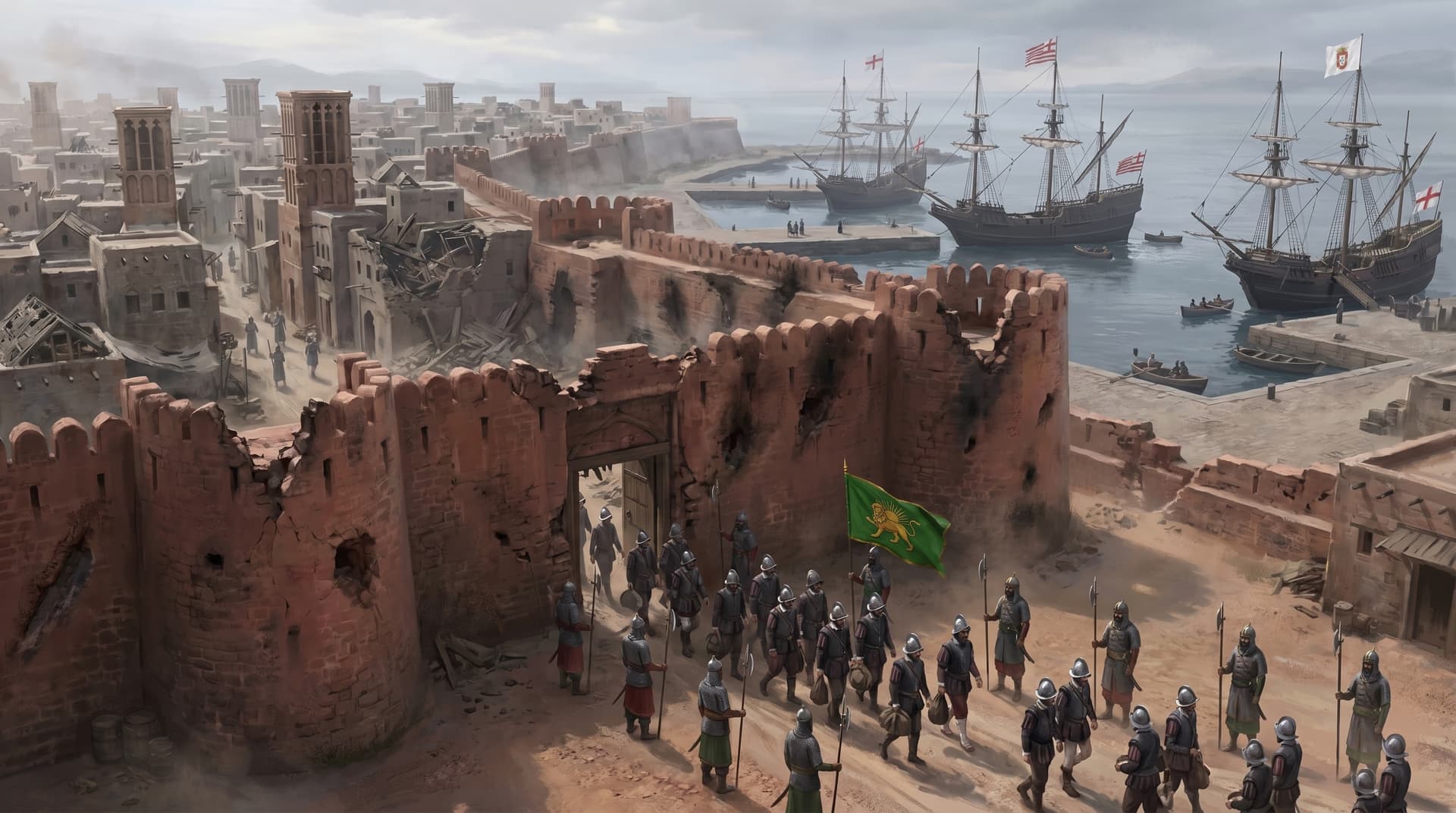
But mathematics does not forgive. Three hundred against nine thousand. A crumbling fort against English naval guns. For ten weeks, the garrison holds. Then, in late April, the Portuguese soldiers mutiny. The next day, the fortress surrenders. The garrison is marched out. The Portuguese are sent to Muscat. Shah Abbas renames the mainland port across the strait Bandar Abbas -- the Port of Abbas -- and grants the English their share of the customs revenue. A century of Portuguese control ends in a single spring.
Albuquerque once told the envoys of Hormuz that cannonballs were the only currency Portugal recognized. A hundred and fifteen years later, English cannonballs paid the debt in full.
But there is an even older story about power in Persia -- about a man who seized not a strait, but a castle on a mountaintop, and from that single fortress waged a war of shadows against every empire in the Middle East. He had no army. He had no navy. He had something more dangerous -- a network of men who were willing to die on command. The Western world gave them a name that is still used today: the Assassins.
