
- Known for
- Destroying the Knights Templar, breaking papal authority, and building a French bureaucratic state through ruthless taxation and political terror
- Fatal flaw
- He believed total control was the same as total security, and crushed every institution that might have saved his dynasty after he was gone
The Story
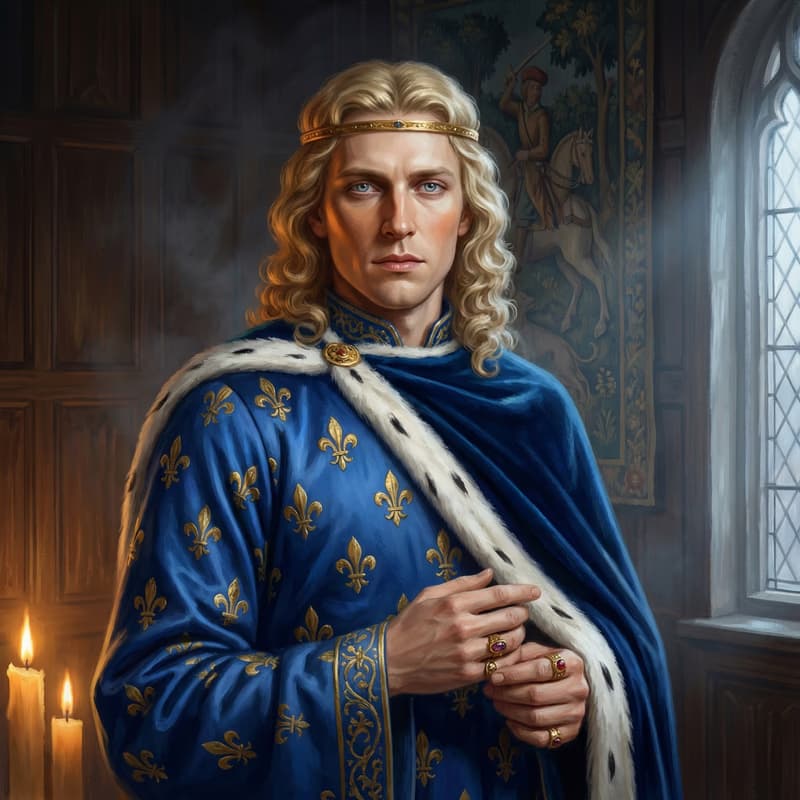
Friday, October 13th, 1307. Before dawn breaks over Paris, soldiers fan out across France carrying sealed orders that were not to be opened until the night before. At first light, they kick in doors simultaneously in every city, every commandery, every Templar house in the kingdom. By noon, nearly every Knight Templar in France is in chains.
The man who ordered this, King Philip IV, is not present for the arrests. He does not need to be. He planned the operation months in advance, coordinated it through royal agents embedded across the realm, and kept the secret from the Pope himself until the cells were already full. The knights who had defended Christendom for two centuries woke that morning as free men and went to sleep as prisoners accused of heresy, blasphemy, and sodomy. Most of them would never see daylight again.
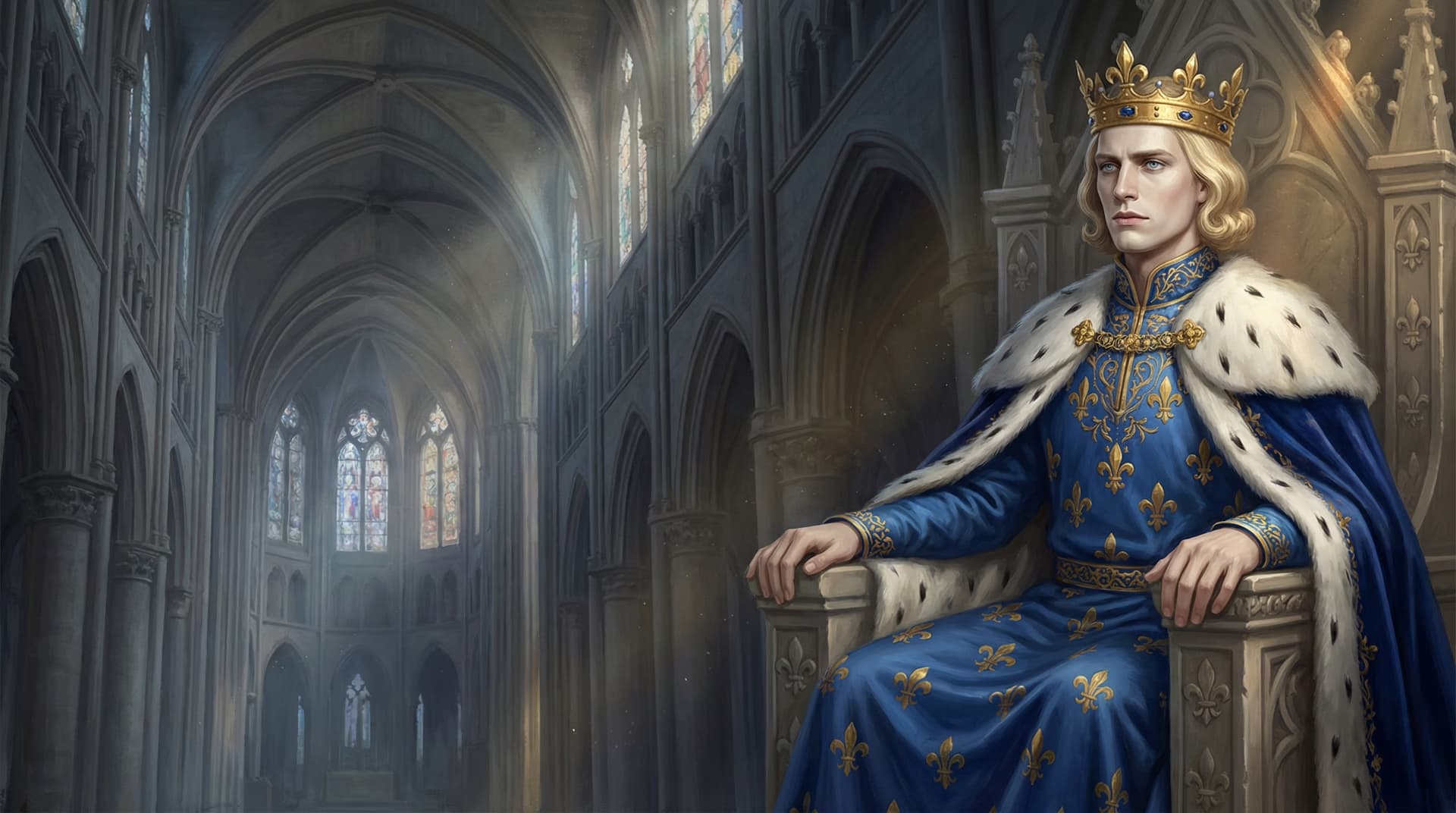
Philip IV of France, called le Bel, "the Fair," was the most dangerous king of the medieval world. Not because he was a warrior. He rarely fought in person. Not because he was cruel, though his cruelty was extraordinary. He was dangerous because he understood something no medieval monarch before him had grasped: that bureaucracy, properly weaponized, was more powerful than any army. He built a state apparatus that could arrest thousands in a single morning, tax the clergy against the Pope's explicit orders, expel an entire people and seize their property overnight, and move the papacy itself from Rome to a French town where it would sit under his thumb for sixty-seven years.
He did all of this while looking like an angel. Contemporaries called him the most handsome man in Europe. Tall, blond, pale-skinned, with features so fine they were almost feminine. Bishop Bernard Saisset of Pamiers, who hated him, said it best: "He is neither man nor beast. He is a statue."
Personality & Motivations
Philip spoke little and showed less. Where other medieval kings raged, feasted, and brawled with their nobles, Philip sat still on his throne and stared. His silence unnerved ambassadors. His stillness unsettled his own court. He was deeply pious, attending Mass daily, fasting rigorously, and wearing a hair shirt beneath his royal robes. He believed, with absolute sincerity, that God had placed him on the throne of France to purify the kingdom and extend its power over all earthly institutions, including the Church itself.
This was not mere arrogance. Philip had grown up in trauma. His mother, Isabella of Aragon, died when he was two after falling from a horse while pregnant. His father, Philip III, was a weak king who died on a disastrous crusade in Aragon when Philip was seventeen. He inherited a kingdom at war, in debt, surrounded by enemies. The lesson he drew from his childhood was simple: trust no one, control everything, and never let sentiment interfere with statecraft.
His advisors did the talking for him. Guillaume de Nogaret, a lawyer from southern France whose grandparents may have been burned as heretics, became Philip's chief enforcer. Enguerrand de Marigny managed the treasury. These were not nobles. They were bureaucrats, men who owed everything to Philip and nothing to the feudal order. Philip did not rule through vassals and oaths. He ruled through paperwork, legal arguments, and men who would do anything because they had no other patron.
What Most People Get Wrong
Most people think Philip destroyed the Knights Templar because he owed them money. The debt was real, but it was not the primary motive. Philip had already found far easier ways to raise cash, including debasing the currency so aggressively that Parisians rioted and he had to flee to the Temple fortress for protection. The irony was bitter: the man who would destroy the Templars once had to hide behind their walls to survive his own subjects.
The real reason was power. The Templars were a military order answerable only to the Pope, with their own treasury, their own courts, their own fortified houses across Philip's kingdom. They were a state within a state. Philip had already proven that he could break the papacy. The Templars were the last institution in France that did not answer to his crown. That made them intolerable. The money he seized was a bonus. The principle was the point: nothing in France would exist outside the king's authority.
Key Moments
The Auld Alliance, October 1295. Philip signed a treaty with King John Balliol of Scotland, creating the alliance that would haunt England for centuries. The terms were cynically one-sided. France would continue fighting England in Gascony, as it was already doing. Scotland would invade England from the north, bearing the full cost of war. Philip gained a strategic distraction for almost nothing. When William Wallace arrived at his court in 1299 begging for military aid, Philip received him politely, gave him money and a letter to the Pope, and sent him away with nothing that would change the war. Scotland was useful to Philip exactly as long as it bled England. Not a day longer.
Unam Sanctam, November 1302. Pope Boniface VIII issued the most extreme assertion of papal supremacy ever written, declaring that "every human creature" was subject to the Roman pontiff. It was aimed directly at Philip, who had been taxing French clergy without papal permission and had arrested a French bishop. Philip's response was to send Guillaume de Nogaret to Italy with armed men. In September 1303, Nogaret and Sciarra Colonna broke into the papal residence at Anagni, held the sixty-eight-year-old Pope prisoner for three days, and may have struck him. Boniface was rescued by the townspeople but never recovered. He died a month later. The medieval papacy, as an institution capable of challenging secular kings, died with him.
The Arrest of the Templars, October 1307. The coordinated dawn raids across France were a masterpiece of bureaucratic planning. Philip's sealed orders accused the Templars of denying Christ, spitting on the cross, worshipping idols, and practicing sodomy. Under torture, the knights confessed to everything. Grand Master Jacques de Molay, an old soldier who had spent his career fighting in the Holy Land, confessed and then retracted, confessed and retracted again. Philip pressured Pope Clement V, his handpicked pontiff now installed at Avignon, into suppressing the entire order in 1312. The Templar treasury, lands, and properties flowed to the French crown.
The Expulsion of the Jews, July 1306. Philip ordered every Jew in France arrested on a single day and expelled from the kingdom. Their property, debts owed to them, and assets were confiscated by the crown. An estimated 100,000 people were driven from their homes. Philip collected at least 140,000 livres from the seizure. He had already debased the currency so severely that the silver coinage lost a third of its value. The expulsion was not religious zeal alone. It was a fiscal operation disguised as piety.
The Tour de Nesle Affair, 1314. In Philip's final year, his own daughter Isabella, Queen of England, exposed the adultery of two of his daughters-in-law with two young knights. Margaret of Burgundy and Blanche of Burgundy were imprisoned. Their lovers, Gautier and Philippe d'Aunay, were castrated, flayed alive, broken on the wheel, and hanged. Philip's third daughter-in-law, Joan, was imprisoned briefly on suspicion of complicity. The scandal struck at the very succession Philip had spent his reign securing.
The Detail History Forgot
When Philip debased the French currency in 1303, reducing the silver content of coins so drastically that prices doubled overnight, the resulting riots in Paris were so violent that Philip had to flee his own palace. He took refuge in the Temple, the fortified Templar headquarters in Paris, where the knights sheltered him behind their walls while his own subjects howled for his blood outside.
Four years later, Philip arrested every Templar in France, including the men who had protected him. The Temple of Paris was seized and converted into a royal treasury. Philip held court in the very building where he had once begged for sanctuary. The knights who had saved his life were tortured in the cells below the halls where he now counted their gold. Jacques de Molay, the Grand Master who had offered Philip refuge, burned at the stake on an island in the Seine within sight of the royal palace.
The Downfall
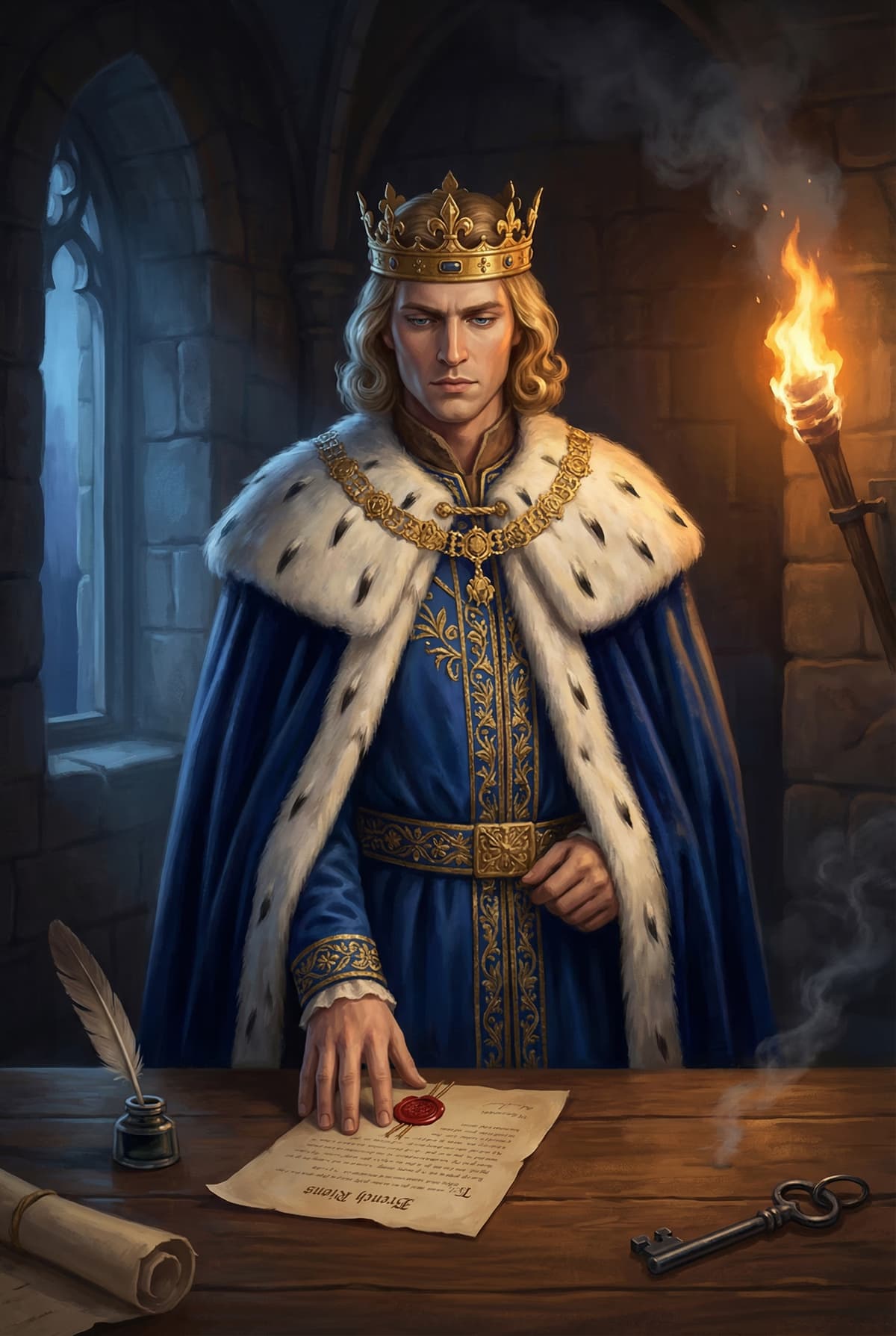
Philip's machine worked perfectly for thirty years. Every enemy was crushed, every rival humiliated, every institution bent to his will. But the machine required a cold, tireless intelligence at its center, and Philip's body failed before his ambition did.
On November 4th, 1314, while hunting in the Forest of Halatte near Pont-Sainte-Maxence, Philip suffered a massive stroke. He was carried to Fontainebleau, the castle where he had been born forty-six years earlier. He lingered for weeks, unable to speak or move, the statue finally frozen in truth. He died on November 29th, 1314, eight months after Jacques de Molay burned.
The curse was a legend, but the pattern was real. Philip's eldest son, Louis X, died in 1316 after reigning barely eighteen months. His second son, Philip V, died in 1322. His third son, Charles IV, died in 1328 without a male heir. In fourteen years, the direct Capetian line that had ruled France for over three centuries was extinct. The succession crisis that followed led directly to the Hundred Years' War, a catastrophe that killed a third of France. Philip had built the most powerful state in Europe and left it to sons who could not hold it for a single generation.
His fatal flaw was not cruelty or ambition. It was the belief that total control was the same thing as stability. He destroyed every institution that might have checked his power, the papacy, the Templars, the Jewish communities, the feudal nobility. What he left behind was a state that depended entirely on the genius of its king. When mediocre kings followed, there was nothing left to hold the structure together. Philip built a masterpiece and made it out of glass.
Frequently Asked Questions
Yes. Philip IV, called "the Fair" (le Bel), was a real King of France who reigned from 1285 to 1314. He was born at Fontainebleau in April or June of 1268 and died there on November 29th, 1314. He was a member of the Capetian dynasty and is one of the most consequential monarchs in French history.
The French epithet "le Bel" means "the handsome" or "the beautiful," not "fair" in the sense of just or equitable. Philip was renowned for his striking physical appearance. He was tall, blond, and pale-skinned, with features so fine that contemporaries considered him the most handsome man in Europe. The English translation "the Fair" preserves the ambiguity, but it refers entirely to his looks.
Philip's motives were a combination of financial need and political ambition. He owed the Templars significant debts, but more importantly, they represented an autonomous military and financial institution within France that answered only to the Pope. Philip had already broken papal authority and could not tolerate a powerful order operating independently in his kingdom. The coordinated arrest of nearly every Templar in France on October 13th, 1307, was followed by years of torture-extracted confessions and culminated in the order's formal suppression in 1312.
The curse is legendary rather than proven. According to later accounts, Grand Master Jacques de Molay called out from the flames as he burned on March 18th, 1314, summoning both Philip and Pope Clement V to meet him before God within a year. Clement died on April 20th, 1314, and Philip on November 29th, 1314. While the timing was remarkable, the earliest eyewitness account says only that Molay declared God would avenge their deaths. The specific curse narrative grew in later retellings.
Philip clashed with Pope Boniface VIII over the king's right to tax French clergy without papal permission. The conflict escalated from 1296 to 1303, with Boniface issuing increasingly extreme declarations of papal supremacy, culminating in the bull Unam Sanctam in 1302. Philip responded by sending his agent Guillaume de Nogaret to arrest the Pope at Anagni in September 1303. Boniface was held captive for three days and died a month later. Philip then engineered the election of a French pope, Clement V, who moved the papacy to Avignon in 1309, where it remained under French influence for sixty-seven years.
The Auld Alliance was a treaty signed in October 1295 between France and Scotland against England. Philip IV negotiated it with King John Balliol to open a second front against Edward I of England during the Franco-English war over Gascony. The terms heavily favored France. Scotland bore all costs of war against England while France merely continued its existing conflict. Philip used Scotland as a strategic tool, offering diplomatic gestures to Scottish leaders like William Wallace but never committing meaningful military support.
Yes. Wallace traveled to France in 1299 carrying letters from the Scottish government requesting military aid. Philip received him at the French court. He provided Wallace with money and a letter of introduction to Pope Boniface VIII in Rome. However, Philip offered no troops or binding commitments. Letters of safe conduct from Philip were found on Wallace when he was captured in 1305. Philip's support for Scotland was always diplomatic rather than military.
Philip ordered the arrest and expulsion of all Jews in France on July 22nd, 1306, confiscating their property, outstanding debts owed to them, and assets. An estimated 100,000 people were expelled. The operation yielded at least 140,000 livres for the crown. While anti-Jewish sentiment provided political cover, the timing strongly suggests fiscal motivation. Philip had severely debased the currency in 1303, triggering inflation and riots. The Jewish expulsion was part of a broader pattern of using targeted persecution to fill the royal treasury.
In 1314, Philip's daughter Isabella, then Queen of England, exposed an adultery scandal involving two of Philip's daughters-in-law. Margaret of Burgundy, wife of the future Louis X, and Blanche of Burgundy, wife of the future Charles IV, were accused of carrying on affairs with two knights, Gautier and Philippe d'Aunay, at the Tour de Nesle tower in Paris. The knights were tortured, castrated, flayed alive, broken on the wheel, and hanged. The princesses were imprisoned. The scandal destabilized the succession that Philip had spent decades securing.
Philip transformed France into the most centralized state in Europe, but the structure depended on strong royal leadership. His three sons all became king and all died without surviving male heirs, ending the direct Capetian dynasty by 1328. The resulting succession crisis, in which Edward III of England claimed the French throne through Philip's daughter Isabella, triggered the Hundred Years' War. Philip's destruction of the Templars, humiliation of the papacy, and expansion of royal power reshaped European politics, but his failure to produce a durable succession undid his dynasty within a generation.